Garhwal Post Bureau
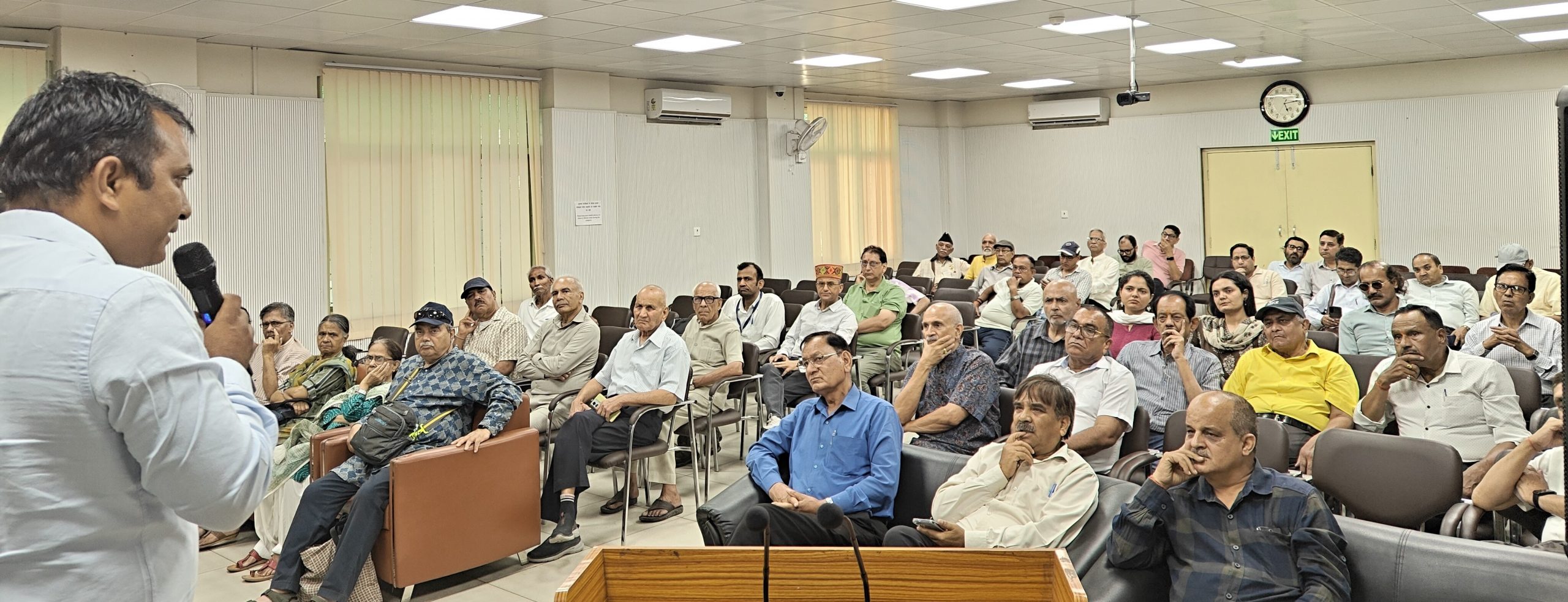
Dehradun, 3 Jun: The Doon Library and Research Centre today organised an illustrated lecture on “Char Dham Yatra: The Changing Nature of Pilgrimage Tourism”, presented by senior journalist Sandeep Gusain through a rich visual presentation. The lecture focused on the historic pedestrian route from Rishikesh to Badrinath, highlighting its cultural, historical, environmental, and socio-economic significance.
Speaking on the occasion, Sandeep Gusain explained that before the construction of motor roads, pilgrims travelling to the Himalayan shrines had to undertake long journeys on foot. Along these routes were numerous overnight halting points known as “Chattis” (resting stations). Many of these once-vibrant halts in the Ganga Valley have now fallen into ruins.
Gusain shared that in 2023 he completed a journey from Haridwar to Kedarnath following the traditional pilgrimage route through these historic Chattis. He noted that only a few of these locations still retain functioning shops and dharamshalas. Historically, there were around 84 Chattis between Rishikesh and Badrinath, and pilgrims often took nearly a month to complete the journey on foot.
Expressing concern over recent developments, he stated that the All Weather Road Project and the Rishikesh–Karnaprayag Railway Project have placed tremendous pressure on the Ganga Valley. According to him, the traditional culture of pilgrimage is increasingly being transformed into mass tourism.
He pointed out that the 67-kilometre stretch between Rishikesh and Devprayag has witnessed the rapid growth of hotels, resorts, and tourist infrastructure, exerting pressure on the Ganga River and its fragile ecosystem. In contrast, large parts of the traditional route through Pauri Garhwal remain neglected. Due to the lack of maintenance and restoration, these historic pathways are now used only by local villagers for short-distance travel.
Referring to the 2013 Uttarakhand disaster, Gusain recalled the extensive damage caused by flash floods and landslides in areas such as Henwal Valley, Rudra Gadera, and Mahadev Chatti. He also highlighted concerns regarding cracks appearing in houses in several villages following the construction activities associated with the railway project. In Saud village near Devprayag, he said, nearly every house has developed structural cracks, while several natural water sources have dried up.
Providing historical context, Gusain described how pilgrims once travelled from Rishikesh to Devprayag on foot. During that period, the Tehri State maintained a porter agency in Rishikesh, while the British administration established a porter agency, police outpost, dispensary, and post office near Lakshman Jhula. Pilgrims travelled through Phool Chatti, Mohan Chatti, Bijni Chatti, Naudkhal Dhar, Bandar Chatti, Mahadev Chatti, Tota Ghati, and Kandi Chatti before reaching Devprayag.
Kandi Chatti, he noted, once housed a dispensary, porter agency, post office, dharamshala, and approximately fourteen shops serving pilgrims. Further ahead, Vyas Chatti had a Kali Kamli dharamshala and several shops, though the structure now lies in ruins. At Vyas Chatti, the Nayar River, referred to in ancient texts as Navalika, joins the Ganga. The confluence is also known as Indraprayag. The Ganga takes a distinctive U-shaped bend at this location. About 12 kilometres beyond Vyas Ghat lies Devprayag, historically known as Bah Bazaar, which once offered numerous shops and resting facilities for travellers. Kali Kamli dharamshalas continue to serve pilgrims there even today.
Gusain further explained that the arrival of the railway in Haridwar in 1880 led to a significant increase in the number of pilgrims from across India. During this period, Swami Vishuddanand, popularly known as Kali Kamli Wale Baba, undertook the Char Dham pilgrimage. Witnessing the hardships faced by pilgrims and the scarcity of accommodation in the high Himalayas, he inspired his followers to establish more than 100 dharamshalas along the pilgrimage routes. During the British period, considerable efforts were also made to improve footpaths, suspension bridges, and small crossings. Dispensaries funded through charitable endowments provided free medicines to travellers.
The speaker observed that the traditional route from Rishikesh to Devprayag passes through the present-day Yamkeshwar and Dwarikhal development blocks of Pauri Garhwal. The route was historically challenging due to difficult terrain, frequent natural hazards, and the presence of wild animals. Pilgrims had to cross numerous streams and rivers, including the Henwal River, Rudra Gadera, and Nayar River, before reaching Devprayag and continuing onward to Gangotri, Yamunotri, Kedarnath, and Badrinath.
Today, pilgrimage is facilitated by roads and helicopter services. However, the Rishikesh–Devprayag corridor has become one of the busiest stretches of the Char Dham region due to rafting, camping, and other adventure tourism activities. Gusain noted that this has intensified problems related to solid waste management and has adversely affected wildlife habitats connected to Rajaji National Park and the Narendra Nagar Forest Division. He referred to warnings issued by the Wildlife Institute of India regarding the ecological impacts of unchecked tourism growth.
Concluding his presentation, he emphasised that the rapidly expanding tourism sector is fundamentally altering the character of traditional pilgrimage. Increasing pressure on road infrastructure and the emergence of new landslide-prone zones are among the significant challenges facing the Himalayan region today.
Sandeep Gusain hails from Nawa village in Ekeshwar block of Pauri Garhwal district. He holds a Master’s degree in Mass Communication from Hemvati Nandan Bahuguna Garhwal University. He worked as a correspondent with ETV (2007–2011) and later with Sadhna News and Zee News before moving to independent digital journalism in 2020. Through his Rural Tales channel, he has undertaken walking journeys across nearly 800 villages. In 2023, he extensively documented the historic Char Dham pilgrimage route while travelling from Haridwar to Kedarnath on foot. His presentation at the Centre focused particularly on the challenges facing the Ganga Valley between Rishikesh and Devprayag.
Among those present at the programme were Chandrashekhar Tewari, Kalyan Singh Rawat, Rekha Uniyal Dhasmana, Kalyan Butola, Devendra Kumar, Raju Gusain, Surendra Sajwan, Dr DK Pandey, Dr Yogesh Dhasmana, Dr Lalta Prasad, Alok Sareen, Chandan Negi, Sundar Bisht, Colonel Kandwal, Dr Atul Sharma, Prem Pancholi, along with several writers, historians, students, researchers, and media professionals.