By Arun Pratap Singh
Garhwal Post Bureau
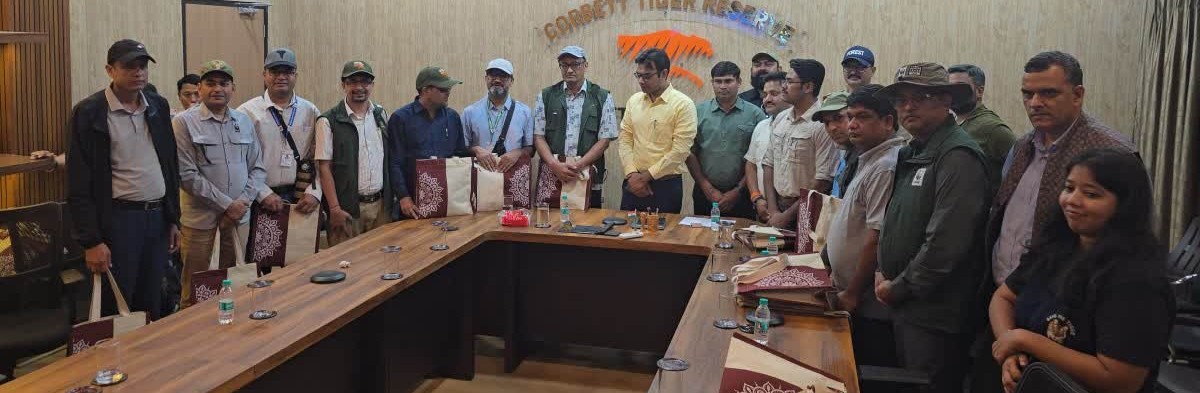
Ramnagar, 23 Jul: A delegation of senior officials from Nepal’s Forest Department today arrived at the world-renowned Corbett Tiger Reserve on a two-day exposure visit under the ‘World Wide Fund for Nature’(WWF) Transboundary Collaboration Programme. During the visit, the officials studied Corbett’s wildlife conservation practices, grassland management, tourism management, patrolling systems and community participation initiatives. A key meeting was also held at the Corbett Tiger Reserve auditorium, where the forest officials from both countries shared their experiences and best practices in the field of wildlife conservation.
The meeting was attended by Corbett Tiger Reserve Deputy Director Rahul Mishra, Park Warden Binder Pal Singh and other senior park officials. Mishra said the exposure visit had been organised under the WWF Transboundary Collaboration Programme for senior officials of Nepal’s Forest Department. The delegation also includes officers of the rank of Under Secretary from Nepal’s Forest Department.
Mishra shared that the visiting officials were given detailed information about the various management practices adopted at Corbett Tiger Reserve. These included wildlife management, grassland management, veterinary facilities for wildlife, tourism management and the involvement of local communities in conservation efforts.
Through a special presentation, the Corbett administration explained the systems and strategies implemented for wildlife conservation and management in the reserve. The officials were also briefed about various programmes and initiatives aimed at involving local communities in conservation activities. They were informed about awareness camps organised for local communities, staff welfare initiatives and the participation of local residents in conservation work.
The Nepalese delegation was also briefed about the patrolling mechanisms adopted at Corbett Tiger Reserve for wildlife protection and monitoring. The presentation covered foot patrols, elephant patrols, drone-based surveillance and boat patrols in water bodies. Officials explained how Corbett effectively combines modern technology with traditional methods to ensure efficient wildlife conservation and management.
Senior Provincial Forest Director of Nepal’s Sudurpashchim Province, Hemraj Bisht, said the delegation is visiting Corbett Tiger Reserve as part of the WWF exposure visit programme. He observed that wildlife knows no boundaries and its conservation cannot be achieved through the efforts of a single country alone. India and Nepal, he said, must work together to strengthen wildlife conservation and management.
Bisht noted that several similarities exist between the conservation practices followed at Corbett Tiger Reserve and those being implemented in Nepal. In such a scenario, the exchange of experiences and best practices between forest officials of the two countries assumes great importance. He said India and Nepal could learn from each other’s successful conservation models and management systems to further improve wildlife conservation in their respective regions.
Bisht also said that the two-day programme features presentations by the officials of Corbett Tiger Reserve on a range of subjects, enabling extensive exchange of knowledge and experience between the two sides. He added that the primary objective of the exposure visit is to understand each other’s working systems and establish better coordination in the field of wildlife conservation.
The officials of the Corbett Tiger Reserve claimed that the members of the Nepalese delegation were highly impressed by the natural beauty, environment and biodiversity of Corbett Tiger Reserve. Appreciating the reserve’s conservation framework, they said that such cooperation and exchange of experience between India and Nepal would further strengthen wildlife conservation efforts in the future.