 By Kulbhushan Kain
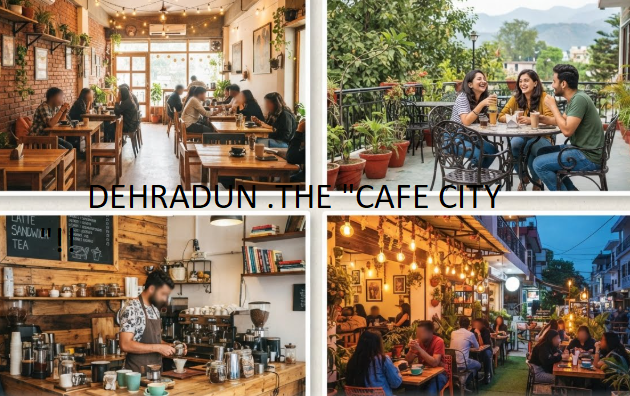
A friend with whom I was having coffee in a café recently remarked as to how “laid back Dehradun has become Cafe Dehradun”. For anyone who knew the valley in its quieter decades, the transformation is undeniable. Today, a new cafe springs up on every street, around every residential bend, and at every commercial intersection.
Having travelled extensively, I have always been fascinated by how a city’s soul is mirrored in its coffee spaces. In Europe, the birthplace of modern cafe culture, these spaces define public life. Vienna’s grand coffee houses like Café Central are recognised by UNESCO as “Intangible Cultural Heritage”- democratic living rooms where a single cup lets you sit for hours. Rome offers the opposite: locals standing shoulder-to-shoulder at bars, tossing back an espresso in two swift gulps. London is a mecca for artisan micro-roasters; Copenhagen champions minimalism; Amsterdam boasts cozy, canal-side specialty shops; and in Lisbon, the cafe is a social equaliser, built around a cheap espresso and a warm pastel de nata.
Walking through my hometown today, I can genuinely say the aesthetic, culinary standards, and sheer vibrance of the scene in Dehradun stand shoulder-to-shoulder with the best in Europe. Our valley has synthesised these global philosophies – the slow reading culture of Vienna, the hip specialty focus of London, the cozy neighbourhood feel of Amsterdam–into a roaring local phenomenon. This marks the transition of a valley once defined by retired professionals, slow afternoons, and massive family dining tables – into a dynamic, fast-paced hub of a generation entirely on the move.
To appreciate this transformation, one must look back at the culinary landscape of my youth, when eating out was a formal, deliberate ritual. We had our legendary institutions – names that evoke instant nostalgia for older Doonites. There was Napoli, with its distinct charm; Kwality, which carried an air of old-world sophistication, Moti Mahal, the undisputed titan of celebratory family dinners, Royal Café with its dim lights and crooners, Jimmys Kitchen – a vegetarian paradise.
These grand establishments were never densely populated. Dehradun’s population was a fraction of what it is today, and the economy of the pocket did not allow the average resident to walk into Kwality or Napoli on a whim; it was a luxury for special occasions. The experience within those walls was defined by unhurried formality. Waiters in immaculate, starch-white livery moved with measured dignity, and waiting for your food was part of the charm—it led to table talk and catch up. Time moved slowly –almost hesitantly. As the town’s demographics shifted, those grand, formal spaces slowly faded away.
In many ways the bridge between that old-world dining and today’s design-forward cafes was built by Indian Coffee Houses and later by Café Coffee Day. In the late nineties and early 2000s, CCD was the pioneer that first introduced middle-class India to the concept of “hanging out” over a single mug of coffee – our first taste of a casual public lounge. Yet, today, even that corporate giant has been largely eclipsed by unique, unbranded, fiercely independent local spaces.
The sensory difference these new cafes bring is stark. The grand restaurants of the past were heavy with the rich, unmistakable aromas of dal makhani, butter chicken, and tandoori tikkas—heavy spices and clarified butter. Step into a modern Dehradun cafe today, and the air smells of freshly ground Arabica beans, steamed milk, and toasted bread. People are no longer gathering for heavy, multi-course meals. Menus reflect a complete revolution in the valley’s dietary habits: bowls of Burmese Khow Suey, perfectly balanced pasta, gourmet burgers, artisanal noodles, momos. More strikingly, the tables filled are with youth ordering avocado toast or asparagus tips – dishes entirely alien to the menus of old Dehradun.
Along with the food, the cafes have democratised social spaces. In the days of Napoli, Kwality or Moti Mahal, dining rooms were heavily policed by the conservative, middle-aged gaze of adjacent tables. For young couples, a romantic date was practically impossible, fraught with the constant anxiety of running into a family friend. The contemporary cafe has shattered that barrier, introducing spaces that double as quiet sanctuaries for connection.
Take Y Cafe, on EC Road, tucked right behind my alma mater, St Joseph’s Academy – a wonderfully cozy, British-style spot with small glass panes overlooking a quiet, verdant lawn. Or Café Greek Orchid known for its blue and white Greek aesthetics. To sit there next to a shelf of books is to step into a quieter, gentler world. Another deeply personal favourite is “The Yellow Marigold”, a kilometre and a half from my residence. It has become a cherished routine for my wife and me to walk over on a quiet afternoon and share their excellent Burmese Khow Suey, delicate dumplings, and healthy, toasted bites, paired with an exceptional cup of coffee.
These spaces, alongside local retreats like Café De Piccolo, The Mudcup, and the greenery-cloaked Foresta Cafe, have become safe, vibrant havens where cozy layouts and ambient music let couples connect without the suffocating weight of societal judgment. Simultaneously, these hubs double as modern digital sanctuaries. In spaces like AMA Cafe, the atmosphere frequently mirrors the tech-savvy cafe crowds of Toronto or London. The rhythmic clink of dinner plates has been replaced by the collective hum of laptop keyboards, as freelancers and remote workers sit parked for hours, fuelled by an endless stream of iced lattes.
What makes “Cafe Dehradun” remarkably resilient is its economic spectrum. On one side, pocket-friendly student hangouts let a student enjoy a comforting plate of pasta or a sandwich for less than 120 rupees. On the other, you can ascend to premium spaces like Farzi Café or the sophisticated bistros on Rajpur Road, where the bill easily touches 1,500 rupees and where the French or Italian dish names are delightfully complex. The speed of modern life shows even in how the bill is settled: no more slow ledgers and counted change, just a scanned GPay code or a tapped card. Beep. The transaction is complete, and you are out the door.
Yet this evolution has not come without a physical cost. To accommodate this voracious appetite for cafes, the physical geography of Dehradun has been irrevocably altered. Many of the old, sprawling bungalows that once defined our residential lanes have been demolished. Quiet patches of greenery, ancient trees, and the generous open spaces have been cleared away for concrete structures, chic glass facades, and outdoor seating.
Change is an uncompromising force. While the romantic and the historian in me will always look back with an affectionate ache for the quiet charm of the old valley, I cannot help but marvel at what Dehradun has become. The large family dining tables haven’t entirely vanished, but they have stepped back into the shadows of our domestic history. The true, pulsating heartbeat of the modern city now lives in its cafes. Dehradun has shed its old skin as a sleepy town for retirees and stepped into the light as typical modern city. The era of “Cafe Dehradun” is well and truly here and, for an old timer, it is a fascinating chapter to witness, with either a sense of nostalgia, anger or hope!
(Kulbhushan Kain is an award winning educationist with more than 4 decades of working in schools in India and abroad. He is a prolific writer who loves cricket, travelling and cooking. He can be reached at kulbhushan.kain@gmail.com)