 By Ganesh Saili
Go past Sister Bazaar and take the road to the right, and you will come across what used to be the home of Doon School teacher and Padma Shri Awardee Hari Dang, which he sold to Dr Chawla of Delhi, whose grandchildren attend a local school. I admit I ghosted him when his mobile jammed and I got too many calls from him. Montpellier looks like it needs a lick of paint, lest it continue to look like a place Time forgot. Beyond that, all of a sudden, the road ends abruptly; it is blocked by an ugly gate. Only memories remain of a road that used to once loop around the last hill.
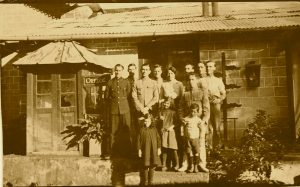
Military Hospital 1880. Pic courtesy: Author’s collection
‘Height is health’ was the new battle cry behind the establishment of the British Military Hospital. Oxbridge scholar Christopher Cowell traces the founders of the BMH back two hundred years to 1823. As he walked past my window I wondered, “Who could this be?” (It was rather late for a Raj leftover to be wandering around.) Chris told me he intends to polish his doctoral thesis on ‘cantonment architecture in the Raj’. He found that a certain Major Bullen was tasked with building kachcha and pukka barracks in both Meerut and Landour. Applying himself, he rode on horseback between Meerut and Mussoorie, changing horses midway. Winters were bitterly cold, especially for the labourers who had come from the warmer climes of Landaura, near Roorkee. This urge to escape the summer’s heat produced 85 hill stations and 62 cantonments, ranging in altitude from 6,000 ft to 8,000 ft and extended from Darjeeling to Dalhousie, Murree to Mussoorie, Ooty to Mount Abu to Shillong.
Look for Landour on a map and you find it lies to the north in foothills of the Himalaya at about 7500 feet above sea level. Although it is far away from the sea, yet it shares some of the characteristics of an English seaside resort: it is packed with visitors in the summer and a quiet hush falls upon it in the depth of winter. But for the warmth, when the monsoon mist wraps itself around the hill station, it’s almost as if you had been transported to Scotland.
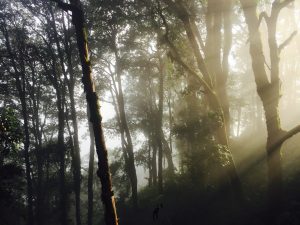
Pic courtesy: Author’s collection
With Brigadier Krish Pennathur as its founding director, the Defence Institute of Work Study began in the 1960s. His youngest daughter Usha, a day scholar, was my classmate. Almost fifty years later she returned with her older sister Sudha, asking around school for anyone from her class who might still be in town. Poor thing — she found me.
Those early houses with thatch roofs were no match for our monsoon; when it poured, they leaked like sieves. During the war years these were replaced by the more practical corrugated tin-sheet roofs. Unpainted, they give our hill station the look of a place built from hammered biscuit tins.
‘The last storm discovered all the joints in our harness,’ wrote Elizabeth Ross, wife of a joint magistrate from Meerut, in her 1880s diary. ‘It was at night, and my endeavours to sleep through it were put to an end by heavy drops beginning to fall on my face. The first drop murdered sleep effectively, and a few more made me jump up to drag the bed into a dry place.’
Satya Prakash Singhal and his brother Dhan Prakash ran a ration shop. Satya Prakash was also the local Congress president. He had organised a public function on the Mullingar Flat in honour the-then Defence Minister, VK Krishna Menon, visiting Landour. He was here to inaugurate the takeover of this cantonment.
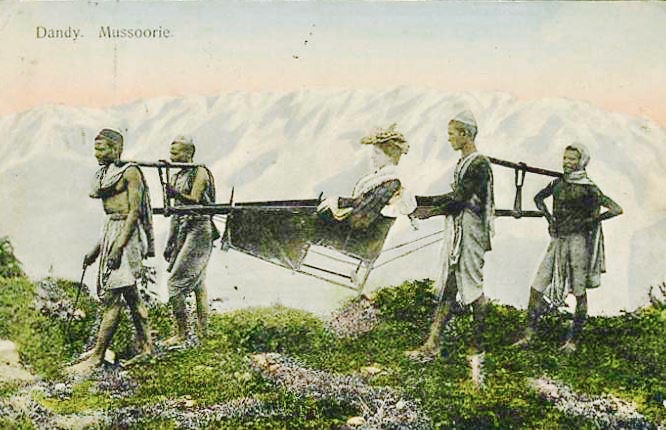
‘How far is it?’ he asked, huffing and puffing after climbing the hill. Someone suggested that he could use a dandi; he flatly refused. The mere thought seemed to horrify him. Father told me later, he was heard to mutter, ‘How can I ride over the people I reign?’ Soon, a pony was arranged to carry the dignitary to the top of the Landour ridge. He cut the red ribbon at the Defence Institute of Work Study, later renamed the Institute of Technology Management. It was sited where the old British Medical Hospital had begun two centuries ago.
(Ganesh Saili was born and grew up in the hills. He belongs to those whose words are illustrated by their own pictures. His two dozen books, some translated into twenty languages, have found renown worldwide.)