By Arun Pratap Singh
Garhwal Post Bureau
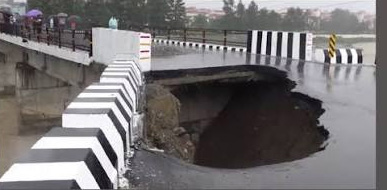
Dehradun, 30 Jul: Barely 16 days after the newly constructed Rs 16 crore Nanda Ki Chowki bridge was inaugurated and opened to traffic, its approach road developed a massive cavity on Tuesday morning following heavy monsoon rain, forcing the authorities to divert traffic and undertake emergency restoration work. The officials have been quick to clarify that the bridge structure itself remains safe and that only the approach road has subsided. While that distinction is technically correct, it is unlikely to reassure the public. A bridge is not merely its concrete span resting on piers. It is an integrated structure comprising the bridge deck, foundations, embankments, retaining walls, approach roads, drainage systems and protective works. If any one of these critical components has failed within days of inauguration, the entire project inevitably comes under scrutiny.
The incident is deeply disturbing not merely because of the damage itself but because of how soon it occurred. The bridge was opened for traffic without any formal inauguration on 12 July amidst considerable publicity as an important addition to Dehradun’s transport infrastructure. Yet before even a fortnight had passed, the first significant spell of monsoon rain exposed what appears to be a serious weakness in the approach road. Infrastructure worth Rs 16 crores is expected to withstand decades of use, not begin raising questions within days of its inauguration.
Heavy rain alone cannot become the convenient explanation every time public infrastructure fails. Uttarakhand receives intense monsoon rainfall every year. These are not extraordinary or unforeseen conditions. Every engineer involved in designing roads and bridges in the State knows that high rainfall, rapid runoff, erosion and saturated soil conditions are normal features of the Himalayan region. Therefore, if rainwater could penetrate beneath the approach road and create such extensive subsidence in such a short period, the obvious question is whether the project had been adequately designed and executed to withstand precisely these conditions.
This naturally leads to the most important question of all, not what happened, but why it happened. Was there a flaw in the engineering design itself? Was the geotechnical investigation sufficient before construction began? Were the soil characteristics properly studied? Was the embankment designed to withstand prolonged saturation during the monsoon? Were adequate retaining and protective structures provided? Was the drainage system properly designed to ensure that rainwater did not accumulate beneath the approach road?
Even if the engineering design may have been technically sound, was it faithfully implemented on the ground? Were the approved specifications followed in every respect? Was proper soil compaction carried out layer by layer? Were the prescribed construction materials actually used? Were quality control tests conducted at every stage? Were the embankments compacted to the required density? Did the contractor adhere strictly to the approved drawings and specifications, or were compromises made during execution?
Drainage deserves particular attention. Inadequate drainage is one of the most common causes of premature road failures. Water is often a far greater enemy of roads than the traffic itself. If rainwater is allowed to seep into the embankment because of inadequate drainage arrangements, it can gradually weaken the earth filling, reduce the soil strength and eventually cause the approach road to sink. If that is indeed what happened, then the issue is not simply one of repair but of whether sufficient attention was paid to drainage planning at the design and construction stages.
There is yet another angle that deserves careful and impartial investigation. For years, allegations have periodically surfaced regarding illegal mining in the Tons riverbed in the vicinity of the bridge. Whether those allegations have any connection with the present incident is a matter that only a scientific inquiry can establish. However, it would be unwise to ignore the possibility altogether. If excessive or unauthorised extraction altered the riverbed, disturbed the natural flow of water or weakened the adjoining banks, could it have gradually affected the stability of the ‘pushta’, the earth filling and the stone pitching supporting the approach road? Could continuous erosion beneath the embankment or gradual loosening of the foundation material have contributed to the sudden subsidence witnessed after heavy rainfall? These are legitimate technical questions that deserve objective examination rather than speculation or outright dismissal.
The role of the PWD also comes squarely under the scanner. Every major infrastructure project passes through multiple stages of scrutiny before it is opened to the public. Designs are vetted, estimates are approved, soil investigations are examined, construction is supervised, quality control tests are conducted and completion certificates are issued. If a project of this magnitude develops such a serious defect within days of inauguration, accountability cannot stop with the contractor alone. It must extend to every official responsible for approving the design, supervising construction, certifying quality and declaring the project fit for public use.
Of course the repair work has been carried out by the contractor at his own cost, the recovery of repair costs alone cannot be treated as accountability. Repairing damage after it has occurred does not answer the larger questions. If there were deficiencies in design, supervision or execution, responsibility must be fixed wherever the evidence leads. Public confidence cannot be restored merely by filling a cavity with fresh earth and reopening the traffic.
Equally important is transparency. The government has ordered a preliminary inquiry, which is an appropriate first step. However, experience shows that preliminary inquiries often remain confined to identifying immediate causes without examining deeper systemic failures. What is required here is a comprehensive technical audit by an independent expert agency. The investigation should examine the engineering design, geotechnical reports, hydrological studies, drainage provisions, quality of construction materials, compaction records, inspection reports, quality control documentation and, importantly, whether any mining activity in the Tons riverbed could have had a bearing on the stability of the embankment.
Also, the findings of such an inquiry should not remain locked in departmental files. They should be made public. Public confidence is restored not by official assurances but by transparency and accountability. This incident also raises a larger concern. Every such failure fuels public suspicion that somewhere along the chain, standards have been compromised. Whether the problem arises from faulty engineering, poor supervision, inadequate quality control, hurried execution, deficient maintenance or any combination of these factors, the outcome remains the same, the public trust suffers. The Nanda Ki Chowki bridge incident should therefore not be treated as an isolated engineering problem requiring only emergency repairs. If lessons are not learnt now, similar incidents will continue to recur elsewhere.
The cavity that appeared on the approach road may soon be filled and traffic restored. But the larger void remains. The authorities did act swiftly to restore the damaged approach road and reopen the bridge to traffic. However, the speed of the repairs automatically does not lead to assurance that this will not happen again. The monsoon is far from over, and many more spells of heavy rainfall are expected in the coming weeks. Even after the immediate damage has been repaired, questions are bound to linger about the long-term stability of the embankment and the effectiveness of the remedial measures. If the cavity has been merely filled and the surface restored without comprehensively addressing the underlying cause of the subsidence, there is always the possibility of recurrence during subsequent heavy rains and the following monsoons every year. Until these questions are answered through a transparent, scientific and time-bound investigation, the restoration of the road alone cannot restore public confidence in the system that built it.