Garhwal Post Bureau
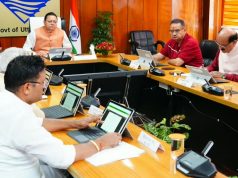
Dehradun, 25 Aug: The Uttarakhand Cabinet, chaired by Chief Minister Pushkar Singh Dhami at the Secretariat here, today, approved a series of important decisions relating to equal pay for UPNL personnel, procurement of 1,320 MW of coal-based power, establishment of a dedicated cell for retired Agniveers, Lokayukta appointments, healthcare, urban development, cooperatives, government employees and rehabilitation of families living along the Rispana river.
Additional Secretary to the Chief Minister and Director General, Information, Banshidhar Tiwari briefed the media about the Cabinet decisions after the meeting. In all 17 proposals were approved.
Among the most significant decision taken by the Cabinet was to extend the benefit of equal pay for equal work to UPNL personnel in three phases. As per the decision, the first phase would cover the employees appointed before 1 January 2016, for whom action is already under way. In the second phase, personnel appointed between 1 January 2016 and 12 November 2018 will be considered, with the process scheduled to begin from 9 November 2026. The third phase will cover those appointed between 13 November 2018 and 15 October 2024, with action to begin with from 1 April 2027.
The Cabinet also decided to remove the condition relating to continuous engagement in view of artificial breaks in the service of UPNL personnel. Employees who were working before 1 January 2016 and continue to be in service will receive the benefit of minimum pay and Dearness Allowance under the government order issued on 3 February 2026, as amended.
In departments where UPNL personnel are working in excess of sanctioned posts, priority for extending equal pay for equal work will be determined according to their date of joining through UPNL. The employees will first be adjusted against sanctioned posts in order of seniority based on joining date. Remaining personnel may be accommodated against entry-level direct recruitment posts for which they possess the prescribed minimum qualification. Where posts are unavailable, supernumerary posts may be created. A separate committee will be constituted at the government level to expedite decisions relating to such adjustments and creation of supernumerary posts. Former UPNL employees engaged on direct contracts in compliance with High Court orders will also be entitled to the minimum of the pay scale and variable Dearness Allowance.
In a major decision concerning energy security, the Cabinet approved the purchase of 1,320 MW of coal-based electricity from Adani Power Ltd at an overall tariff of Rs 5.746 per unit for 25 years. The contracted capacity will be 1,234 MW. It was clarified at the briefing that M/s Adani Power has been identified as the lowest bidder (L1). Uttarakhand Power Corporation Ltd has been authorised to sign the Power Supply Agreement with the company, fulfil the necessary conditions and obtain statutory approvals from the Uttarakhand Electricity Regulatory Commission. The government said the procurement would help ensure reliable base-load electricity and strengthen the state’s long-term energy security.
The Cabinet also approved the establishment of a dedicated state-level cell for former Agniveers returning to civilian life after completion of their service. The decision follows CM Dhami’s announcement that a dedicated mechanism would be created to facilitate former Agniveers in obtaining benefits under various state government schemes. Six contractual posts will be created for the cell, comprising one Deputy Director, two Assistant Directors, two Junior Assistants and one Data Entry Operator. The cell will deal with matters relating to former Agniveers and facilitate their access to various welfare and employment-related schemes of the state government.
Besides this, importantly, the Cabinet also approved the Uttarakhand Lokayukta Search Committee Rules, 2026, providing a formal framework for the functioning of the search committee constituted under the Uttarakhand Lokayukta Act. The rules will prescribe the tenure of the search committee, allowances payable to its members and the procedure for preparing and forwarding a panel of suitable names for appointment as Chairperson and members of the Lokayukta to the selection committee. The decision is aimed at bringing greater clarity and an institutional mechanism to the process of identifying suitable candidates for the Lokayukta. It may be reminded here that the post of Lokayuta has been lying vacant and the High Court has directed the government to ensure early appointment of the Lok Ayukta in the state
The Cabinet approved the Uttarakhand State Cooperative Policy, 2026, aligned with the National Cooperative Policy, 2025. The policy seeks to make cooperative institutions more transparent, accountable, technology-enabled and economically viable.
The Cabinet also approved changes in the state pay matrix to bring it in line with the Central Government structure. Pay Level-15 will be replaced by Level-14 for the Rs 1,44,200-2,18,200 scale, while Level-16 will be replaced by Level-15 for the Rs 1,82,200-2,24,100 scale.
In a significant decision, some changes were also approved in the Green Cess regime for motor vehicles. The Cabinet has decided to withdraw the tax exemption presently available to certain hybrid and CNG vehicles. The decision has been attributed to the growing prevalence of such vehicles and the consequent revenue implications.
In the healthcare sector, the Cabinet approved the Uttarakhand Medical Supplies Corporation for time-bound and transparent procurement of medicines, surgical materials, chemicals, equipment and implants. It also approved the service rules for the Medical, Health and Family Welfare Statistical Cadre.
The Cabinet approved allotment of 116 houses at Kathbangla to beneficiaries selected from among families living in the slum settlement along the Rispana River. The move is part of the government’s plan for planned rehabilitation of settlements located along rivers.
The Cabinet also approved the restructuring of the Uttarakhand Urban Sector Development Agency (UUSDA) and creation of 94 temporary non-cadre posts for implementation of various sewerage, drinking water, road, street lighting, public transport and other urban infrastructure projects in several towns, including Rishikesh.
In another health-related decision, one acre of land at Government Medical College, Haridwar, will be leased to the National Centre for Disease Control for 99 years at a nominal lease rent of Rs 1 for establishing an NCDC branch.
The Cabinet approved the Uttarakhand Population Survey and Records Operations Rules, 2026, to facilitate modern surveys of urban population areas and improve land records and urban planning through GIS-based technology.
The Cabinet also approved the Uttarakhand Private University Statutes, 2026, relating to Uttaranchal University. The Cabinet further approved the proposal to install the statues of soldiers who have made the supreme sacrifice in their respective native villages. The cabinet felt that the initiative would honour the bravery and sacrifice of Uttarakhand’s martyrs, keep their memories alive and inspire the younger generation towards service to the nation.