By ALOK ULFAT
Dehradun, 4 Sep: In an age when education systems around the world are searching for new answers, a remarkable educational movement in the Himalayan foothills has been quietly evolving since 1946. It is called Nanhi Dunya, “International (Intercultural) Movement for Children and Their Friends”, running nine schools and welfare activities for children, youth and women. On Teachers’ Day, let us celebrate this extraordinary and immensely challenging journey of human development of nearly eight decades, exploring the art of learning and living many of the principles that the future of education is only now beginning to rediscover.
Its founder, Prof Lekh Raj Ulfat, felt in 1952: “Nanhi Dunya should become a community of learners, where difference is a natural part of childhood. In an inclusive environment, children must grow in freedom and develop the skills needed for a creative life in the future. I feel, in the future, academic learning alone will not be enough; what will be essential is the ability to use what we have learned whole-heartedly.” He also emphasised that “Children are the creators of the future” and that education should help develop human beings who are “complete, balanced, just, and independent”. Ulfat Ji did not intend to build a huge institution but a small, human-scale initiative based on the needs of people—a creative community for discovering new ways of living and learning, engaged at the grassroots level with local means and materials.
Nanhi Dunya’s story began in 1946 with Prof Lekh Raj Ulfat and, later, his wife Sadhana Ulfat, who gathered a small group of children under a tree for stories and games. From this modest beginning grew an educational movement that continues to work with children in and around the Dehradun Valley. The Vedic impulse to learn from the universe and continually renew our thinking inspired Ulfat and Sadhana Ji to bring teachers, students, thinkers and seekers from across the world to Nanhi Dunya, creating a vibrant space for shared wisdom, inquiry and discovery.
Today, Nanhi Dunya has grown into a widespread social movement, reaching children and communities through a tiny galaxy of seven centres and several small schools. Rooted in the belief that “small is beautiful”, it was attempting to put into everyday practice principles such as inclusive, diverse, interdisciplinary, child-centred and experiential education, social-emotional-spiritual development, and learning at one’s own pace—long before these became part of international educational discussion.
Nanhi Dunya’s most powerful idea is simple: children belong together. No child is “normal” or “handicapped”; each child has different abilities. It is a school where “different is normal”.
Children from diverse social, economic and cultural backgrounds, including those with additional educational needs, learn and grow together in shared spaces. Nanhi Dunya has pioneered this co-learning approach and inspired wider educational practice. It goes beyond inclusion as a policy; it creates a community where the child is not a number, but an individual. For us, a school is not an industry but a community for cooperation, not competition.
Children are individuals, not identical learners moving through an educational system. Nanhi Dunya recognises their different interests, abilities, personalities and rhythms of development, allowing children to learn and grow at their own pace. The question changes from “How does this child compare with everyone else?” to “Who is this child, and how can we help this child flourish?”
At Nanhi Dunya, the arts and creative expression are integral to education, not merely after-school activities. Through music, movement, play, imagination and productive work, children explore themselves and the world around them.
Ashu Satvika Goyal, Cultural Coordinator of Nanhi Dunya, takes children abroad to participate in international art festivals free of cost. These exchanges give children new cultural experiences and return them with greater confidence, motivation, and a renewed sense of possibility.
The school nurtures the physical, intellectual, social, cultural and spiritual development of every child—an approach increasingly important in an age dominated by screens and artificial intelligence. Over the past thirty-five years, I have developed my approach to education, which we call Life in Learning and Natural Intuitive Learning, inspired by great sages, teachers and my studies in India and abroad. My experiences at Emerson College in England and with Johanna and Ivar Heckscher in Sweden further deepened my spirit of learning. I believe a teacher must never stop enquiring.
As machines become better at calculating, retrieving information and generating content, human creativity may become more, not less, important. This creates a form of education concerned not only with producing successful individuals, but with developing responsible and sensitive human beings. We have the task as teachers to create people who have the courage to bring positive change.
Sadhana Ji worked closely with women for over 30 years, helping many discover the art of teaching through hands-on experience in Nanhi Dunya schools. She firmly believed that a college degree did not necessarily make someone a good teacher. With her love, care and faith in people, she helped nurture and shape at least two thousand teachers across the region.
She firmly trusted: “Aspiring teachers as individuals are at different stages of life. Some are gifted; others have to work harder to learn and unlearn to become accomplished teachers. Life itself is an open space for learning. I strongly believe that anyone with a compassionate heart and eager to learn can contribute to any learning community. We are a nation in making, so let us help one another become more imaginative, caring teachers and, in doing so, remain students for life.”
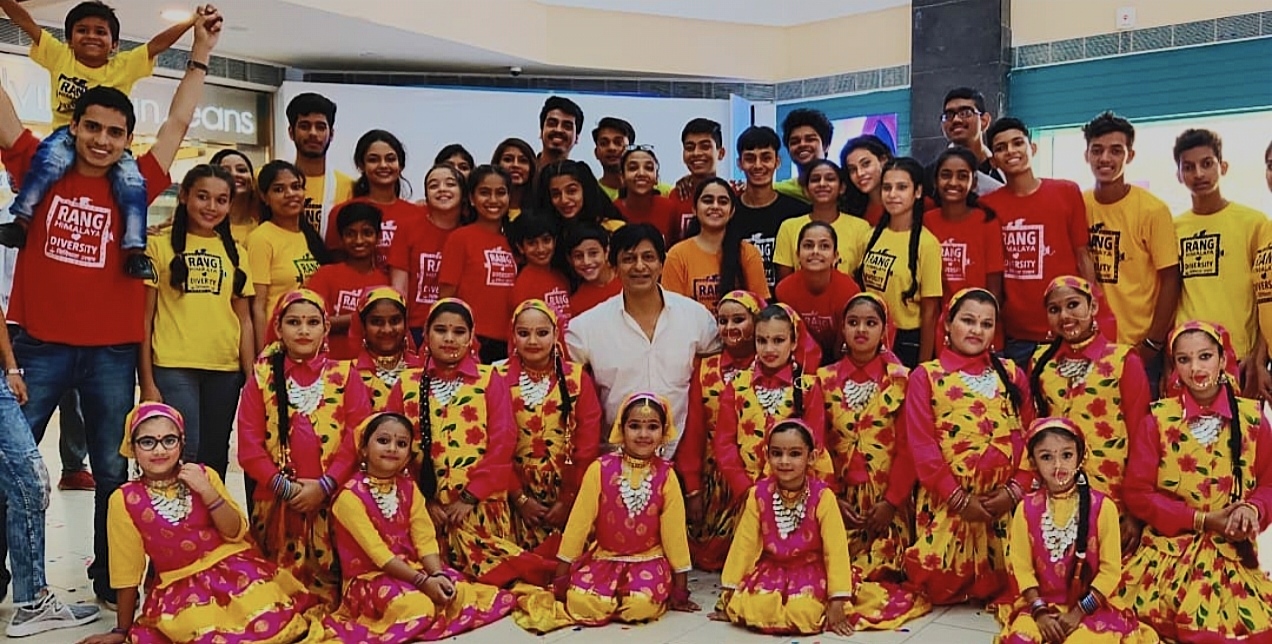
Today, Prof Lekh Raj Ulfat and Sadhana Ji are not physically present, but their vision continues to inspire Nanhi Dunya and its community. Each year, they are remembered through events across Dehradun, including Sadhana Utsav, Jashn-e-Ulfat, Jashn-e-Bachpan, and Rang Himalaya, “Intercultural Festival for Diversity and Earth Fellowship”. These initiatives engage schools, colleges and communities across Dehradun, fostering meaningful participation and connection. Their legacy thus continues to live on through the people and communities they inspired.
Perhaps equally remarkable is Nanhi Dunya’s social and economic model. Nanhi Dunya does not depend on government grants but relies on small contributions and gifts from parents and friends. Its aim is to make education accessible to all children, with a large proportion coming from economically disadvantaged backgrounds. Education for us is not positioned as a commodity that families purchase; it is understood as a social responsibility and a service to children. School fees are flexible, with each family sharing and contributing according to its capacity.
This is genuinely a compelling story, especially its combination of inclusion, freedom, creativity, nature, affordability and almost 80 years of continuity. Nanhi Dunya eagerly awaits more participation from individuals who would like to volunteer and help in the cause.
Please do find time to visit Nanhi Dunya by making an arrangement through email: alokulfat@gmail.com.