The Books from My Shelves – 8
Dr Samir Sinha
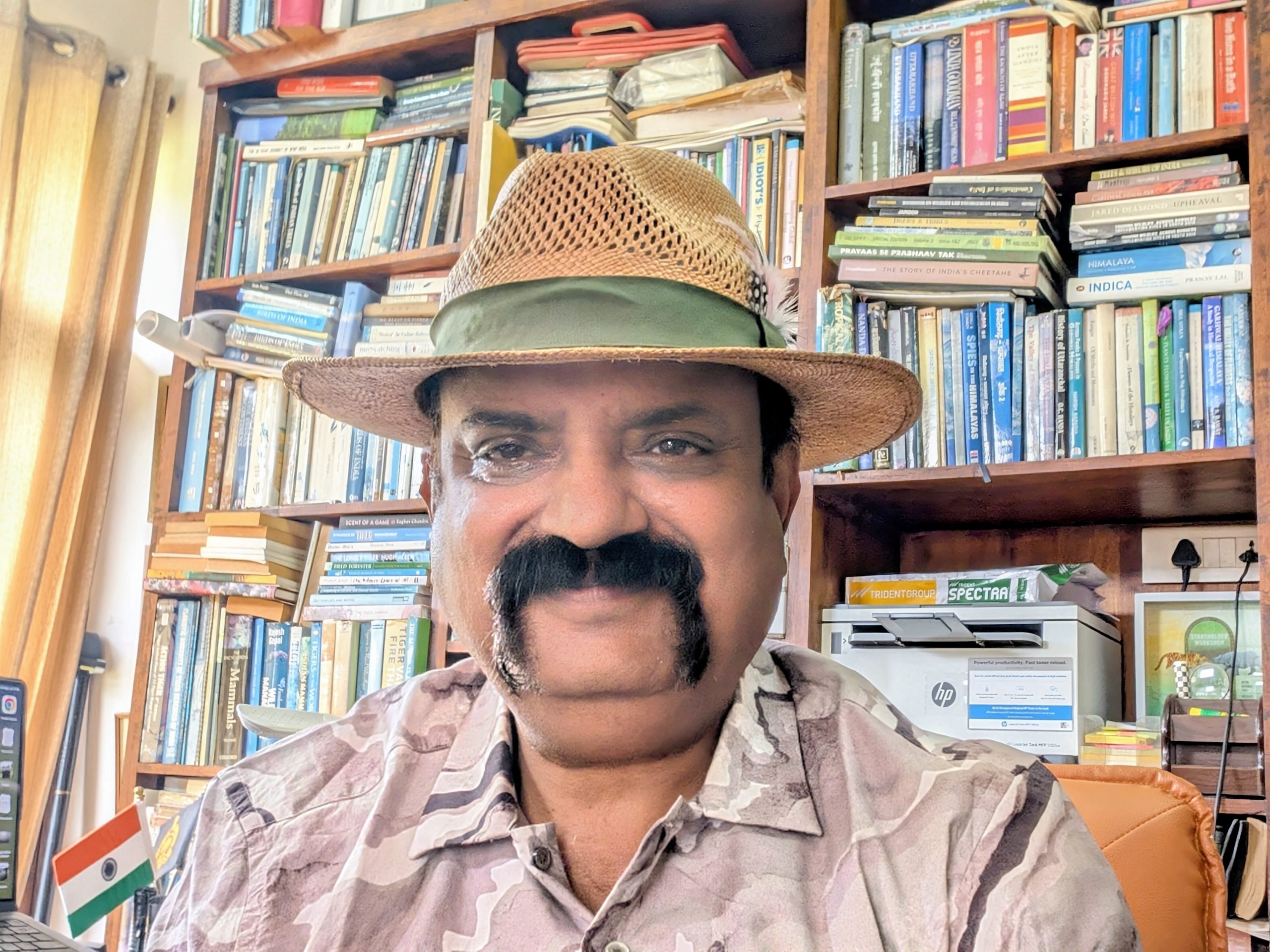
I grew up in a home surrounded by books as my late father was a lawyer and my mother is a retired professor of Hindi Literature. That interest has endured and, today, my study is overflowing with books that cover a wide swathe of interest and often deep personal memories. Let me share some of these with you.
Amongst my large collection of books on ecology and wildlife conservation – tigers, elephants, birds, butterflies, reptiles, et al – Jim Corbett’s books have pride of place. Of these, “My India” stands out. Dedicated to “my friends the poor of India”, it moves away from his well-known hunting exploits and is a social chronicle and tribute to the simple, hard-working, and resilient villagers Corbett lived and worked alongside in present day Uttarakhand and for over twenty years at Mokamah Ghat in Bihar as a Railway Trans-shipment Inspector. It reveals his deep respect and empathy for these common folk, their enduring spirit and depth of character. If there is one Corbett book you must read, I suggest you choose this.
Two books by British Forest officer and conservationist, F.W. Champion, “With Camera in Tiger-land” (1927) and “The Jungle in Sunlight and Shadow” (1934) are significant as they carry the first ever Camera Trap photographs of wildlife in India. His images from the forests of present-day Corbett Tiger Reserve are stunning even by present day standards. Many years later, as a young DFO, I lived in the same bungalow in Lansdowne where Champion processed his photos and wrote these books. This association makes these books even more special.
The complete set of “Adventures of Tintin” remains another favourite. These comic books by the Belgian cartoonist Herge chronicle the globetrotting journeys of Tintin, a young investigative reporter, his loyal fox terrier, Snowy, and their interactions with Captain Haddock, Professor Calculus and the bumbling detectives Thomson and Thomson. Blending humour with mystery, adventure and dashes of political intrigue, these timeless classics are the favourite of children and adults alike. I was introduced to Tintin while at school and his stories take me back to my days at De Nobili School in Dhanbad, Jharkhand.
I find the works of Harishankar Parsai, widely regarded as one of modern Hindi literature’s greatest and most pioneering satirists, a very special read. Described as “conscience-pricking humour”, his writings laced with humour, irony, and sarcasm expose hypocrisy, political corruption, and moral decay and force us to confront uncomfortable truths around us. Viklaang Shraddha Ka Daur, which won him the prestigious Sahitya Akademi Award, and Sadachar Ka Taveej, are personal favourites.
The poetry of Kabir, Gibran and Rumi shares space with books on Hindi and Urdu poetry and prose by eminent litterateurs including Roop aur Awaaz by Harivansh Rai Bachchan, Munawwarnama by Munawwar Rana, Pazi Nazmein by Gulzar, Kakkaji Kahin by Manohar Shyam Joshi, Uttarakhand Kavya by Girish Tiwari “Girda”, Saaye mein Dhoop by Dushyant Kumar and Naraaz by Rahat Indori. Ye jo zindagi ki kitab hai by Rajesh Reddy shares his evocative take on everyday life-
“Mere dil ke kisi kone mein ek masoom sa bachcha
Badon ki dekh ke duniya bada hone se darta hai..”
“The innocent child in some corner of my heart,
after seeing the world of grown-ups, is afraid to grow up!
“Spies in the Himalayas”(2003) by M.S. Kohli and Kenneth Conboy is an insider account of one the most intriguing covert operations carried out jointly by the CIA and Indian intelligence to plant a nuclear powered sensing device on Nanda Devi in order to monitor various military activities across the border. Since this operation required unique mountaineering skills, the normal kind of “spies” could not be deployed for this task and the mantle fell on a small group of elite mountaineers. An absolute thriller that captures the geopolitics of that era and the heroics of a committed few.
Gitanjali by Rabindranath Tagore was originally written in Bengali and comprises 157 poems, many of which have been turned into iconic songs composed by the maestro himself. Tagore translated this into English and the translated version, Gitanjali: Song Offerings, published in November 1912 contained 103 poems including translations of 53 poems from the original Gitanjali, as well as 50 other poems. In 1913, Tagore received the Nobel Prize for Literature for this, making him the first non-European and the first Asian and the only Indian to receive this honour. My copy is a facsimile of the original manuscript of Gitanjali and carries the original Bengali version along with an English translation in the hand of the Guru himself. It will always remain priceless for me.
I find back stories on law very fascinating. “Beyond the Courtroom” (2025) by Fali S. Nariman, one of the tallest figures in Indian jurisprudence addresses several important questions such as the state of our nation, technology to enable speedy and accessible justice, silences in our constitutional law, evolution of separation of powers and the relevance of ethical values in law.
“Governance and the Sclerosis That Has Set In” (2004) by Arun Shourie is a sharp and witty takedown of the way government systems function. It includes a part hilarious part painful narrative on which officers are permitted to use ink colours other than blue or black. This question to the Department of Administrative Reforms and Public Grievances invoked the views of the National Archives of India as the ultimate custodians of Government records. The Ministry of Defence was also asked for their views. After much deliberation, Chapter 6, para 32, sub-para 9 of the Manual of Office now states, “….. Black or blue ink will be used by all category of staff and officers. Only an officer of the level of Joint Secretary to the Government of India and above may use green or red ink in rare cases.”
Further, Para 68, sub-para 5 of the Manual of Office Procedures now reads: “Initial drafting will be done in black or blue ink. Modifications in the draft at the subsequent levels may be made in green or red ink by the offices so as to distinguish the corrections made.”
Finally, I find the poems authored by my mother, Dr Maya Prasad, very special, more so because I am a witness to her creative process.
A few lines from her recent book “Hum Jahaz ke pakhi”:
“Badh raha hai vish bahut vatavaran me
Aaj aao pyaar ka chandan ugayein”
“As poison rises in the environment,
Come, lets plant the sandalwood of love today…”
(Dr Samir Sinha is a former member of the Indian Forest Service (IFS), who recently retired as Principal Chief Conservator of Forests & Head of Forest Force (HoFF), Uttarakhand. A Fulbright Nehru fellow and PhD in Wildlife Science, he has also served as Principal Chief Conservator of Forests & Chief Wildlife Warden, Uttarakhand, Director, Corbett Tiger Reserve, Nanda Devi Biosphere Reserve, Rajaji National Park & Head, TRAFFIC India (WWF-IUCN).)