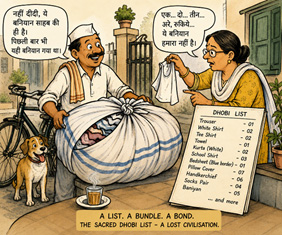
The Sacred Dhobi List
 By Atul Rawat
“Trouser – 01
White Shirt – 02
T-Shirt – 02
Towel – 01…”
There was a time when sending clothes for washing was almost a sacred household ritual. It was never a casual errand; it was a solemn process.
Every garment was counted before it left the house and meticulously checked on its return. There was always an observation.
“Button phir tod diya hai, bhaiya.”
“Neel zyada daal diya… poora kapda neela ho gaya hai.”
It was a beautiful human relationship that families built with the neighbourhood dhobi. One could never cease to marvel at his memory—his own personal “computer” that kept track of hundreds of garments. Not a single handkerchief or pair of socks would get mixed up.
With an enormous bundle of clothes balanced on his bicycle, he would make his way through the neighbourhood, season after season, year after year.
Over time, he became part of the family.
He knew everything that was happening in the house—examinations, celebrations, heartbreaks, visiting relatives, and even what was cooking in the kitchen.
Sometimes, over a cup of tea or a glass of lemonade, he would share stories of his own life—his grandfather, his father, his wife, his children, and his everyday struggles.
The relationship quietly grew beyond a service transaction into something deeply human.
In today’s world of washing machines with “AI Mode” and detergents promising “mountain freshness”, it is almost impossible to explain the emotional significance of the legendary Dhobi List.
And what a list it was.
A handwritten document maintained by every respectable household with the precision of a bank ledger.
“Doh white kurtas… one with a loose button.”
“Teen school shirts.”
“Ek bedsheet blue border wali.”
“Ek kaali pant….”
Every item was recorded with astonishing detail.
“Bhaiya, kal jaldi aa jana. Kal office blue shirt pehen kar jana hai.”
In a world without mobile phones or WhatsApp reminders, such planning and commitment ensured that life ran smoothly.
Then he would arrive, balancing an impossible mountain of freshly ironed clothes on his bicycle, open the gate with one hand, greet the family dog, and sit cross-legged in the verandah while the lady of the house began counting garments with the intensity of an auditor.
The freshly ironed clothes carried that unforgettable fragrance of a coal-heated iron.
“Ek… do… teen… arre, ruko… yeh baniyan hamara nahin hai.”
He would respond with complete confidence:
“Nahin didi, ye bhai saheb ki hi baniyan hai. Pichli baar bhi yehi baniyan gayi thi.”
The counting resumed.
Inevitably, there would always be one mysterious extra item.
He would calmly declare,
“Arre didi, yeh Kusum didi ke ghar ka hai.”
And somehow, by the following week, every missing garment mysteriously found its rightful owner.
The whole process also had its signature moment—the tying of clothes into the sacred bedsheet bundle.
Not plastic bags.
Not laundry baskets.
A proper cotton bedsheet tied diagonally into a giant knot that looked capable of surviving the worst natural calamity.
There were always moments of anxiety.
“Pillow cover paanch thhe ki chhe?”
And once again, the counting began.
Nobody questioned the system.
This was simply the Circle of Life.
“Theek se check kar lo!”
“Pichli baar bhi ek napkin kam tha!”
Today, of course, none of this exists. Somewhere along our journey towards Amrit Kaal, this entire exchange has quietly disappeared.
Now I simply put the clothes into a washing machine, press a few buttons, and trust something called “TurboWash 360”.
No arguments. No Dhobi List.
No neighbourhood diplomacy. No suspense.
No accidental exchange of bedsheets between families.
Efficiency has won.
Humanity has quietly stepped aside.
The old dhobi system was never merely about washing clothes. It was a social interaction, accounting practice, emotional endurance training, neighbourhood gossip, and low-level detective work—all wrapped in a faded cotton bedsheet.
And somewhere, inside an old steel almirah in an old Indian home, lies a yellowing Dhobi List, its fading handwriting preserving the memory of a slower, noisier, wonderfully complicated India. Those of us who grew up in boarding schools can relate equally well to the priceless Dhobi List—it was such an important part of our school life.
Perhaps that fragile piece of paper wasn’t merely a laundry record after all.
It was a register of trust.