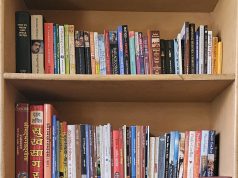
The Books from My Shelves
By Upendra Arora
I consider myself extremely fortunate to have been born into a family of booksellers, always surrounded by books at our bookstore.
In my formative years I was fond of Batman and Superman comics, but soon migrated to children’s classics, inspired by my grandfather, Lala Narain Das — considered the founder of the book trade in India and a well-known Urdu poet. I often found him reading, and became convinced that good reading is what helps one write impressive poetry — a gift God gives only to those He loves.
In school, my English teachers, Mrs Edwards and Mrs D’Souza, always carried a book in hand. Both were passionate book lovers and an inspiration to me and all my schoolmates. They believed the simplest and smartest time-management strategy anyone can follow is to never go anywhere without a book under your arm.
Soon after leaving school, I became addicted to James Hadley Chase, the crime-thriller author. Two of his books, ‘No Orchids for Miss Blandish’ and ‘The Way the Cookie Crumbles’, still occupy my bookshelf and remain outstanding. The first tells of Miss Blandish, kidnapped by a gangster for ransom and then fought over by rival, more violent gangs seeking to extract an even greater price — sparking an inter-gang war. The second is a gripping tale of a meticulously planned heist at one of the world’s safest banks, and the secret detective who gets on its trail. These are golden thrillers that no other author has matched — in fact, many Hindi films produced in Bombay have borrowed plots from Chase’s novels.
At the instance of some friends in the Army, we chose to publish the book ‘Field Marshal Sam Manekshaw: Soldiering with Dignity’ by Lt General Depinder Singh (2002). This book is the authorised biography of the Field Marshal who led us to victory in the 1971 war against Pakistan. The author was Military Assistant to FM Manekshaw during his tenure as Chief of the Army Staff, and also belonged to his regiment. Field Marshal Sam Manekshaw has undoubtedly been the most controversial and dynamic figure in the history of the Indian armed forces. His showmanship and flamboyance might have sometimes irked even those most devoted to him. Yet, in the moment of truth, when war lay like a leaden weight on all Indians in 1971, Manekshaw stood the test of the hour and led his country to victory. His exemplary commitment to the Indian nation stands out as a golden chapter in Indian military history. The book is an absolute class — it takes you inside the Army and tells us what our men in uniform are made of. Having read it, I felt I knew the Field Marshal extremely well. It is full of incidents from the war and after, speaking to his brilliance and outstanding leadership. One of the finest biographies I have read so far.
I also read “Life’s Magical Moments by Ruskin Bond” (Penguin, 2025). As India’s most beloved author entered his nineties, he shared decades of wisdom drawn from personal experience — the things that helped him reach this age unharmed. Written with wit and warmth, the book is a tribute to life’s magical moments, and one my generation of readers will truly cherish.
Another favourite, published more recently, is ‘The Clothing of Books’ by the award-winning Jhumpa Lahiri (Penguin, 2017) — a personal reflection that delightfully explores the art of book jackets from both the reader’s and the writer’s perspective. It probes the complex relationship between text and image, recounts instances where a designer’s cover failed to capture a book’s content, and examines how publishers approach cover design differently across the countries where her work has been translated.
‘The Courage to Be Disliked’ by Ichiro Kishimi and Fumitake Koga (Allen & Unwin, 2013) also made a strong impression. Framed as a conversation between a philosopher and a young man, it offers convincing answers to questions we all carry, and the courage to change one’s thinking — and one’s
life — for the better. I found it deeply enriching.
I’ve always loved travel writing. “The Valley of Flowers” by Frank Smythe (Hodder & Stoughton, 1938), the noted mountaineer and adventurer, recounts the four months he spent in the Garhwal Himalayas during his successful 1931 expedition to Mount Kamet. On his way back, while exploring the region near the sources of the Alaknanda and the Gangotri — two tributaries of the Ganga — he discovered the Valley of Flowers, now a World Heritage Site. Reading it, I felt as though I were in the valley myself, enjoying its beauty without ever having set foot there.
The celebrated travel writer Peter Hopkirk read Rudyard Kipling’s ‘Kim’, the novel that immortalised the Great Game, and — fascinated since childhood by the tale of an orphan boy recruited into the Indian Secret Service — retraced Kim’s footsteps across India to see how much of that world remained. His pursuit took him to nearly every place mentioned in the novel and led to his own brilliant book, ‘Quest for Kim’ (John Murray, 1996), a captivating account of the places he visited and the people he met. On his way back from Mussoorie, Hopkirk stopped in Dehradun to see the original headquarters of the Great Trigonometrical Survey of India, and — hoping to find a copy of Ruskin Bond’s account of life in Mussoorie — wandered into our bookshop near his hotel. By extraordinary coincidence, a pile of his own books, ready to be sent to Woodstock School in Mussoorie, sat on my desk at that very moment. He introduced himself, somewhat sheepishly, and the encounter became a story he later shared generously in his own book. It remains especially dear to me.
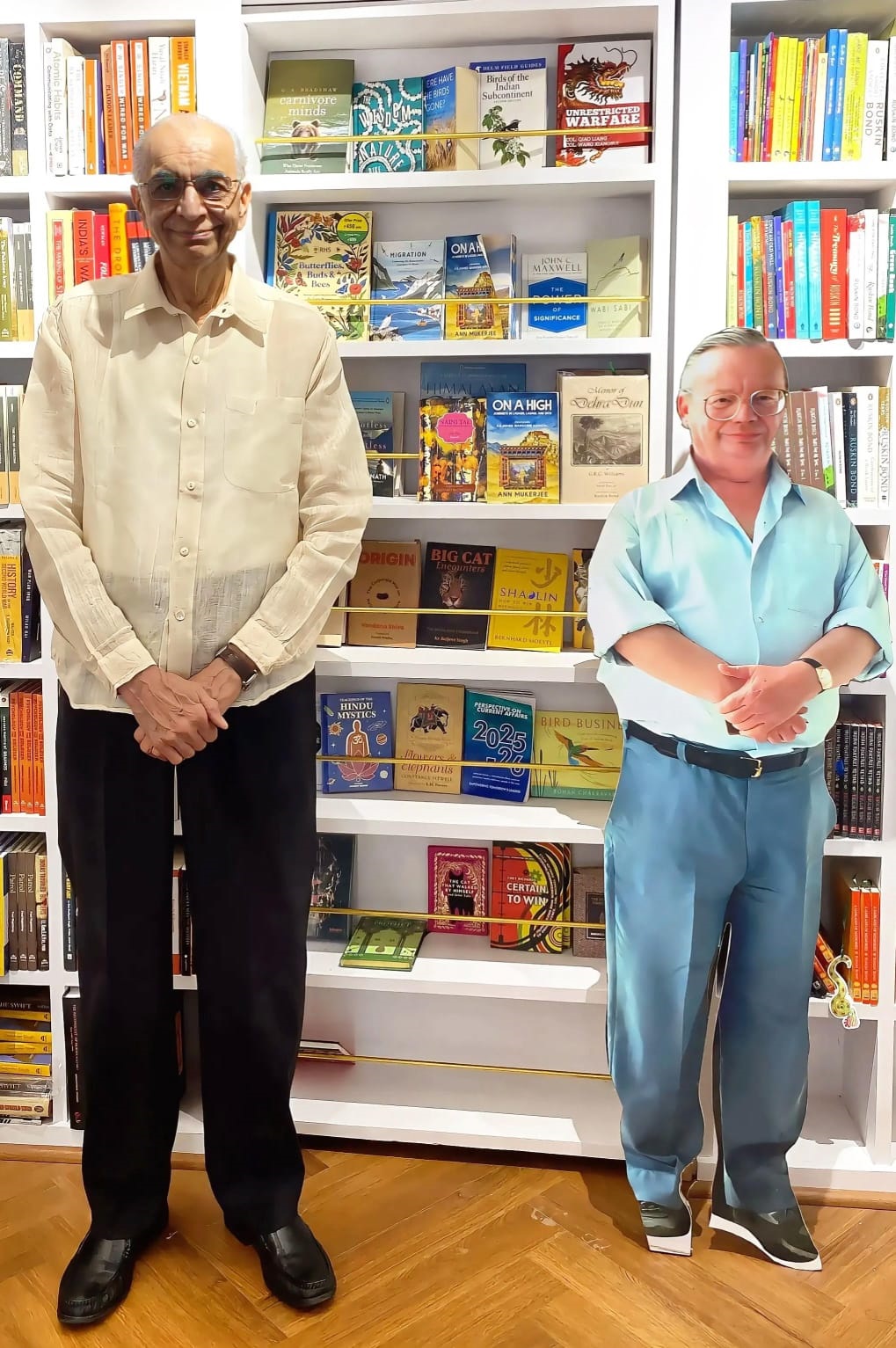
In the same vein, “On a High: Journeys in Ladakh, Lahaul and Spiti” by Ann Mukherjee (Natraj, 2025) is another favourite — a vivid, exciting travelogue of her journey by road through the Trans-Himalayas at the age of seventy-five, full of incident and marked by courage, curiosity, and a spirit of exploration. When both her ears suddenly failed, leaving her distressed and depressed, a stroke of luck led her to an ENT specialist in Goa who restored hearing in her right ear. To celebrate, she undertook her expedition through Ladakh, Lahaul, and Spiti. The book carries a heartwarming foreword by His Highness Jigmed Wangchuk Namgyal, Raja of Ladakh. Ann Mukherjee, incidentally, passed away three weeks ago at ninety-three.
Most recently, I added “A History of Booksellers and the Bookshop” by the noted French historian Jean-Yves Mollier (Mountain Leopard, 2026) to my shelf. It explores the bookseller’s role through the ages in helping authors disseminate their ideas and enriching readers with their words — tracing how, over the centuries, a profession was invented that constantly renews itself to adapt to a changing world. It is a history of booksellers and bookstores, and a tribute to the vital, often mysterious industry that sits at the crossroads of ideas and economics — and to all who help carry a book into its reader’s hands. Readers may be interested to know that, in France, bookshops are supported and sponsored by both the government and society at large.
‘A Book of Books’ by Sonali Bendre Behl (HarperCollins, 2025) — the formidable actress and passionate advocate of storytelling — is my current favourite. In it, she offers thirteen reasons why everyone should read, making the case for why reading matters, in a book perfect for readers and aspiring readers alike. Sonali Bendre Behl is also a great supporter of independent bookstores, and has led campaigns across the country encouraging readers to visit, browse, and buy — helping these bookstores survive.
“So long as you live, keep learning how to live,” said the Roman philosopher Seneca. And yet most people never read more than a handful of books after finishing their formal schooling. In times of rapid change, ideas are the true currency of success. It takes only one idea, from the right book, to reshape your character, transform your relationships, or revolutionise your life. A good book can change the way you live.
(Upendra Arora manages The Natraj Bookshop on Rajpur Road.)