By Arun Pratap Singh
Garhwal Post Bureau
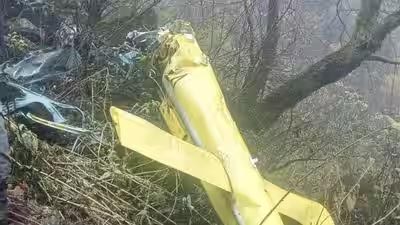
Dehradun, 30 Oct: The helicopter crash near Chai village in Joshimath, involving an aircraft returning from Badrinath Dham, has once again raised serious questions over the safety of helicopter operations in Uttarakhand, particularly as the Char Dham Yatra season approaches its conclusion. Six people, including the pilot, were on board when the helicopter lost contact while flying over the Joshimath valley and crashed killing all the six on board. The incident has brought weather-related safety concerns into sharp focus.
The most pertinent question being raised is how and why the helicopter was allowed to operate despite a yellow alert for bad weather for today. According to the IMD Chamoli district was likely to witness generally cloudy skies, rainfall and thunderstorms today. An earlier warning issued yesterday had forecast lightning, thunderstorms and strong winds reaching speeds of 40 to 50 kmph. Several helicopter services had reportedly remained suspended due to adverse weather conditions, raising questions about how the ill-fated helicopter was permitted to operate.
It may also be reminded here that this is not the first aviation incident involving a Trans Bharat Aviation helicopter. Earlier, helicopters operated by the company were involved in crash landings near the Kedarnath Temple and on a road close to the Sersi helipad. More recently, one of the company’s helicopters was forced to make an emergency landing near Chamba in Tehri district.
While Uttarakhand Civil Aviation Development Authority (UCADA)’s CEO Prateek Jain has suspended all helicopter flights operated by M/s Trans Bharat Aviation Private Limited, the question still remains, who cleared the ill fated flight despite adverse weather alert. Of course, after a series of serious chopper accidents last year putting the UCADA under scanner, this year the helicopter operations during the first phase of the 2026 Char Dham Yatra had remained free of accidents since the government and the UCADA had undertaken several measures to improve operational safety. However, the latest accident has once again exposed the challenges of conducting helicopter services in the state’s mountainous terrain, particularly during unpredictable weather conditions.
It may be recalled that the 2025 pilgrimage season witnessed several helicopter-related incidents. According to information provided by the Union Ministry of Civil Aviation on 21 July 2025, four helicopter accidents had been recorded during the Yatra up to June. No accidents were reported in 2021 and 2024, while one each was recorded in 2022 and 2023.
The first major tragedy occurred on 8 May 2025 near Gangnani on the Gangotri route in Uttarkashi district. A Bell 407 helicopter operated by Aero Trans Services crashed into a gorge, killing six people, including the pilot. The preliminary investigation by the Aircraft Accident Investigation Bureau (AAIB) revealed that the helicopter’s main rotor had struck a fibre-optic cable while attempting to land on a road.
On 12 May, another helicopter returning from Badrinath had to make an emergency landing at a school playground in Ukhimath due to poor visibility. All passengers escaped unhurt.
On 17 May, an Airbus AS350 air ambulance operated by Pinnacle Air met with an accident while landing at Kedarnath. Its tail boom became detached after it landed short of the designated helipad. No casualties were reported. On 7 June, a Crystal Aviation helicopter developed a technical problem shortly after taking off from Sersi for Kedarnath and was forced to land on the main road. The pilot sustained injuries, while passengers remained safe.
The worst tragedy had occurred on 15 June last year when an Aryan Aviation Bell 407 helicopter crashed near Gaurikund while returning from Kedarnath to Guptkashi. All seven people on board, including the pilot and a child, were killed.
Following the June 2025 tragedy, helicopter services in the Char Dham region were temporarily suspended. The Directorate General of Civil Aviation (DGCA) and UCADA were directed to review operators’ functioning, pilots’ experience and operational safety. Greater emphasis was also placed on restricting flights during adverse weather and improving access to real-time meteorological information.
But the latest Joshimath accident has once again revived these concerns. With rainfall, thunderstorms, strong winds and rapidly changing weather posing challenges in high-altitude areas, strict adherence to weather advisories is essential.
The crucial questions now are whether the helicopter took off despite the weather warnings and whether adequate safety precautions were followed. These issues can be conclusively established only through a detailed official investigation.