 By: Ganesh Saili
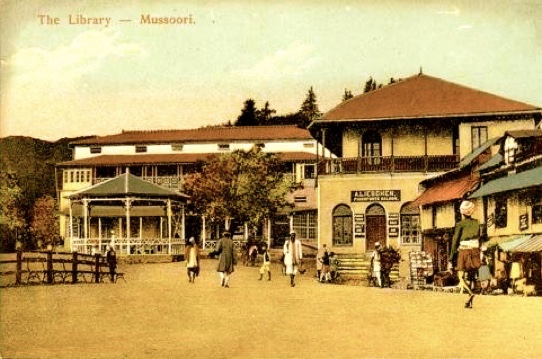
Call it Library Chowk, call it Kitab-ghar, or call it Gandhi Chowk. It makes no difference because you would still be talking about the same place that displays the crown jewel of our hill station. In 1843, the Library was gifted to the town by a combination of British merchants, missionaries and military officers, who had come together and chosen a site on the western edge of town by forming a Committee with Mr Vansittart, the then-Superintendent of the Doon, who was its Chairman. On 1st April 1844 its ownership was transferred ‘to be held forever in trust for and on behalf of the Mussoorie Library Committee.’
It was here two years before Waverley Convent began; it was here ten years before Maharaja Dalip Singh of the Punjab was exiled here; it was here twenty-two years before Mount Everest got its name; it was here before the Charleville, the Savoy or the Himalaya Hotel existed; and it was here long before Woodstock, Allen Memorial and the Railway School of Oak Grove had been dreamt of. These three schools fructified in 1888.
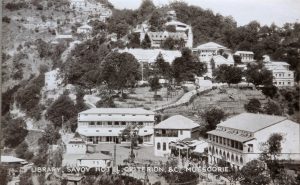 ‘A library? Who needs one these days, especially one in the middle of a busy town square?’ Doubting Thomas, Chairperson of the Doubter’s Society, wonders.
‘Elsewhere in the world, this Victorian building would be a UNESCO site! It’s present-day traffic that would be diverted,’ a research scholar opines.
As a member of the hill station’s oldest living institution, I have got used to proposals, both decent and indecent. There were some priceless ones: ‘What this place needs is a Coffee Shop, a pool table and a few card-tables.’
‘I have an event better suggestion,’ I tease. ‘Why not build a glass skywalk to the eateries across the road and to nearby Criterion building?’
But it’s not all black. Of course, the good news is that it has survived and lived to tell the tale. A hundred and eighty years later, to some of us, this is a lifeboat: a place to paddle one’s canoe, to detox, to clean the cobwebs of the mind and open the windows to the world.
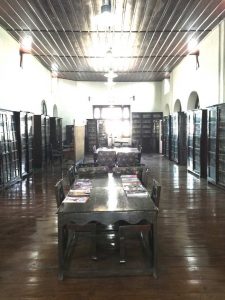 The historic Reading Room continues to attract authors, historians, and scholars from all around the globe. All of them want to look for rare books on topics far and wide. Come, turn a page and begin a new journey into the unknown.
‘If you want to destroy a civilization, destroy its libraries. You can either burn them, bury them or neglect them.’ There are still some who see us it as a preserver of the faith; too many others view it as little more than an impediment in the middle of a town square!
‘You may change your environment, Ganesh!’ says Hugh Gantzer. ‘But remember, our heritage always remains the same.’ He should know, after all; his family has contributed in ample measure to the existence of the Mussoorie Library.
A few years ago, my phone rang. On the line was Woodstock alumnus, actor Tom Alter. ‘Ganesh! Can we shoot a film in the Mussoorie Library?’ Tom asked, in impeccable Hindi.
‘How big is your film crew?’ I asked. I knew full well that our wooden floor could not possibly bear the added load of a generator, film equipment and people.
‘Tom! Ask them to shoot with a hand held camera,’ I suggested. ‘There would be fewer people on the floor.’
‘No way! Kitab is a full-fledged film,’ Tom replied.
‘Then let’s look for another place with a concrete floor!’
Fortunately, we were able to find a place next to Picture Palace and that was where Kitab was eventually shot.
At day’s end, it’s about trust – the trust that our founders reposed in us. It makes us the Keepers of the Faith, and with the sixteen thousand books in our Library, we celebrate knowledge that provides us shelter from life’s buffeting. Each treasured tome is a rendezvous with greatness. Foremost among them you will find Mussoorie’s first Padma Bhushan awardee – author Rahul Sanskritayan – who in the 1950s, wrote fifty-six books during his seven year stay in Happy Valley’s Herne Cottage. Meanwhile Kitabghar – our house of books – carries on.
Ganesh Saili born and home-grown in the hills belongs to those select few whose words are illustrated by their pictures. Author of two dozen books; some translated into twenty languages, his work has found recognition worldwide.