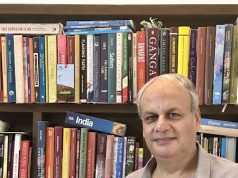
By Dr. Satish C. Aikant
When Kabir was approaching the end of his life, he set out from Kasi and headed for an obscure town called Maghar. The people of Kasi urged him to spend his last days in the holy city where he had lived all his life. Always an iconoclast, Kabir told them that salvation can be found anywhere. It was his last act of defiance.
Kabir stands among the long line of dissenters in Indian tradition. In the Rig Veda the ‘Nasadiya Sukta,’ the Hymn of Creation, speculates about the creation of cosmos and its manifestation, and ends with radical doubt:
But who really knows, and who can say
whence it all came, and how creation happened?
For the gods themselves came after Creation.
so who knows truly whence it has arisen?
Whence all creation had its origin,
He whether He created all that is, or did not,
He who looks upon everything from the highest heaven,
He alone knows – or maybe even He does not know
This is evidently the beginning of Indian scepticism when no human or divine agency was taken for granted. This spirit subsequently gave rise to various religions in India –Buddhism, Jainism and, later Sikhism. Their founders, Buddha, Mahavir and Nanak dissented from the ritualistic and caste rigidities of the orthodox tradition to discover new paths of spirituality, metaphysics and social organization. We must not forget that Hinduism (distinct from Hindutva which is a political ideology as well as a project) itself is a capacious concept encompassing both orthodox and heterodox systems of thought. If it was, and has been, largely the domain of believers, it also had within its fold materialists like the Charvaks of the Lokayatan philosophical school for whom what mattered was the material world of experience rather than the promise of an otherworldly transcendence. Buddhism and Jainism, both radical faiths, were not posited on the notion and existence of God, and they rejected completely the scriptures of Hinduism and many of its foundational concepts like the eternal soul and the ubiquitous Brahman.
The medieval Bhakti period, when religious orthodoxies were vigorously challenged, brought in a refreshing egalitarian outlook making God accessible to all, without resorting to the mediating role of priesthood, mosque, temple or sacred books. The medieval saints set in motion the enterprise of energizing social life when fanaticism and exclusivism of varnashrama-dharma was trying to keep the majority of the people in ignorance of the truth. Kabir, Tukaram, Namdeo, Mirabai, Nanak were all speaking against formal religion redefining the exclusionary practices of dominant religions. There were others who were thinking about the ways in which dominant practices of religion could be re-defined. Many of them were of humble origin and came from lower castes such as Kabir (a weaver), Dadu (a cotton-carder), Ravi-das (a shoe maker), Sena (a barber) and so on.
Kabir drew on various religious traditions and from the knowledge base of both Hindu and Islamic traditions, but his spirituality went beyond any religion. He was a rationalist who wasn’t afraid to question or criticize anyone. He emphatically declared his independence from both of the major religious traditions of his countrymen, vigorously attacked the follies of both and tried to kindle the fire of a similar autonomy and courage in those who claimed to be his disciples. Kabir’s compositions are remarkable for their insistence on the necessity for both religious and social reform. He attacks not only superficial and superstitious religious rituals in both Hindu religion and Islam, but also the sacred authority of religious texts. He also attacks the pretensions to social superiority of so-called high-born persons, particularly Brahmins and Kazis. Today he would undoubtedly be hauled before a court of justice for his insults to traditional religious orthodoxies and for allegedly fomenting communal conflict. Shades of a totalitarian and theocratic state where secularism is derided as ‘sick-ularism.’
One of the stock phrases in Kabir’s verses is ‘ghata ghata mei’ (in every body, in every vessel). Kabir perceptively understood the countless ploys by which we avoid recognizing ourselves. One form our foolish ignorance takes is our desperate, seemingly sincere, searching outside ourselves. Unable to introspect and look within we are obsessed with externalities. The accessibility of Kabir’s poetry is directly linked to the language he uses. His verses are composed in Hindi and not in Sanskrit. Sanskrit, being the prerogative of upper-caste scholarly discourse, was the language related to formal religion. Kabir’s compositions in the vernacular use common metaphors and symbols drawn from daily life – markets and temples, boats and rivers, clay and idols. Wordsworth eloquently described the poet as ‘a man speaking to men.’ Kabir’s verses are about the common people and their daily activities and struggles. He stands with his god in the marketplace- ‘Kabira khada bazar mein, maange sabaki khair’ (Kabir stands in the marketplace wishing well for all and one).
Tagore was greatly impressed by the poetry of Kabir. His ‘One Hundred Poems of Kabir’ is a selection based on a compilation of Kabir’s songs by Kshiti Mohan Sen (Amartya Sen’s grandfather). He chooses the songs which are more mystical in content and message but he does not underplay the social side of Kabir. Often what one encounters in the translations is an esoteric world where ‘flame burns without lamp;’ ‘the lotus blossoms without a root;’ ‘a strange tree, which stands without roots and bears fruits without blossoming.’ This Kabir is more or less a vedantin. Tagore’s propensity for the mystical Kabir is understandable in terms of his own strong personal inclinations for the metaphysical. But for the socially concerned Kabir is a revolutionary who sang against the tyranny of the powerful and the privileged. For the oppressed, Kabir is Mahatma, like Gandhi, who spoke in their own tongue against the bane of untouchability. For a spiritual seeker, Kabir is a great Yogi, a Sat Purusa who shines like a beacon in the blinding storm. For men of letters, of course, Kabir is a poet par excellence.
Kabir is one of the most personal of Bhakti poets not because he dwells on his private experience as do Mira or Tukaram, but because he gets personal with his listeners. While Sur or Tulsi addresses God, Kabir primarily addresses us. The reader is central to Kabir – ‘Kahai Kabira suno bhai sadho, suno ho santo’ as the refrains goes he speaks to us, makes us listen, wants to engage, awaken and startle us. Kabir, in a way also our contemporary, is modern as much for his style as for his universal message that transcends all forms of sectarianism and dogma.
On principle, all agree that God is omnipresent and dwells in every human heart, and that all are equal in the eyes of God, but when these precepts have to be put into practice, suddenly we find pride, social distinction and class divisions playing their nefarious roles and those who are supposed to be equal in the eyes of god are rendered unequal in the social order. Man does have the capacity to minimize the force of inequities, social evils and tyrannies, and live in peace and happiness, but ironically, our sorrows are only perpetuated on account of the dichotomy between the precept and the conduct. Following Kabir, Gandhi applied himself to solve this dilemma. Both of them, in their search for a solution embrace the outcastes and the downtrodden. Indeed, for them it was not merely a matter of social reform; it was a divine injunction, a means to serve God as Daridranarayana. A professed and practising Hindu himself Gandhi’s preferred mode of worship was conducting inter-faith prayer meetings usually at open spaces.
As the consecration ceremony of Ram-lalla in Ayodhya approaches a tidal wave of Ram bhakti sweeps across India. Devout Indians (not only Hindus) view it as a vindication of their faith. But there are also those who simply want to reap political benefits from it. We know that the parliamentary elections are around the corner.
T. S. Eliot narrates in his poem ‘Journey of the Magi,’ that when Jesus Christ was born three Wise Men ‘from the East’ travelled all the way to Bethlehem to pay their homage to the infant Christ (Christian counterpart of Ram-lalla ?). They recount their experience which transformed them:
We returned to our places, these Kingdoms,
But no longer at ease here, in the old dispensation,
With an alien people clutching their gods.
One hopes that those returning from Ayodhya with the blessings of Ram-lalla will undergo a similar transformative experience. Will our netas return chastened and humbled from their Ayodhya experience? We also expect that our pollical leaders in particular to lead us by example. The least that is expected of them is that they do not cross the limits of civilised discourse while dealing with their political opponents and that one hears no more of Didi-O-Didi jibes.
(The writer is former Professor and Head of the Department
of English, H.N.B. Garhwal University)