 By DR. SATISH C. AIKANT
When Narayana Murthy, the Infosys co founder, suggested that Indians should work 70 hours a week to contribute to the country’s economic growth and increased productivity, it sparked an intense debate. While some viewed it as a call for a stronger work ethic, others found it as a gateway to burnout and toxic work culture, contrary to the demands of work-life balance. Of course, an inveterate idler like this columnist must have been farthest from the mind of Murthy.
To let work alone take over our lives is foolish and counterproductive. There are several other things that need our time and attention, such as friends, family, hobbies and above all rest. However, I have a larger point to make about the place of slowness (in preference to what is hailed as the cult of speed) in our lives. For the greater part of human history life and work coordinated, limited by the momentum of our bodies. But since the Industrial Revolution machines have enabled us to exceed speed limits. Since then, we have had to adapt to the speed of our machines, and our lifestyle has become determined by their schedules. The process of urbanization has made us forget about our natural rhythms and harmony with nature. In the West time is viewed in its linear progression whereas the ancient traditions like the Chinese, Hindu and Buddhist traditions, view time as more cyclical. In Western society the finite time is therefore a precious resource. The obsession with making the most of time grew as we became accustomed to the phrase: ‘time is money.’ The modern urban life is fast paced. In our rush to keep up with the speed of modern life, we forget about the pleasure of enjoying existence one bit at a time. We feel compelled to rush rather than rest.
Fast is busy, aggressive, hurried, stressed, superficial, impatient and quantitative rather than qualitative. Slow is the opposite: free, calm, still, relaxed, deep, patient and qualitative rather than quantitative. It is about making real and meaningful connections -with people, culture and environment. Being slow means that we are in control of our own lives.
Our fast-paced lifestyle has found its way even to our dining tables. We have come to prefer food that is readily available, regardless of its health risks. Instead of sitting down to a meal with family and friends, we often eat alone, rapidly, usually while doing something else. These rushed eating habits and ready-made meals have adverse effects on our bodies. Eating fast doesn’t give our stomachs enough time to tell the brain that we’re full. But these habits aren’t insurmountable. We can learn to deal with food in a more mindful way. Cooking and eating slowly can be a wonderful way to unwind, like a form of meditation.
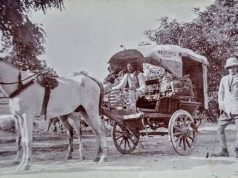
Take mobility of transport. Speedy travel robs us of the joy of slow- paced, leisurely, journey that might familiarise us with our surroundings, flora and fauna and the people around. In comparison with travelling in a plane a train journey is much more enjoyable and enriching experience giving us a feel of ‘real India’ to use a term popularised by E.M. Forster in A Passage to India. As a train passes stations of bigger or smaller towns one hears the ubiquitous vendors crying out ‘chai, chai,’ or have the smells of puri- sabji, vada -sambhar and crispy samosas wafting across to us.
There is pleasant cacophony of the crowds converging and parting, consolidating our communal identities. An Indian railway station is a veritable carnival. We miss all this when we make an air dash. The ‘aeroplane class’ misses all this commonplace bustle. In any case, those locked within their islands of prosperity and privilege would hardly deign to have any communion with the masses. There is palpable class divide.
There is a connection between walking and thinking. Writers and philosophers have long known and appreciated the benefits of walking. Socrates would walk long distances while engaged in animated discussion with his companions. Aristotle famously did most of his philosophising while walking around Athens. Jean-Jacques Rousseau, one of the central figures of the Enlightenment, wrote an autobiographical work called Reveries of a Solitary Walker, in which he admits that he intensely felt inspired to think during his long walks around Paris. The German philosopher Immanuel Kant never ventured outside of his hometown of Königsberg in Prussia during his life but stuck to a regular daily schedule of an afternoon walk by which people would set their watches. His schedule was interrupted only once when he was unable to put down David Hume’s Treatise of Human Nature, which as he claimed had awoken him from his dogmatic slumber.
Gandhi wrote Hind Swaraj during his return trip from England to South Africa between November 13 and 22, 1909, on board a ship. I doubt if a faster mode of travel would have enabled him deeper reflection for his manifesto for a postcolonial India. Speed gives thinking a staccato quality. For Gandhi walking became a tool for swaraj. He familiarised himself with the condition of his people through his all too frequent marches in the country. The historic Dandi march led by him, with thousands of followers, that challenged the might of the British Empire, has become an iconic representation of non-violent resistance and satyagraha. That also brings to mind another Gandhian, Martin Luther King, the Afro American civil rights activist, who galvanised his people to fight against racism and staged a historic march at the Lincoln Memorial in Washington where he delivered his stirring speech ‘I have a dream.’
Crafts are a perfect expression of the Slow philosophy. As the pace of life accelerated in the nineteenth century, many people fell out of love with the mass produced goods pouring from the new factories. William Morris and other proponents of the Arts and Crafts movement, which started in Britain, blamed industrialization for giving machines the upper hand and stifling the creative spirit. Their solution was to return to making things slowly and carefully by hand. Artisans produced furniture, textiles, pottery and other goods using traditional, pre-industrial methods. Crafts were hailed as a link to a kinder, gentler era. More than a century later, when once again technology seems to be calling the shots, our passion for the handmade is getting stronger than ever.
The access to information seems our greatest luxury nowadays whereas it is freedom from information, the chance to sit still, that should be our ultimate desire. Stillness is not just an indulgence for those with resources- it is a necessity for anyone who wishes to gather less material assets.
The seductions of technology are hard to resist, and in our age of instant information for instant gratification the benefits of speed and efficiency can seem unalloyed, their desirability beyond debate, yet we must be attentive to what we stand to lose. As technology takes charge of our affairs the ‘human elements’ tend to become outmoded, redundant and dispensable. The media spews out news and information, often trivial and dispensable, from news studios with twenty-four hour news channels. More often than not the information we get on the social media is unverified and unreliable as on the unedited Wikipedia. The one thing technology doesn’t provide us with is a sense of how to make the best use of technology.
With the networked computers shrunk to the size of our smartphones, it is a movable feast, available anytime, anywhere. It is in our home and at our office. Their expanding influence rarely allows the potential concerns to get in the way of their use and enjoyment of the technology. As the uses of the internet have proliferated, the time we devote to the medium has grown apace, even as speedier connections have allowed us to do more during every minute we are logged on. The more data come streaming in on us, the less time we have to process any one of them. There is always this anxiety for speedier internet. So, from 3G we had 4G and to 5G and so on. With faster connection, we are assured, a file will download with lightning speed. But why this anxiety? Heavens are not going to fall if a file takes a minute longer to download.
Our mythology tells us that when Ganesha and his brother Kartikeya were once asked to race to circle the world thrice, Kartikeya zoomed off on his vehicle peacock, but Ganesha seated on a mouse, his mount, simply asked his parents to sit together, and walked around them thrice. He won the race when he triumphantly asserted that since his parents meant a world to him, when he went around them thrice it was equal to circling the world thrice. To be slow is both being ingenious and pragmatic.
(The author is former Professor and Head of the Department of English, H.N.B.Garhwal University and former Fellow of the Indian Institute of Advanced Study, Shimla)