 By: Ganesh Saili
‘I’d like to thank the Mussoorie Library Committee for letting me use their space to study for the last two years,’ said Anil Rawat at a function held to felicitate him on his selection to the Uttarakhand Civil Services.
Given his humble background (a ‘first’ from the Kempty village of Jaunpur), he remains a shining example of the miracle of a new India unfolding in our times.
Ask for Gandhi Chowk, Library or Kitabghar, and you will be in the same place. Forty years ago, as a fresher, I was applying for membership.
‘Be careful!’ warned Auntie Maisie Gantzer, Honorary Secretary, who had held the fort, like other illustrious members of her family, for close to forty years. ‘Don’t try to sneak past the Librarian!’
‘You might end up looking like a dying duck in a thunderstorm,’ Aunty continued, her penetrating gaze transfixing me to the spot.
When I mentioned this to Pramode Sawhney, a senior member of long standing, he threw his head back and laughed, saying: ‘Oh! She was our dragon lady all right. Who would dare try to sneak past her?’
‘Library? Who needs a library in a busy town square? With access to knowledge in other devices now, who needs books?’ the Doubters say.

Do we even need books, or libraries for that matter? Isn’t that like asking if we still need roadmaps, with so many roads?
‘A library is a second home for those who love to read. Within its walls, ignorance is healed. Books are to the mind what bandages are to wounds.’
‘Remember, Mr. Daniel?’ reminisces Rakesh Agarwal of Prakash Stores, a Committee member of many years. ‘The old librarian stumbled down our stairs, his bag thumped open, and out fell a volume of Encyclopaedia Britannica. His jig was up!’
‘Oh yes! We found all the others he had taken over the years adorning the bookshelves in his home.’
And the Library has survived it all. Why else would it still be around after a hundred and seventy-two years?
So what’s our raison d’être?
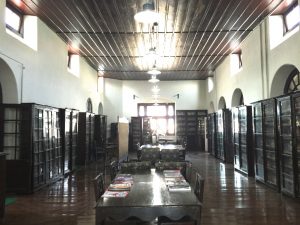
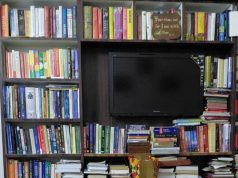
To us, this library is a lifeboat – a place to paddle your own canoe, detox, and clear the cobwebs from your mind. This is a window to the world; a celebration of knowledge; a shelter from the vagaries of life.
It was here, sixty years ago, that author Ruskin Bond, while working on a project run by the charity CARE International, discovered many a lost treasure. It was here that he found the material for Strange Men, Strange Places.
Sixty million years ago, an asteroid, approximately fourteen kilometres wide, slammed into the Earth with an unimaginable force, converting rock into liquid. The catastrophe triggered tsunamis, wildfires and sent up a cloud of ash and dust that enveloped the earth, blocking the sun and chilling the climate. It killed seventy-five per cent of life on the planet, including the dinosaurs.
Now, what does that have to do with our library?
A much bigger asteroid is heading our way. The signs are all there. Remembering what happened in the past prepares us for the future. The first to die was Life Magazine, which vanished without a murmur. Next followed the familiar yellow-bordered monthly magazine of geography exploration, National Geographic. Disney acquired the magazine in 2019, laid off its remaining writers and announced that henceforth there shall be no more newsstand purchases!
Be warned, dear Reader, new asteroids like Google and Artificial Intelligence are hurtling towards us. They can easily reduce us from a house of books to a book museum.
What has kept us going? We are the keepers of the Faith. We celebrate Knowledge here. Under my watch, I have revered Kitabghar, our House of Books, as the epitome of living tradition.
Many have gone before us. We, too, are temporary. We shall come, and we shall go. We shall, God willing, weather the changes wrought by the midsummer madness that engulfs our hill station.
Today, boys like Anil Rawat give us new hope for the future. Our doors remain open to all those like him who want a dip in these calming waters.
Ganesh Saili, born and home-grown in the hills, belongs to those select few whose words are illustrated by their pictures. Author of over two dozen books, some of which have been translated into twenty languages, his work has garnered recognition worldwide.