 By: Ganesh Saili
‘Can I come see you?’ Rahul Kohli asked. He had found some sketches of Mussoorie dating to 1829.
Remember, back then this hill station was in its infancy, barely five or six years old.
Thus far, I have collected maps, trade directories, postcards, photographs, prints, early guides, journals, newspapers and magazines. Almost anything on these hills. It has left me hungry for more.
Nothing so early had ever turned up.
Initially, they left me unimpressed. Just twenty-six squiggles, or line drawings on crumbling paper, these parallel lines converged at Fisher’s Terrace, or atop what is today Taylor’s Flat, facing the defunct lime-kilns of Khattapani.
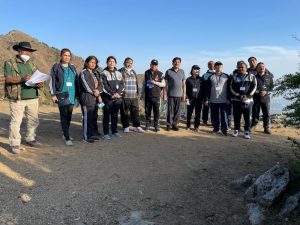
Then, very slowly, familiar names began to surface. At the base of Bhadraj was Dudhli village, giving company to the Park Estate. The view of the snow-covered peaks had shifted eastwards.
Almost two hundred years ago, an amateur surveyor had sat down, pencil in hand and made these rudimentary drawings on these pages, that had yellowed with time. Fortunately, these had been retrieved from an antique shop in England. Rahul had picked them up, sensing they had something to do with Mussoorie.
The two of us, trowels in hand, amateur historians trying to dig up whatever we could of what lay before us.
What gave the game away were the regular contours at every twenty feet: a stray stump here, a lost boulder there, a weather-beaten bush or a bent tree swaying in the wind. They were all par for the course.

The oldest map thus far was from 1831, drawn on stone and published by J.B. Tassin. It had been given to me by Hugh Rayner, an antiquarian living in Bath. Of the thirty-three names, only Hukeem Mendy is Indian.
When we placed the old map on top, superimposed it on the squiggles, it fit like a glove.
If you were to go in chronological order, the next map to enter the public domain was thirteen years later. After that came Northam’s Guide to Mansuri, Landour, Dehra Dun and the Hills North of Dehra. Then followed Murray’s Map of 1903.
We must remember that Colonel Lambton founded the Great Trigonometric Survey of India in 1818, with Colonel George Everest as his assistant. When Lambton passed away, Everest was appointed Surveyor-General of India. He was all of forty years old.
Everest came to the Park to bring to a culmination the Great Trigonometrical Arc. At that time, his illustrious neighbours included William Frazer, the Resident of Delhi, who owned Leopard Lodge, and Major Swetenham, Commandant of the Convalescent Depot in Landour, the owner of Cloud End that lay west of the Park.
Granted that the Earth’s tallest peak is named after him, but to me, the grandest monument in his honour remains The Arc of the Meridian, a mammoth survey which covers the land from Cape Comorin to the Himalaya.
The lure of the mountains brought Everest to the western edge of the hills in 1832, where he built his office and residence, having assured his masters that it was temporary ‘until the two northern sections of the Great Arc are brought to a satisfactory termination.’
Was there a biwi khana? I don’t think so.
Everest was a strict disciplinarian with no time for trifles. His hands were full with matters pertaining to the estate: the road was slippery for riding horses, and the lack of water was a constant source of irritation; it had to be carted up from a nearby spring on mules and ten years after he came here, he was still struggling with his approach road.
Almost two hundred years later, all that we have to showcase Everest’s efforts is a Disneyland where helicopters mindlessly clatter around.
Perhaps proper museum could be a more fitting tribute. We could show (even virtually!) the accoutrements of early surveyors’ trade: thirty-foot tripods, telescopes, theodolites, chain-links, compensation bars, spirit levels, perambulators, Pundit Nain Singh’s and Khintup’s prayer beads, prayer wheels and pendulums, plus all the other countless improvised tools.
This is where they deserve to be.
Maybe this windswept flat overlooking the Himalayan range would be the perfect place for a world-class heritage museum.
Ganesh Saili, born and home-grown in the hills, belongs to those select few whose words are illustrated by their pictures. Author of over two dozen books, some of which have been translated into twenty languages, his work has garnered recognition worldwide.