Garhwal Post Bureau
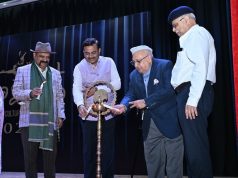
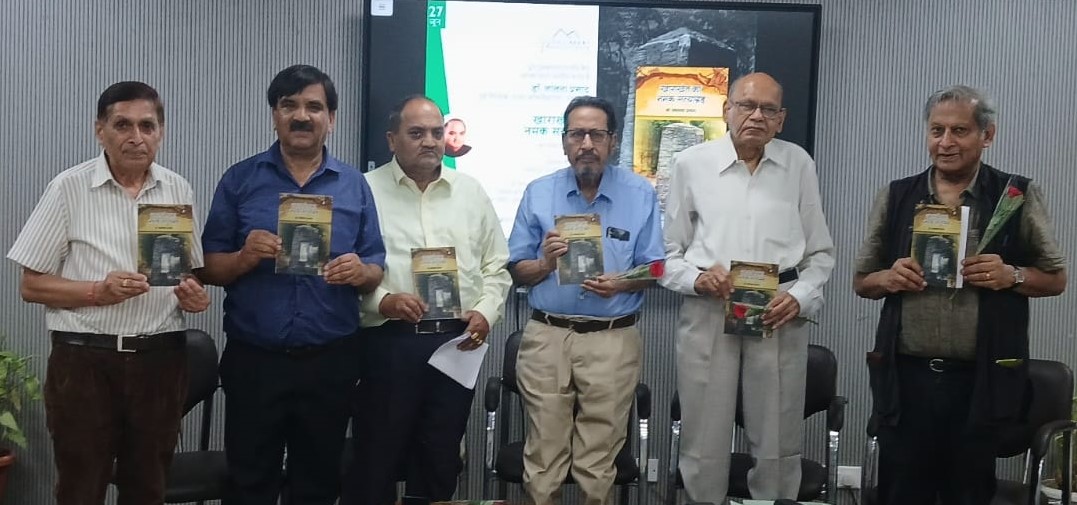
Dehradun, 27 Jun: This morning, on behalf of Doon Library and Research Centre (DLRC), Dr Lalta Prasad’s book, ‘Kharakhet Ka Namak Satyagraha’, was released in the auditorium of the centre. After that a group discussion was organised.
Today’s programme was chaired by Prof BK Joshi, Chairman of Doon Library and Research Centre. Supreme Court advocate and writer Anil Nauriya, senior historian Prof Sunil Kumar Saxena, social historian Dr. Yogesh Dhasmana and Dr Lalta Prasad participated in this discussion. The discussion was successfully conducted by social thinker Biju Negi.
Prof BK Joshi said that Uttarakhand has played a significant role in the national freedom struggle. Due to the active participation of local leaders in many sessions and meetings of the Indian National Congress during the freedom movement, the wave of the freedom struggle spread rapidly among the people of Uttarakhand. On 20 April 1930, freedom fighters gathered on the banks of the Noon River near Kharakhet, ahead of Bidhauli village in Dehradun, and made salt. This book by Dr Lalta Prasad has come as an authentic book based on the Salt Satyagraha of Kharakhet, which is an important thing.
During the discussion, it came to light that when Gandhiji reached Sabarmati through Dandi March on 12 March 1930 and broke the salt law and made salt, the freedom fighters of Uttarakhand were also not behind in that period. The freedom fighters reached here in several groups on the banks of the Noon River near Kharakhet on 20 April 1930 and made salt. A large number of Satyagrahis participated in Kharakhet under the leadership of Pandit Nardev Shastri, Mahavir Tyagi, Pandit Narayan Dutt Dangwal and some other leaders of Dehradun. In this way, the Salt Satyagraha of Kharakhet in Dehradun played an important role in the local context in the national freedom movement.
It also emerged in the discussion that the Salt Satyagraha, which took the form of a movement with Kharakhet as its centre, had equal participation from all sections of the society. Due to awareness among the rural and urban people of Dehradun about the Salt Movement, hundreds of Salt Satyagrahis went to jail. Their families faced immense hardships and made this Salt Satyagraha successful. The prominent people under whose leadership the Salt Satyagraha was carried out in Dehradun were Nardev Shastri, Ramswaroop Navkoti, Gautam Dev Vidyalankar, Guru Prasad Sharma, Lala Ram, Krishna Dutt, Shyam Lal Gupta, Mitra Sen Jain, Sharmda Tyagi and Somendra Mohan Mukherjee.
During the discussion, the speakers expressed deep concern and also said that it is really unfortunate that an important event like Kharakhet in Dehradun has not got proper place in the pages of history and as a heritage site. Till now no other published details are available on this important local historical event of Kharakhet. They also suggested to the local organisations and aware citizens to take proper initiative in this direction.
In the booklet ‘Kharakhet ka Namak Satyagraha’, Dr Lalta Prasad has shed light on the activities related to the national freedom struggle and has provided detailed information on the Salt Satyagraha of Noon River in Kharakhet. In the booklet, he has also provided a list of more than 140 Satyagrahis of Dehradun district who were arrested and sent to jail. This list includes their brief introduction, the crimes imposed on them, punishment, date of arrest, etc. Apart from this, the significance of the booklet has increased due to rare photographs of more than 12 Salt Satyagrahis and some photocopies of court decisions. The book has been jointly published by Doon Library and Research Centre and Samay Shaksya.
At the beginning of the programme, the Centre’s Program Associate Chandrashekhar Tewari welcomed the people present in the auditorium and the guest speakers and thanked them at the end. People also asked questions during the programme.
Dr Subhash Thaledi, Padma Shri awardee Kalyan Singh Rawat, Anoop Kumar, Devendra Kandpal, Raju Gusain, Dr Atul Sharma, Ravindra Jugran, Jagdish Babla, Shailendra Nautiyal, Jagdish Singh Maher, Kusum Nautiyal, Praveen Bhatt, Kusum Rawat, Trilochan Bhatt, Dinesh Joshi and Kamala Pant along with readers, writers and people interested in history were present at the programme.