All Around the World with the Most Travelled Indian
 By Nitin Gairola
As part of the fossil finding tour of ours in the deserts of Afar region, we had reached the famous Lucy fossil site (refer my last Sunday feature). But Lucy was not the only famous fossil there since the Afar region has the 4.4 million year old ‘Ardi’ found in 1994 and the ‘Dikika Child’, a 3.3 million year old Australopithecus hominid fossil of a 3 year old child (based on its size and maturity of its teeth). So the local Hadar chief, Abdullah and John & Dave (our tour guides) lead us to the Dikika Child site but warned that there had been some flash floods and it may be a bit of a challenge to reach there even in an SUV. We were in for it and decided to press on but upon reaching, we indeed found the newly created flash flood river in between us and the site.
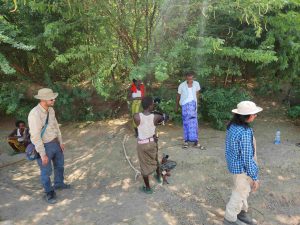
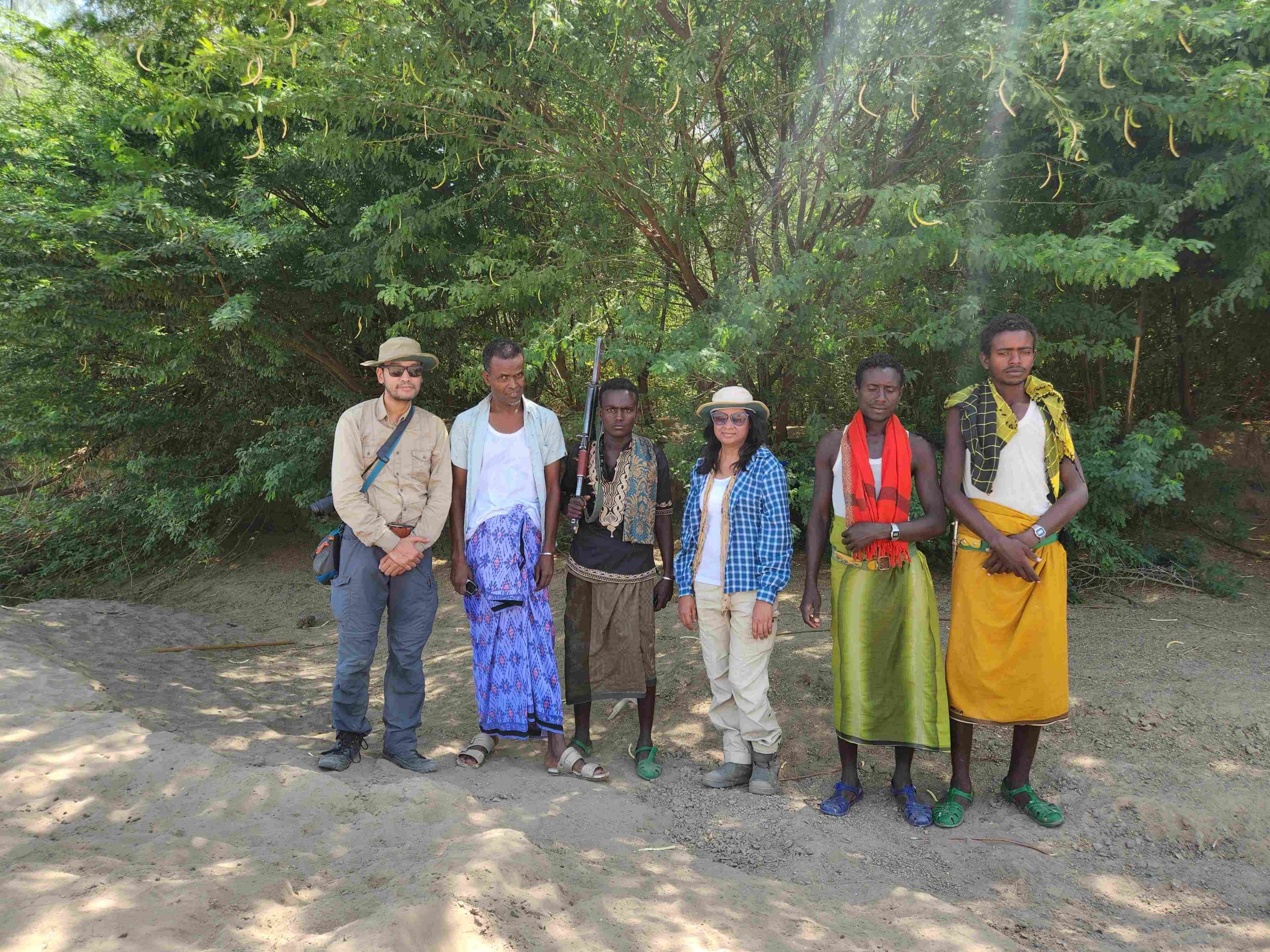
So we got off the Toyota Land Cruiser and started walking towards the river to take a closer look and it’s then that I suddenly saw a few Afar men who were holding Kalashnikov rifles (Russian gun popularly known as AK-47). I just somehow kept on walking casually whist watching these armed men from the corner of my eye. Dave, John and Richa did the same and we all then stood quietly at the river bank. I was breathing a bit heavy realizing that we were in the middle of nowhere, deep in a desert and in the land of these armed Afar people. And if by chance any one of them didn’t like our face, we would be at their mercy. Language was a barrier too, but thankfully we had Abdullah with us and perhaps that’s why these desert men even allowed us to walk towards the river.
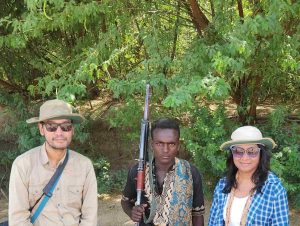
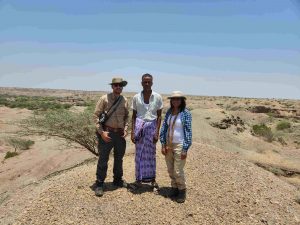
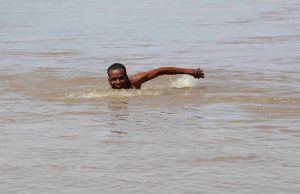
Abdullah decided to take a swim in the fast flowing flash flood waters. For the Afar desert people, water is gold and they cherish any chance they get to take a dip in it. This seemed like a rare event and Abdullah was clearly thrilled. Once he was done with the swim and I could gather my thoughts and courage, I decided to ask if we could have our photographs taken with the Kalashnikov toting men, knowing quite well that I needed permission for it. You see the Afar people, and also the nearby Somali, don’t like their photographs taken since they feel we are taking away a part of their soul when we take a photograph. And who are we to explain otherwise. So I wanted to play safe and go through Abdullah. Even to put my request to Abdullah I had to go via John (who knew English & Amharic both) and then in turn Abdullah spoke with the tribesmen in their tongue which wasn’t Amharic. But finally this was not a case of lost in translation and they seemed to nod in agreement.
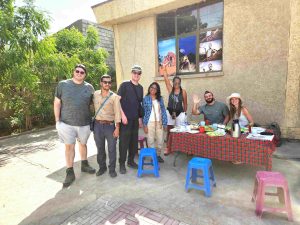
We were still quite scared as I really wanted to get back in the car fast since in the past decade or so some tourists and paleoanthropologists had been killed by the tribes, but these incidents were few and far between. Somehow we register and remember only the high impact negative news and forget that despite many here carrying guns on their shoulders, attacks against foreigners in Afar are a rarity. The last 2 such incidents that happened were in 2012 and 2017 when some tourists were killed and few abducted. Even so, while the Erta Ale volcano site of Afar is safe now, I don’t fully recommend going into the less frequented desert areas and definitely not without a good quality tour operator, since safety should be the top priority. I suppose it’s a case of the ‘you only live once’ mindset vs. ‘you only have one life’. This also applies to those who think they are cool cats since there are no nine lives, I’m afraid.
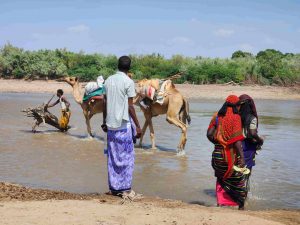
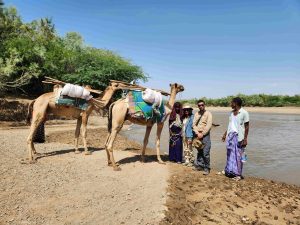
So we got our snaps taken quickly, before any of the chat chewing gunmen snapped. We just wanted to be out of there in a hurry but still had to act nonchalant about it and not show any fear. But as luck would have it, we saw some more nomads approaching with camels. They were preparing to cross the river with their camels and Richa couldn’t resist taking photographs with them either. Otherwise a shy and private person, I don’t know what gets into her during these trips since I was just keen to head out of that godforsaken place. It took a while to make them understand why we wanted photographs as they didn’t seem comfortable initially. In any case, we did get the images that we wanted after which they proceeded to cross the water that led to the Dikika site which we never saw.
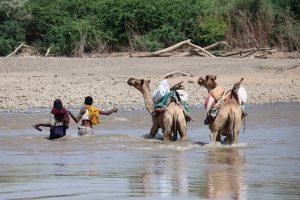
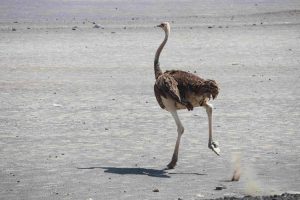
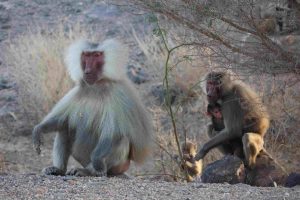
This was another reminder that such tours don’t always go as per plan. You really can’t tell the guide that ‘you didn’t show me that place which was part of the itinerary’. Just like the one to the fossil sites of Melka Kunture, Gombore and Tiya earlier, this tour also didn’t go according to plan but here the trade-off worked in our favour, at least in hindsight. Had the flash flood not happened, we wouldn’t have stopped and met this Afar tribe and for me it was quite special. In fact it was so scary that I won’t forget it for the rest of my life. Just to add that nowhere in any of our tours in Ethiopia was it mentioned that we would see wildlife, but we saw so much of it – from huge human like Hamadryas baboons to antelopes and exotic birds like ostriches, secretary and others. It was a treat for sure and we ended the day with some meat and shiro (vegetarian chickpea option) which we devoured with their ever popular injera bread.
Richa and I were quite tired and rested once back in Semera, as the next day we were to begin our foray into the white salt flats and the magma spewing volcanoes of north Ethiopia and Eretria. While we were to be on a private tour, we would be accompanied by 2 other SUVs carrying adventure tourists and guides too. This convoy would be a safeguard in case a breakdown were to happen in the hottest place on Earth. Yes, the Danakil Depression has the highest average annual temperate anywhere on Earth and it sits 125 meters before sea level (hence called a ‘depression’). And we decided to go in the May heat. It just certified that we are a couple of mad hatters.
Richa and I also met some amazing fellow mad hatters in Semera who were going towards the volcanic desert too – such as David from Germany, Lukas from Switzerland besides a Russian couple (with whom we had a language barrier) and also a lady from the West Indies. If that was not all, our SUV convoy the next day would include 3 Polish friends and an Ethiopian couple as well. All we needed was a Jack from Australia, a Jose from South America and a Penguin from Antarctica and then we would have covered all 7 continents. It was proper United Nations in the desert and I guess this is the best part of world travel. People from around the world come together in one place and all they want is to experience something special in peace. So here’s to peace on Earth which seems fragile at the moment due to some narrow mindedness which I believe goes away when one sees the wider world. As I always say, we need more world travel, not world wars.
Nitin Gairola is from Dehradun and has travelled the natural world more than almost any Indian ever. He has set world travel records certified by India Book of Records, has written for Lonely Planet, and holds National Geographic conservation certifications. He is also a senior corporate executive in an MNC and in his early days, used to be a published poet as well. More than anything else, he loves his Himalayan home.