By Arun Pratap Singh
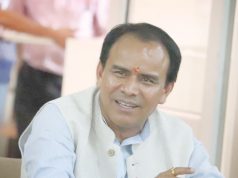
Dehradun, 1 Jul: In Uttarakhand, no Chief Minister, except ND Tiwari, has completed a full five-year term. In recent weeks, there had once again been some speculation in the state regarding a possible change in leadership. However, with the re-election of BJP MP Mahendra Bhatt as the BJP State President, such speculation is expected to be put to rest, at least for now. Bhatt was Chief Minister Pushkar Singh Dhami’s own choice, and his re-election to the post, an unprecedented occurrence, reflects the Centre’s continued trust in Dhami’s leadership as Chief Minister. Today, Bhatt formally took charge at the party headquarters in Dehradun, marking his second term in the post.
The reappointment of Bhatt is widely being viewed as a strategic move by the BJP’s central leadership to maintain the party’s delicate socio-political balance in Uttarakhand, a state long defined by its intricate equations of regionalism and caste. These factors, while often invisible to the public eye, continue to exert a substantial influence within the corridors of power.
Bhatt, a Brahmin hailing from the Garhwal region, complements Chief Minister Pushkar Singh Dhami, a Thakur from Kumaon, fitting neatly into the BJP’s time-tested formula of balancing caste and regional representation. Traditionally, the BJP ensures that if the CM is from Kumaon, the party chief hails from Garhwal, and vice versa. Likewise, if the CM belongs to one caste group, the party head is chosen from another prominent caste.
The decision to retain Bhatt signals that the BJP high command is, for now, content with the state government’s functioning and organisational management. According to political analysts, Bhatt’s reappointment reflects an endorsement of the existing leadership, suggesting that any imminent leadership shake-up is unlikely in the near future.
It may be recalled that political murmurs regarding a possible change in Chief Ministership had been fuelled by the long delay in cabinet expansion and the consolidation of key portfolios under Dhami. However, Bhatt’s re-election sends a message that the central leadership is not inclined to alter the status quo at least at this juncture.
The BJP has, in the past, replaced Chief Ministers in the run-up to elections to stave off anti-incumbency sentiment, as also seen in states like Gujarat, Haryana and Karnataka. Yet, with the 2027 Assembly elections still two years away, the leadership appears focused on stability rather than experimentation.
While Dhami’s hold over the administration remains firm, unresolved issues such as the vacant ministerial berths continue to generate speculation. Some party leaders have quietly expressed concern over the delay in cabinet expansion, which they feel may be creating discontent among the cadre. However, the central leadership’s silence on the matter further underlines its preference for continuity over disruption, at least for the time being.
Insiders suggest that if the BJP were to consider a leadership change before 2027, the party would likely look for a Thakur leader from Kumaon to maintain its caste-regional arithmetic. However, most of the names previously doing the rounds for the Chief Minister’s post were Brahmin leaders, a scenario that has now shifted with Bhatt’s reappointment.
At the same time, senior party leaders welcomed Bhatt’s elevation. Rajya Sabha MP Anil Baluni has praised the BJP’s internal electoral process, calling it unparalleled in Indian politics. Chief Minister Pushkar Dhami, too, extended his full support, recalling Bhatt’s role in strengthening the organisation during his previous tenure. Dhami stated that since Mahendra Bhatt became the state party president, the party has registered victory in every election. He has played a pivotal role in uniting workers and leaders across all levels.
Bhatt, known for his accessible demeanour and disciplined organisational approach, enjoys support from both the central leadership and state cadre. His reappointment not only ensures internal coherence but also projects the image of a united front as the BJP prepares for the 2027 battle.
Bhatt’s second innings as Uttarakhand BJP President is a calibrated move to retain equilibrium in a politically sensitive state. With the leadership puzzle temporarily solved and caste-regional formulas aligned, the BJP appears to be charting a course of stability, at least for now. Whether this strategy will carry the party through 2027 remains to be seen, but for the moment, Pushkar Dhami’s chair appears secure.