 By: Ganesh Saili
“Where do you live?’
‘In Khachchar khana!’ That would be the answer.
So perverse was the imprint of the Remount Depot in our hill station that by 1960, the residents had had enough, and now demanded a change.
‘What could be more infra-dig?’ they moaned.
Gopal Dutt Dimri, the fiery labour leader, (schooled with my father at Mesmore Inter College in Pauri-Garhwali) too had it to the gills of living in a place called ‘a place of mules.’
After winning an election to the Mussoorie Municipality, he moved a resolution that it be renamed Laxmanpuri, and that is what it is known as today.
It was not always so. Next to the Remount Depot was the old Garhwali Dharamshala, where my grandfather spent his first night (that was to become the stuff of family lore). Having arrived late in the evening at the hill station, he had had to sleep on a rough-hewn bench.
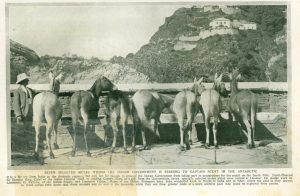
In those days, you would have found the teacher Suresha Nand Dimri, or ‘Pundit ji’, as he was affectionately called by the students at the Language School; or Khyat Singh Rawat, who worked in the electricity office but moonlighted with goats, the stink followed him wherever he went; Pitamber Dutt Thapliyal, who climbed the hill every morning – he too taught Hindi at the Language School – taking a break with a quick nap on the narrow parapet wall lining the road leading to the school. Briefly, the area was crammed from one corner to the other with folks who had come out of Garhwal for the first time.
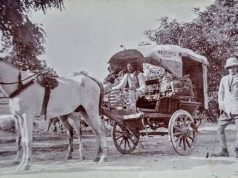
Mules too were first-timers, known for their sobriety, patience, endurance, sure-footedness, and courage. They were bred here and had stellar qualities that made them ideal pack animals. No wonder that even in these modern times some four thousand mules continue to assist the army.
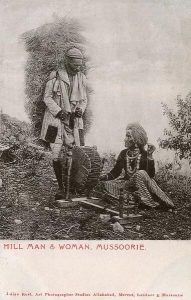
In the nineteenth century, tasked by Lt. General Sir Douglas Haig of the Indian Supply and Transport Corps who wished to send a gift for Falcon Scott’s forthcoming expedition to Antarctica, Lieutenant G. Pulleya trained seven mules at the Landour Remount Depot to draw sledges by pulling wooden sleepers up a slippery slope, hoping they would do so in Antarctica.
Much later, in the spring of 1960, a freak summer storm saw a bolt of lightning hit the slope outside Lachi’s Workshop, and three large mules of the Forest department, chained together, were struck dead. These large animals were bred from mares of Austria’s Noric breed and Australian male donkeys that produced mules fit for carrying bigger loads.
Of course, the gunths brought from Tibet by Bhotia traders were smarter. Fanny Parks wrote: ‘The little fellow had never had a woman on its back before, but it carried me bravely up the sheer path, for roads there was none.’ To her, Moti, an iron-grey, was more like a horse than a pony, with an exceedingly thick, shaggy mane and a very thick, long tail. It was a most sure-footed animal; it never tired and was never alarmed while going past the most dangerous places.
Of course, mules were a whole other story: one fellow slipped over a precipice, getting stuck in the fork of an oak tree! A wriggle would have meant plunging to a certain death. But it froze to the spot until his minders dug a ledge large enough to stand on.
‘We shall leave it be till next morning,’ they said to each other. ‘Let it recover from its fright.’
At daybreak, it was their turn to be amazed. Having hauled itself out, the mule was chomping grass alongside the road. No wonder we say: ‘As stupid and as stubborn as a mule.’ Had it been a horse, it would have struggled and perished. But the mule knew that it was wiser to be quiet and wait for help.
On my last visit, I teased a shard of metal loose from the ground. It was an old horseshoe that I slipped into my pocket. For good luck, I nailed it over our front door. It is the only survivor from that day my grandfather slept on a bunch of wooden slats called a bench.
Ganesh Saili, born and home-grown in the hills, belongs to those select few whose words are illustrated by their pictures. Author of two dozen books; some translated into twenty languages, his work has found recognition worldwide.