 By Savitri Narayanan
“Papa, have you been to Tibet?” asked Kunal as he poured more dal into his dinner plate.
Kunal wasn’t really fussy about food. He was a final year student of the nearby high school. While his friends often found reasons to eat in the school canteen, Kunal was happy with his lunch box of roti and subzi. For dinner too he had dal and rice daily with absolutely no fuss.
“Why Tibet?” asked his mother as she passed the bowl of yoghurt to her husband. “Coming to think of it, we haven’t heard Tibet mentioned for a long time!”
“That’s true,” said Mr Malhotra turning to Kunal with interest, “Betey, what makes you talk about Tibet today?”
Kunal was pleased with the attention from both his parents. He put down his spoon, leaned back in the chair and said, “This morning there was a talk in our school auditorium by a Tibetan.”
“And what did he talk about?” asked his mother.
Dinner time was when the three of them got to relax and exchange notes.
“That’s my question too,” said Mr Malhotra, a keen interest evident in his voice. As a marketing executive of a textile firm, he often travelled to international destinations, but Tibet never came up on the list! Coming to think of it, the last time he heard of Tibet must have been as a student in the school’s classrooms!
Kunal straightened up and continued. There was no excitement in his voice as he said, “Well, he talked about people from the monasteries and homes running away to escape from the invaders. He also talked about sad things like living in refugee camps, working as construction labourers, government in exile, etc. Must have been hard on them!”
“Oh! Yes, now I remember,” said his mother thoughtfully. “We learnt in school about how along with the monks from the monasteries and other villagers, the Dalai Lama walked down the Himalayas to safety here in India.”
“Yes, they still have a government in exile in Dharamsala,” said his father. “Never thought of it all these years.”
“Must be so hard for them being refugees, imagine living and growing up in somebody else’ house….”
The thoughts lingered in the mind. As Dorje got into bed it felt as if he was trekking down the slopes of the Himalayas….
###
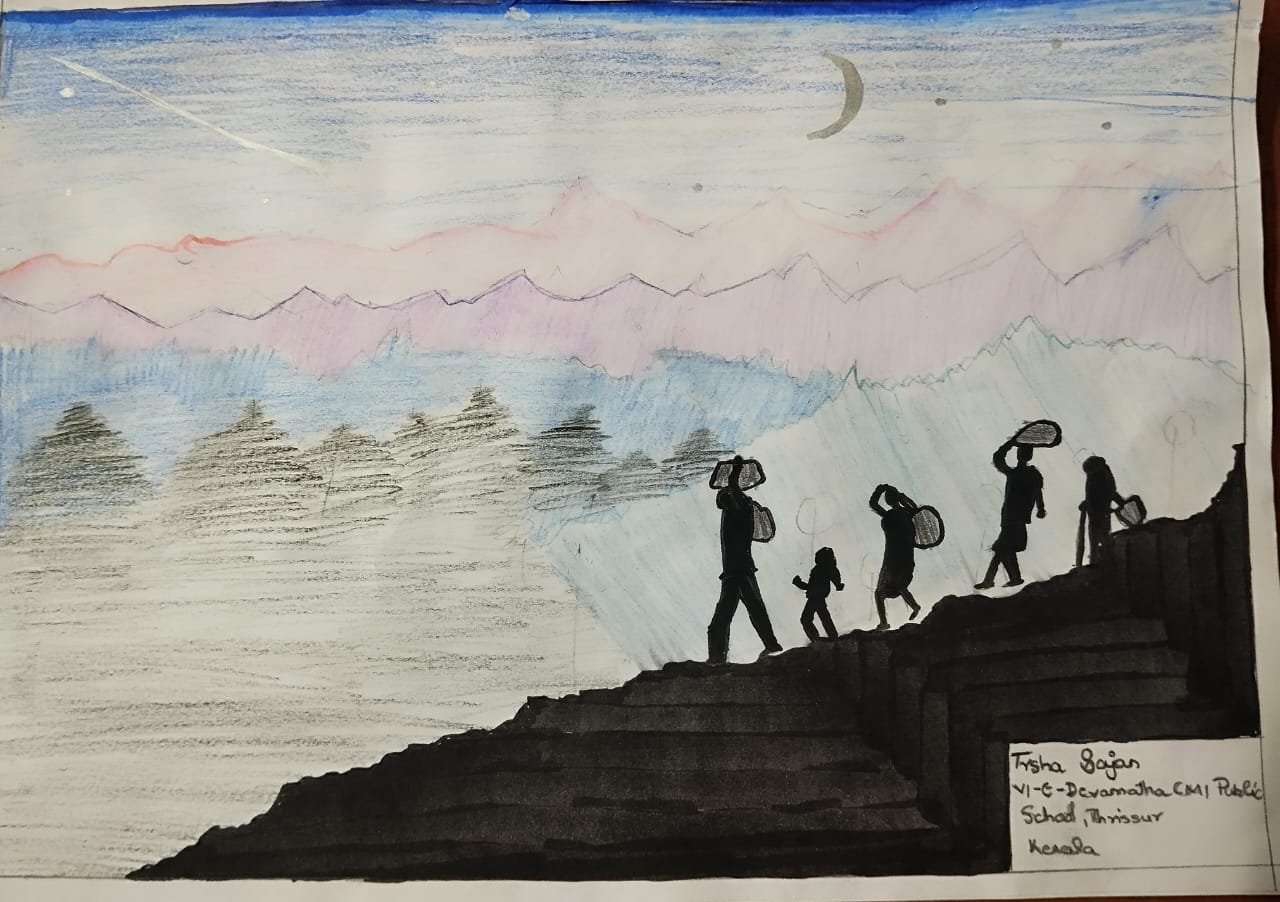
Dorje walked in between his grandfather and father, holding on to their hands. There were many of them walking down the mountain. When the news of the invasion spread, when the enemies approached, the villagers escaped to safety. It was painful to leave behind their possessions and family members but what to do! Those who could not walk were left behind!
‘May be the enemies won’t reach our village!’
‘Let them loot but not hurt the people!’
‘We’ll be back one day to take them along!’
‘May be this is a nightmare from which we could wake up!’
Nobody talked to each other, but they seemed to read each other’s thoughts. Dorje felt his arms being tugged harder, so walked faster.
###
All those who escaped the invasion and fled Tibet had got shelter in India. Refugee camps were set up where they settled down. Opportunities were created to enable them to earn their livelihood. Some did farming, many worked as construction labourers, some went to the factories in the nearby towns, the women made handicrafts, taught singing and dancing to keep their traditions alive. The young pursued their studies in mainstream schools and colleges.
Dorje had got used to life at the refugee camp in Chandigarh. After the morning meal, the children sat down to learn Tibetan. Their teacher Dolma ani always started the session with the words, ‘We’re refugees here, one day we’ll go back to live in our own country!’
‘Where’s our country?’
‘There, up in the Himalayas!’
‘Why don’t we go there now?’
‘We’ve to free our country from the invaders!’
Dorje didn’t really understand. He’d never been outside the refugee camp. In the mornings, Apha left to work on the road construction, Ama went to the handicraft centre and Dorje went to Dolma laoshi who taught Tibetan to the children.
Soon it was time to start education. The primary school in Nehru Colony was just a kilometre away. Dorje joined the group of older children who walked down there daily. A new world opened up in his mind. Slowly it registered that they didn’t belong, were expected to go back when Tibet became free. In the refugee camp they spoke only in Tibetan but, in the school, he mastered Hindi and English which broadened his world and understanding.
The more he knew, the more he admired and respected this country, India. ‘Many kinds of people, dressed differently to suit their weather, cultivated and ate climatically suitable foodgrains, fruits and vegetables, spoke different languages yet a strong thread of unity runs through,’ he often thought.
###
Dorje was studious and ambitious. Having done well in the board exams, he had won a scholarship for higher studies. So, he shifted base and joined the University of Delhi. He stayed in the refugee camp in north Delhi. The Metro was a convenient mode of transport. After college he had boarded the metro to Kashmere gate. The Metro was rather quiet and deserted so Dorje took out his book and started reading.
He was engrossed in reading when he heard the words, ‘chink chink meau meau!’
They had passed Tilak Nagar. Most of the metro’s seats were occupied. A few college students were standing.
The source of the slang!
Dorje got agitated, not at the teasing but at the students’ insensitivity.
He closed his book, looked straight at the offender and asked aloud, “Nee enthokkeyaa parayunnathu?”
The student looked the other way. His friends too ignored Dorje’s question and whispered at each other.
“Enthaa mindaatthe?” Dorje continued.
Many eyes turned their way. The public got interested in this unusual interaction.
“That’s a language of this country which I learnt from my classmate! I know you’re teasing me because of my ‘flat nose and tiny eyes’. I’m a Tibetan refugee. Decades ago, when China invaded my country many of us along with our Dalai Lama escaped for our life and your country gave us refuge. We’re in awe of and grateful to your country, which is so inclusive and respects all traditions including mine. Wish you too would practise the motto, ‘Unity in diversity’ and strengthen the thread that runs through. The day will surely come when we get freedom, and we’ll go back to our country. This is what we’ll carry back with us- unity in diversity!”
There was respectful silence followed by applause.
The metro chugged on.
“Kunal, wake up, you need to go to school.” It was mummy at the door, “Were you dreaming about, ‘unity in diversity’, etc.?”
The applause died down and the metro chugged away as Kunal got out of bed.
(Savitri Narayanan is a retired educationist at present in Goa. A mother and grandmother, loves reading, writing and travelling.)