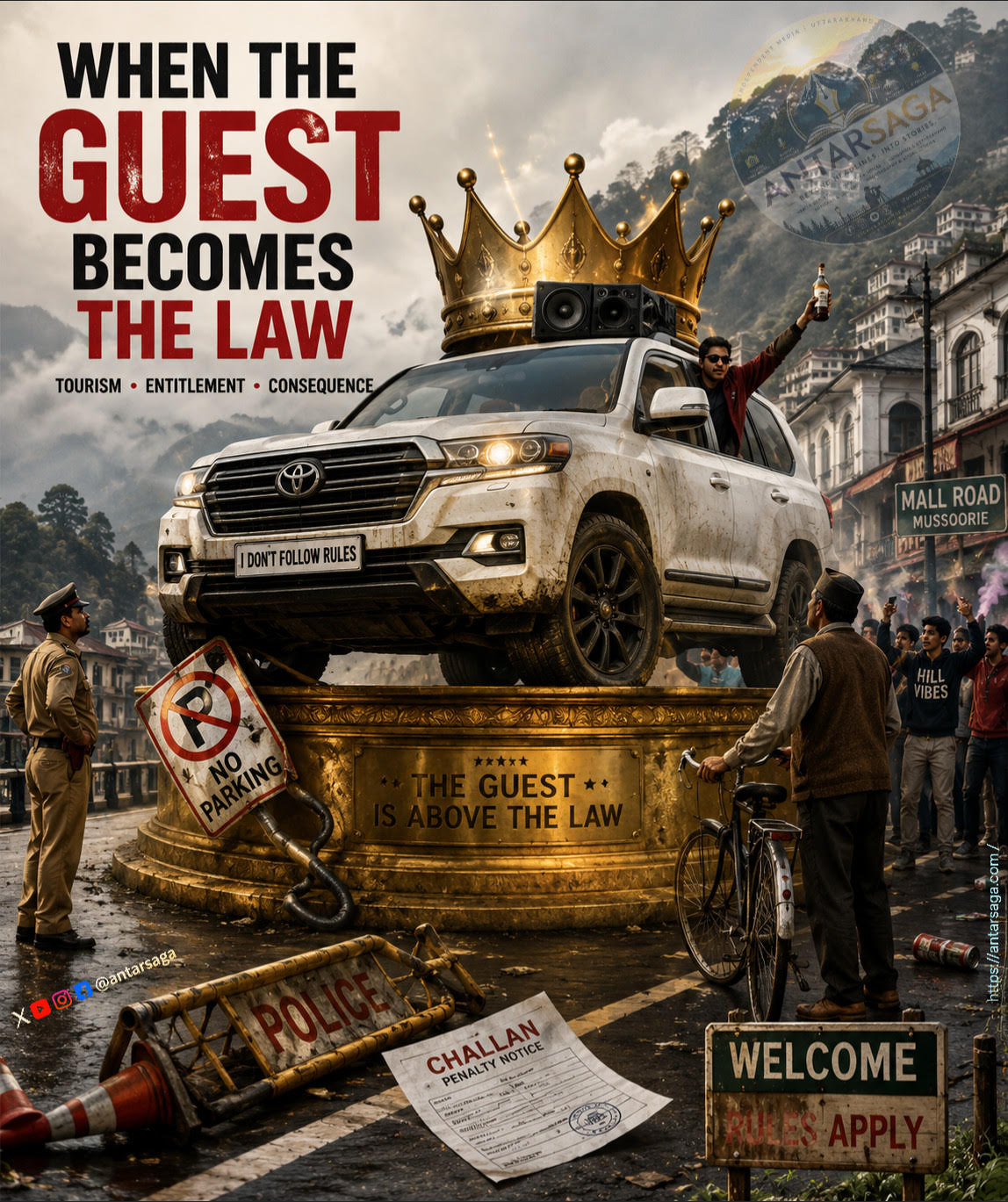
Mussoorie does not need to become hostile to tourists. It needs to stop being intimidated by them.
 By Rajat Aikant Sharma
There is something unsettling about the new videos emerging from Mussoorie.
A car parked wherever its driver pleases. Music spilling out of oversized speakers into the night. Young people drinking in public as though a hill road were an extension of their private living room. A small disagreement becoming a fight. A police officer arriving, only to find that the person being questioned appears more offended by the questioning than by the possibility of having broken the law.
And then, inevitably, someone takes out a phone. Within hours, the hill town has another viral video.
But perhaps we are looking at these videos incorrectly.
The real story is not merely that some tourists are rude, drunk, noisy or reckless. The deeper story is about what happens when a person begins to believe that his social position, money, confidence, connections, or simply the knowledge that he is a paying customer, place him beyond consequence.
That is a much more uncomfortable story.
In recent months, Mussoorie has seen a series of tourist-local confrontations. In June, a dispute near Mall Road reportedly escalated into an assault on a local couple, with a tourist subsequently arrested and the vehicle challaned. In July, two separate clashes involving tourists and locals in Hussain Ganj and Picture Palace led to police action against seven people. There was another confrontation in May when a Delhi tourist reportedly refused to comply with the restricted-hour vehicle entry rules at the Mall Road barrier and left his vehicle there for hours, causing a major disruption.
These are not isolated stories anymore. They are becoming a pattern.
Why does the hill sometimes appear to make people forget the word “no”?
A person who would not park in front of a police barricade in his own city sometimes leaves his vehicle wherever he finds a little space in the hills. A person who would not ordinarily play music at full volume outside his own home suddenly believes that a public road at midnight is an acceptable dance floor.
Is it because the mountains are beautiful? Or because they appear powerless?
People do not always test rules because they hate rules. They test rules when they suspect that the rules will not be enforced.
A signboard saying No Parking is only a sentence. A challan is a consequence. And consequence is what turns a sentence into a rule.
This is why the problem of illegal parking in Mussoorie is larger than traffic. The Uttarakhand High Court has itself taken cognisance of the problem of unauthorised roadside parking and the resulting congestion in the town. Garhwal Post has repeatedly reported how haphazard parking has contributed to severe traffic jams during the tourist season.
When one vehicle is allowed to park illegally, the next driver learns something. When ten are allowed, the eleventh believes he is entitled to do the same. Eventually, the exception becomes the culture. The rule still exists on paper. It has simply disappeared from the street.
And then comes “Rutbaa”
There is a word in our vocabulary that captures something modern India increasingly understands instinctively: Rutbaa.
It is not merely wealth or political influence. Rutbaa is the invisible confidence that one’s position will somehow protect one from ordinary consequences.
It says: Do you know who I am?
Sometimes it is spoken aloud. More often, it is communicated through behaviour. The expensive vehicle. The loud voice. The refusal to move. The assumption that the local shopkeeper, driver, waiter or resident should adjust.
A visitor may arrive believing that he has paid for a room, a meal, a holiday, and therefore has purchased a certain amount of freedom. But tourism is not the purchase of sovereignty. A hotel room is not a temporary kingdom.
A tourist may buy a room. He cannot buy the road. He may spend money in Mussoorie. He cannot purchase exemption from Mussoorie’s laws.
And a local resident, equally, cannot claim ownership of the law merely because he was born here. Because the answer to tourist arrogance cannot be local aggression. The moment locals decide to enforce the law with fists, they too have abandoned the law. The law has to be the third person in every argument.
Hospitality is not Servility
There is perhaps no phrase more frequently invoked in Indian tourism than Atithi Devo Bhava. The guest is divine. Beautiful. But somewhere along the way, we seem to have misunderstood the sentence.
Atithi Devo Bhava never meant Atithi Is Above the Law. Hospitality means opening the door. It does not mean removing the door from its hinges.
Mussoorie welcomes millions of visitors because tourism sustains livelihoods and connects this small mountain town to the rest of India. The shopkeeper needs the tourist. The hotel needs the tourist. But the relationship cannot become one in which economic dependence demands social submission.
A local saying, “Please don’t park here,” is not an inferior person challenging a superior one. A police constable issuing a challan is not insulting someone’s status. Sometimes “no” is simply governance.
But the administration must also answer
There is no point lecturing visitors about discipline if enforcement remains inconsistent. If a vehicle can block a road for hours before action is taken, the lesson reaches thousands of people watching from behind their phones. If a person creates a public disturbance and walks away without meaningful consequence, the next person learns that the risk is manageable.
Interestingly, Mussoorie Police has demonstrated that firm intervention is possible. In May, “Operation Prahar” involved action against a driver allegedly driving under the influence while using a hooter and projecting VIP status. Police have also acted after viral videos of public disorder, including a case involving a person creating a disturbance on Mall Road.
The answer, therefore, is not hostility. It is consistency.
The law should not become stricter because a person is poor, nor softer because he arrives in a large SUV. It should not matter whether the number plate reads UK, DL, HR, UP, PB or anything else. The law should recognise neither status nor accent. Only conduct.
Perhaps the hills are asking us a very old question
Civilisation is not tested when everything is convenient. It is tested when we are told: No. No, you cannot park here. No, you cannot drink here. No, you cannot turn a public road into your private playground.
And perhaps the measure of a person’s character is not how loudly he can challenge that “no”, but how gracefully he can accept it.
The mountains have survived empires, roads, hotels and generations of visitors. What they cannot survive indefinitely is the idea that whoever arrives with more money, more confidence or more “rutbaa” gets to decide the rules.
Mussoorie does not need to become hostile to tourists. It needs to remain hospitable without becoming submissive. Welcome the guest. Guide the guest. But when the guest crosses the line, let the line remain visible.
Because a town loses something far more precious than traffic discipline when its laws become negotiable. It loses its authority. And once authority disappears from the street, the loudest person in the room, rather than the law, begins to decide what is permissible.
That is not tourism. That is surrender. And the hills should not have to surrender simply because someone came here on holiday.
(Rajat Aikant Sharma is a writer and photojournalist exploring culture, history, and human stories. Beyond print, he creates digital content, posters, and social campaigns that extend his editorial voice into the world of influencer engagement and brand storytelling.)