 By Ganesh Saili
‘It was the Road which caused the trouble. It usually is the road. That and a reigning prince who his uncle accused of having secretly sold his country to the British.’ A.E.W. Mason’s The Broken Road (1907) is a tale of three generations of one family trying to forge a road in the restive North West Frontier region.
To get to Bellevue, they cut across the spur of a balding fifty acres. The first rock-cut Tassin map of Mussoorie dates to 1831. It shows that a certain Lieutenant Fisher, and was called Bellevue up until 1844. Subsequently, it was acquired by the Government for an Afhgan Emir, Mohammad Yaqub Khan and his entourage, who had signed the Treaty of Gandamak, outside Jalalabad, ceding Afghan territory to British control, famously saying: ‘I would rather work as your servant, cut grass and tend your garden than be the ruler of Afghanistan.’
In 1852-53, another Afghan Emir, Dost Mohammed, his grandsire, had preferred to be exiled in Bala Hisar because of the abundance of game. His return to Kabul saw him rule for another twenty-three years.
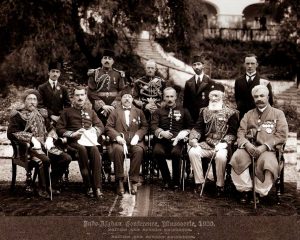
Pottering around the ruins, I think of how he must have chafed at the bit, for only being allowed supervised visits to the station’s hot spots. Keeping a watchful eye on him were troopers from the Northumberland Fusiliers (or the 5th Foot) led by J. C. Fisher, a British Political Officer.
Fisher noticed that his charge had the habit of suddenly spurring his pony into a gallop, without any warning to his companions. These seemingly random bursts of speed became more frequent, but the officer dismissed them as a whim. Then came the day the import of what was happening was brought to bear on him, as he stopped at the fork in the road near the old Library to chitchat with a friend. Imagine his abject horror as he saw the Emir hightail it and gallop down the road to Kingcraig, and perhaps on to freedom. Fisher chased after him, took precarious shortcuts and blocked the escapee. Afterwards, he sent a detailed report of the incident to the Governor-General.
Pic courtesy: Author’s collection
‘Don’t hurt one hair on his head,’ came the laconic orders, which had to be followed.
Though the tsunami of history follows no orders. It whispers: ‘See-you-later-alligator!’
This time the Alliance Bank put Bellevue on the auctioneer’s block, where it was picked up by the Chamaria family of Calcutta, to be renamed as Radha Bhawan. This is evident in the map of 1968.
My late friend, Munna Kabari, remembered the old patriarch of Radha Bhawan, and he often reminisced about the days spent. He was particularly rattled by today’s Johnny-come-latelys in their large SUVs. Unable to conceal his contempt, he would snap: ‘Cheapskates! Pimps whoring themselves! No asli raees, these! The last wealthy man was Chamaria Seth! Believe you me, to seat his guests at the nautches, I delivered a forty-seer mattress along with satin cushions and bolsters.’ He missed those days of wine and roses, when, wafted by the breeze, the cloying scent of incense and attar of roses enveloped the bazaar a mile away.
‘Saili Saab! Show-offs flaunt just their money. Real wealth is for those who have time! Chamaria Seth had the gift of leisure.’
But who can beat the Sandman? At the end of the 1960s, the blue-on-white Cantonese tiles shipped from China began to chip. Vandals were at work. For a brief while, Radha Bhawan hummed to the looms of Tibetan carpet weavers, who later moved to Rajpur.
Walking on this mist-wrapped spur, I wonder about the Emir, his sirdars and risaldars. Did they dream of their mountain home in the sun-singed Hindu Kush? Would they have heard the muffled sounds of a caravan of wizened traders moving along: some astride camels; some on horseback; some on foot; some with swords; some with spears or rusty flintlocks.
Wintering in Dehradun, he lived in a smaller house on East Canal Road. It looked like a smaller replica of Bala Hisar. His long lockdown had lasted forty-three years. Freedom came in the dying months of 1923, when he passed away.
Ganesh Saili, born and home-grown in the hills, belongs to those select few whose words are illustrated by their pictures. Author of two dozen books, some translated into twenty languages, his work has garnered worldwide attention.