 By SHEESHPAL GUSAIN
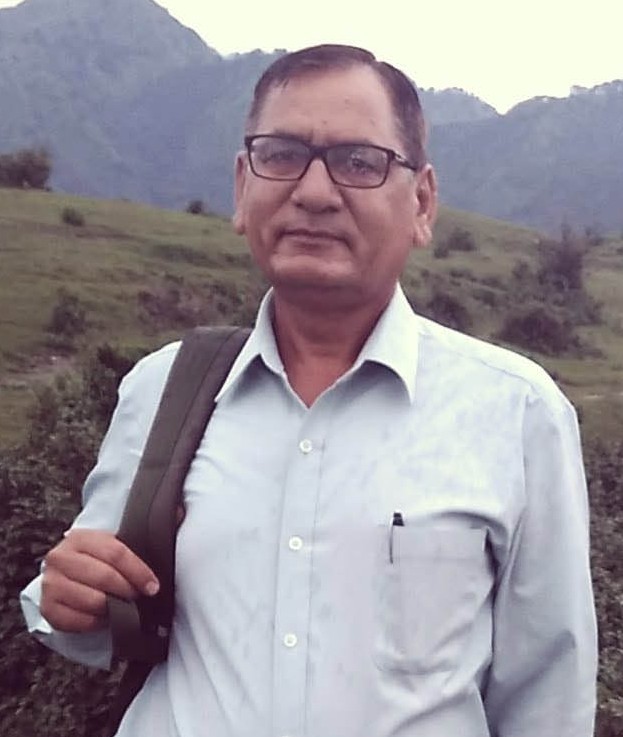
Some personalities are remembered not for the honours they receive but for the legacy they leave behind. Padma Shri awardee Dr Kalyan Singh Rawat ‘Maiti’ belongs to that rare category. A teacher from the hills of Uttarakhand, Maiti has shown that environmental conservation is not only about planting trees but about restoring the emotional bond between human beings and nature.
Dr Rawat has spent his life proving that genuine determination can bring about social transformation without political power, money or publicity. Through his ideas and efforts, he has encouraged communities to see nature not as a resource to be exploited but as part of daily life.
What makes Dr Rawat’s philosophy stand out is the way he speaks about conservation in human terms. For him, forests are not just trees but a repository of collective memory. Rivers are not merely streams but the heartbeat of civilisation, while soil is the inheritance of generations. This blend of understanding and sensitivity is visible in every initiative he has taken.
One message he repeats often is, “Planting a tree is not the greatest achievement; ensuring that it survives is.” At a time when plantation drives are announced on a large scale, his thought raises a simple but important question: what is the use of planting saplings if people do not care for them afterwards? This thinking gave rise to the Maiti Movement in 1995. More than an environmental campaign, it turned a family tradition into a conservation practice. Under the movement, when a daughter leaves her parental home after marriage, she plants a sapling before departure. That sapling becomes a living symbol of her childhood, memories and bond with her maternal home. Her family nurtures it with affection, and years later she finds a part of her past still growing there.
Few environmental movements have given nature such deep emotional meaning. Perhaps that is why the Maiti Movement has not only planted trees but ensured their survival. Today, nearly five lakh trees planted under the initiative continue to provide shade, flowers and fruits in different regions. They are not just trees; they are living memories of countless families.
Dr Rawat’s career as a teacher has been equally inspiring. He never treated the school as only a place to impart lessons. While serving at the Inter College in Rajgarhi, Uttarkashi, he noticed attempts to encroach upon school land. Instead of waiting for administrative action, he set up a nursery of 40,000 saplings on the disputed land. The place that people wanted to occupy slowly turned into a green space, and even those who had opposed the effort eventually joined the plantation drive. This was not only an environmental act but also a lesson in leadership. Dr Rawat turned conflict into participation and showed how a committed teacher could change the mindset of an entire community.
His respect for history is visible in Rajgarhi as well. Instead of letting the remains of the palace built by Tehri State’s first Maharaja, Sudarshan Shah, fade away, he developed the site by building platforms, planting trees and organising cultural programmes. It was a rare effort to preserve history through nature and to show that heritage survives not only through monuments but also through the culture that grows around them. The green forests of Dakhyat village in the Rawain Valley stand as proof of his foresight. Their existence is not the result of one-time plantation drives but of years of patience, community support and commitment. Dr Rawat has said that his years in Rajgarhi shaped his environmental thinking and led to the Maiti Movement.
One of the most moving episodes he recalls is linked to Tiladi Martyrs’ Day. Instead of restricting remembrance to speeches, he connected it with tree plantation. Seven young girls carried sacred water vessels to consecrate newly planted saplings while the community took part collectively. The ceremony had the feel of a spiritual ritual and reflected the harmony between nature, culture and Indian tradition. Dr Rawat often says that after such a programme he realised that nature itself is divine. That thought lies at the core of his environmental philosophy. Protecting nature, in his view, is itself an act of reverence.
He also took a unique step in the Tehri Dam submergence area. While most attention was on the submerged town and buildings, Dr Rawat tried to preserve memories in another way. Soil was collected from 35 historically important places in old Tehri and used to plant trees at Badshahithaul. This was not just afforestation; it was an effort to revive history through living symbols. His concern extends beyond trees to wildlife conservation as well. During his tenure in Rajgarhi, he mobilised schoolchildren and villagers against hunting. He taught them that forests are not only for human beings but for every living creature that depends on them.
Dr Rawat’s life also reminds us that major social change does not always require authority or large resources. For most of his life, he worked simply as a schoolteacher. Without government power, funding or institutional support, he initiated programmes that are now considered models of environmental conservation at national and international levels. His simplicity makes his achievements even more striking. Even after receiving the Padma Shri, he continues to travel by ordinary public buses like any other citizen. There is no display of pride, no desire to make his recognition a matter of show. At a time when public life is often marked by self-promotion, his humility stands out. True greatness, after all, is often reflected in simplicity.
Towards the end of his lectures, Dr Rawat often speaks of his concern for Dehradun and Uttarakhand. His warning is not just as an environmentalist but as someone deeply concerned for future generations. He says that as cities expand, populations rise, roads grow crowded and trees disappear, oxygen, water and green cover may become the biggest challenges ahead. He has also cautioned about the spread of chir pine and the decline of broad-leaved forests across the Himalaya. In his view, the rain-fed rivers of the region are the lifeline of Uttarakhand, and the destruction of forests will eventually lead to the weakening of these rivers. His warning appears to be relevant not only to Uttarakhand but to the country as a whole.
Dr Rawat’s life shows that environmental conservation succeeds not through laws alone but through values and tradition. Trees survive when they become part of people’s memories. Forests endure when communities see them as part of their identity. Nature remains safe when people see themselves not as its masters but as its custodians. Born on 19 October 1953 in Bainoli village near Karnaprayag in Chamoli district, Dr Kalyan Singh Rawat inherited his love for forests from his family. His grandfather’s association with the Forest Department nurtured his affection for nature, while his father’s role as Block Pramukh of Karnaprayag inspired him towards public service. These early influences shaped a mission that later became the Maiti Movement.
Dr Kalyan Singh Rawat has been much more than an environmentalist or a teacher. He is a guardian of nature who has devoted his life to trees, society and future generations. The nearly five lakh trees nurtured through his initiatives will continue to provide oxygen and greenery, while also reminding future generations that one determined teacher can change the course of history.
(Translated by Arun Pratap Singh)