By: Ganesh Saili
‘When a bird’s nest falls, you get upset,’ a young boy said at the Landour Cantonment Board Office, adding, ‘What’s there to celebrate when someone else’s home is pulled down?’
That, more than anything else, sums up the general feeling in Landour over the past years. Granted, the courts have ruled against resident Sanjay Narang, upholding the local authorities’ decision to demolish Dahlia Bank.
Rewind to twelve years ago, and change was in the air. Walking past those ugly concrete hawa-ghars (rain-and-sun shelters), stained by years of neglect, I was pleasantly surprised to see all six of them newly clad in local slate to bring them in sync with the ethos of a magical hill station. Further up, it seemed as if someone had waved a magic wand to clean up the hillsides. No longer was garbage strewn around. Instead, there were solid steel monkey-proof dustbins, prudently embedded into concrete, with catchy slogans pasted on them. Sampling? They advised you to: ‘Go to Nature to be soothed and healed and to have your senses put in order.’ / ‘It feels good to be lost in the right direction.’/ ‘The quieter you become, the more you can hear.’ / ‘Never be afraid to sit a while and think.’

Pic courtesy: P.Roy
I took a friend, who’d suffered a nasty fall, to the hundred-year-old Landour Community Hospital – a place that continues to provide much-needed medical aid to the hill station. I was pleasantly surprised that it had been revamped – with no drumbeats, no fanfare, no plaques nor strings attached. Sanjay had fixed the seemingly unfixable.
And yet in the pit of my stomach, I knew this was too good to last. Something had to give. Landour felt like the cleanest destination in the north, as community efforts began to fructify.
Meanwhile, at Char Dukan, the crumbling St. Paul’s Church (1835) was restored to its old glory. But the grumps complained: “Why should a non-believer be fixing a church?” even as carpenters (brought in from Lucknow) hammered in perfectly matched British-era pews. Presently, it is now top of the list of must-see places in Landour.

Lending whole-hearted support to an NGO to keep Landour’s Environment & Ecology Natural (KLEEN), household garbage collection begins from door to door and from garbage bins placed along the roadside. This segregated garbage has now become a source of income for local unskilled youths. It is Landour’s version of the ‘Swatch Bharat Abhiyan.’
Being an entrepreneur, he set about restoring a clutch of old dilapidated buildings, which created employment for some three hundred odd local boys from the abutting villages. Here was a model of truly ‘Made in India.’
So, where did all this derail?
It had set the wheels of change and progress in motion. Was it success that churned the boundless oceans of jealousy and envy? Unfortunately, some still believe that to be wealthy is a crime, even though one might have made one’s fortune the hard way and without a fiddle. Here was a businessman who, along with his gifted sister Rachna, built Asia’s largest in-flight catering business along with other restaurants and hotels. He sold it and broke away to settle down in this Himalayan ridge. To an ex-alumnus of Woodstock, it was a homecoming of sorts.
He had to put up a board pointing the wrong way outside his home. It simply said: ‘Sachin Tendulkar’s home is 2136 kms away! That way!’
The loaded dice rolls, and no matter which way it lands, my heart weeps for Landour. Future historians will have their task cut out. Our history, if you can call it that, shall be divided into just two periods: Before SN and After SN.
At day’s end, there is no victory or defeat, and when the hurly-burly’s done, human beings tend to bounce back. We fall, we get up, and walk again. Victory is temporal; it is no slave to logic. This much I know: whatever he puts his hands to, Sanjay will be reaching for the stars once again.
In this tussle, Landour is the lonely loser. Instagrammers and influencers gather outside Bakehouse and Rokeby Manor, willing them to thrive.
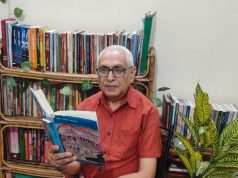
Ganesh Saili, born and home-grown in the hills, belongs to those select few whose words are illustrated by their own pictures. Author of two dozen books, some translated into twenty languages, his work has found him renown worldwide.