Garhwal Post Bureau
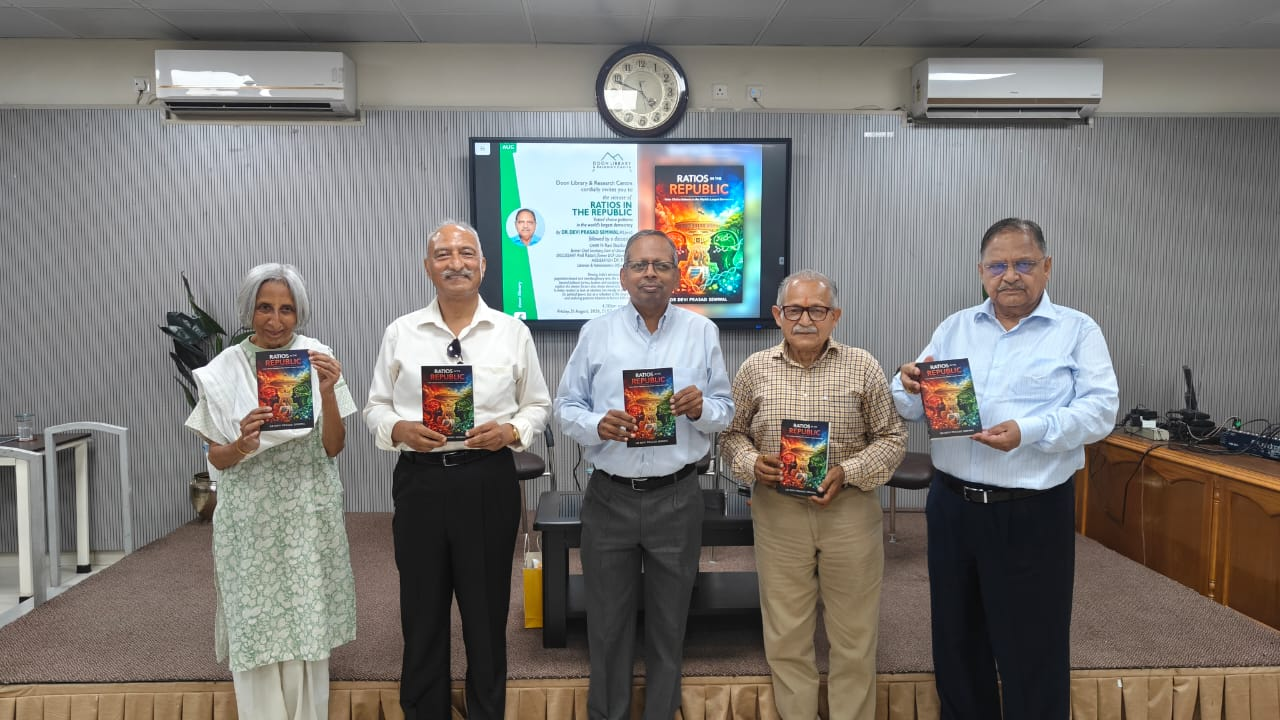
Dehradun, 21 Aug: The book, ‘Ratios in the Republic: Voter Choice Patterns in the World’s Largest Democracy’, authored by Dr Devi Prasad Semwal, a retired officer of the Indian Revenue Service, was launched on Friday at the auditorium of the Doon Library and Research Centre. The discussion following the book launch focused on India’s electoral democracy, voter behaviour, social conditions and emerging electoral patterns over seven decades.
The programme was chaired by N Ravi Shanker, Honorary Director, Doon Library and Research Centre and former Chief Secretary, Government of Uttarakhand. Anil Raturi, former Director General of Police, Uttarakhand, shared his important observations on the book.
The book is based on all 18 Lok Sabha elections held in India from 1951–52 to 2024 and attempts to understand the patterns visible in voter decisions and electoral outcomes. The author has not limited his analysis to political parties, leaders, election campaigns or immediate political events. Instead, he raises the question of whether the collective decisions of millions of voters reveal deeper and recurring patterns of human behaviour that can be understood at a broader level.
During the discussion, Dr Semwal explained that the central idea of the book is not that an individual’s electoral decision is determined solely by genes or inherited predispositions. Rather, the book seeks to understand the interaction between genes and environment. Family, education, culture, economic conditions, social surroundings, political events, leadership and changing circumstances all influence human behaviour. Consequently, similar predispositions may express themselves differently in different social and political environments.
The audience raised several questions concerning the subject and methodology of the book. During the question-and-answer session, participants showed particular interest in whether long-term tendencies in voter behaviour could be identified from electoral outcomes, how political circumstances and the social environment influence voter decisions, and whether the study of past electoral data could help in understanding future democratic behaviour. The author clarified that the book does not claim to predict the outcome of any particular election with certainty. Rather, it attempts to understand broader patterns of human behaviour on the basis of electoral experience and social contexts.
In his Chairmanship remarks, N Ravi Shanker highlighted the importance of voter choice in a democracy. He observed that in a vast and diverse country like India, elections are not merely a process for determining political power; they also reflect the thinking, aspirations and changing priorities of society.
Anil Raturi connected the subject of the book with contemporary social and administrative contexts and observed that political events alone are not sufficient to understand a democratic system. Social behaviour, leadership, circumstances and the role of public sentiment also need to be understood.
The discussion also brought out the point that the study of elections should not remain confined to political analysis. A better understanding of the relationship between voter behaviour and social conditions can also contribute to public policy, administration and broader human welfare.
Intellectuals, writers, journalists, officials and young readers present at the programme appreciated the initiative of the Doon Library and Research Centre, observing that such book-centred dialogues enrich public intellectual life and establish the library not only as a centre of learning but also as an active space for discussion and exchange of ideas.
The programme was conducted by DK Pandey, Librarian and Administrative Officer, Doon Library and Research Centre.
On the occasion, Programme Officer of the Doon Library Chandrashekhar Tewari, Dr Lalta Prasad, Sunder Bisht, along with officials from the administration and various departments, academicians, intellectuals, journalists, litterateurs, writers, researchers and a large number of young readers were present.