 By: Ganesh Saili
Abhiram Sankar IAS, a student and avid bird-watcher, is on the phone. He sounds horrified. Did they really hang people from the ceiling upside-down to extract momaii from the cranium? Is that what happened in the ruins? Or so the locals claim.
‘Tell me it’s not true, sir!”
Well! I happily tell him that it couldn’t be farther from the truth.
For on the edge of Bansi Estate, or Lyndale’s six-acre spread, are the remains of a brewery. Mussoorie was three years old when the Master Brewer Henry Bohle, in 1830, on finding Meerut too hot to brew beer, headed to these hills. Others like him, elsewhere, all over India, others took to the cooler climes of hill stations like Murree, Solan, Darjeeling and Nainital to make beer.
Lynndale’s spring waters suited him perfectly. But trouble lurked around the corner in the shape of Colonel Young, Superintendent of the Dun, who accused Bohle of selling alcohol to privates from Landour’s Convalescent Depot by carrying forged passes. He was called to account for distilling spirits without a licence. The venture floundered, and his estates were put to the hammer. Four years later, the Scotsman, John Mackinnon, founded the Masuri Seminary – the first English medium school in the Himalaya. But midstream, he switched careers in 1850, turned brewer and married Bohle’s sister. What story on our breweries can be complete without repeating the well-worn tale that has everyone smacking their lips over a much better brew?
Its source was traced to Vat 42 – ‘everyone re-drank, re-tasted and re-tested, till the diminishing level of beer revealed a worker who had, while removing the scum, slipped and fallen unnoticed into the vat and drowned. His supreme sacrifice did not go in vain. It gave our local beer a real fillip.
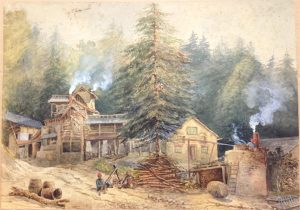
Pic courtesy: Rahul Kohli
Downtown Barlowganj in 1867 saw Messrs Murch & Dyer start the Crown Brewery, which folded after two years. Relaunched in 1876, under the watchful eyes of J.H. Whymper, who lent his name to what later became the swimming pool in Brookland Estate, where generations of schoolboys learnt to swim and take part in inter-school swimming competitions.
Come to think of it, by 1864, thirty-six long years before the first train came across the Siwaliks and into the Doon – our three breweries: Mackinnon, Bohle and Crown – were distilling beer. The price was reasonable: eight annas per dozen for bottles, which was allowed when bottles were sent or returned.
‘I have the honour to inform you that the Beer supplied by you to the depot under my command has invariably been of most excellent quality, and that the Non-Commissioned Officers and men prefer it to any other which has at any time been issued to them.’ Reads a testimonial from the Commandant of the Landor Depot, adding: ‘I therefore hope that you will have no difficulty in obtaining authority to continue the supply.’
In the early days of Landour Cantonment, there are reports of the troopers being lonely, depressed and drunk. Where were they finding the alcohol? The officers wondered until it was discovered that white lightning from the nearby villages had found its way to the billets. There are reports of Mr Blunt, the army chaplain, an abominable drunk, exposing himself to both soldiers and sailors, ‘talking all sorts of bawdy and ribaldry, and singing scraps of the most blackguard and indecent songs, to render himself a common laughing stock.’ He careened down the corridors of the Sergeant’s Mess at the top of Landour Depot, singing: ‘Beer! Beer! Glorious Beer! Fill me right up to here!’
By the time John Mackinnon passed away in 1870, his sons, Philip and Arthur, expanded the business, and the Old Brewery gave our beer a reputation which fuelled the demand.
At the time of the Kangra Earthquake of 1905, the two breweries employed 131 men and produced nearly half a million gallons of beer and five years down the line, it was over. Our three breweries were outpaced by new technology that enabled brewing on the plains.
Mussoorie’s dalliance with brewing anything stronger than tea had reached the end of the line.
Ganesh Saili, born and home-grown in the hills, belongs to those select few whose words are illustrated by their pictures. Author of over two dozen books, some of which have been translated into twenty languages, his work has garnered recognition worldwide.