NABARD launches State Focus Paper 2026–27 at Uttarakhand State Credit Seminar
Garhwal Post Bureau
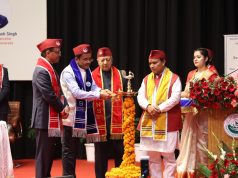
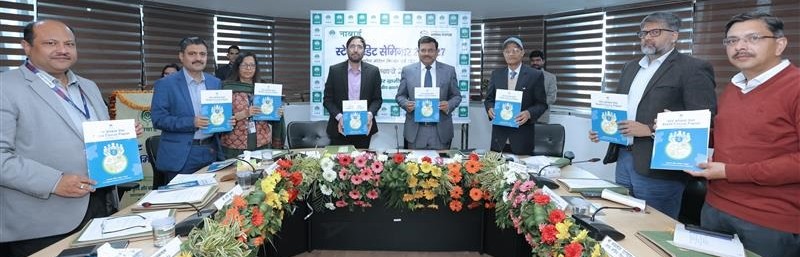
Dehradun, 24 Feb: The Uttarakhand Regional Office of the National Bank for Agriculture and Rural Development (NABARD) today organised the State Credit Seminar 2026–27 in Dehradun. During the event, the State Focus Paper (SFP) 2026–27 was formally released, projecting a priority sector credit potential of Rs 65,916 crore for the financial year 2026–27—reflecting a 20.51% increase over the previous year.
The Chief Guest was Anand Bardhan, Chief Secretary, Uttarakhand. The seminar witnessed the participation of Dr SN Pandey (Secretary – Agriculture), Dr Ahmed Iqbal (Secretary – Cooperation), Navneet Pandey (Additional Secretary – Finance), the General Manager, Reserve Bank of India, senior officials from SLBC, Punjab National Bank, State Bank of India, and other commercial banks, Uttarakhand State Cooperative Bank, District Central Cooperative Bank, Uttarakhand Gramin Bank, various government departments, members of FPOs, SHGs, etc.
A notable highlight was the presence of Bhagirathi Devi, popularly known as ‘Van Amma’, whose grassroots efforts in forest conservation and women’s empowerment were appreciated by all dignitaries.
The Chief Secretary lauded NABARD’s efforts of coming out with State Focus Paper every year. He complimented NABARD on various developmental projects implemented by it apart from infrastructure assistance. He highlighted that the State Government has been consistently implementing a wide range of initiatives to address livelihood challenges, migration from hill regions, gaps in infrastructure, and persistent water-related issues.
He observed that despite sustained interventions, the State’s Credit–Deposit (CD) ratio continues to remain significantly low, which limits economic growth and reduces the overall impact of development programmes.
He further pointed out that although Uttarakhand has secured 29 Geographical Indication (GI) products, this achievement has not yet translated into meaningful economic benefits for the producers and local communities associated with these traditional products.
Emphasising the way forward, he stated that proactive and deeper participation of banks in the State Government’s flagship programmes and schemes is essential to ensure sustainable livelihood opportunities and to enable developmental benefits to effectively reach the grassroots.
Pankaj Yadav, Chief General Manager, noted that NABARD is increasingly recognised as a robust ecosystem developer driving rural prosperity, fostering innovation, financial inclusion, and sustainable development across diverse sectors.
Referring to the International Year of the Woman Farmer 2026, he underlined the need to reaffirm collective commitment toward strengthening livelihoods and empowering the agricultural community.
He informed the gathering that a pilot project in Champawat is being initiated in collaboration with Van Panchayats, aimed at developing a model of community-linked natural resource management and livelihood enhancement. A focused project is being launched in Uttarkashi to reduce the drudgery of women farmers by introducing appropriate farm implements, thus ensuring dignity, operational efficiency, and improved productivity.
He also highlighted that faster onboarding on the Agri Stack is expected to play a pivotal role in enabling seamless ground-level credit flow through integration of farmer data, improved targeting, and enhanced transparency—significantly strengthening financial inclusion.
The enhancement of the Agriculture Infrastructure Fund (AIF) from Rs 1 lakh crore to Rs 2 lakh crore provides an important opportunity for Uttarakhand to accelerate investments in critical agricultural infrastructure and value-addition facilities.
The effective implementation of e-KCC is crucial for modernising the loan delivery system and ensuring timely and hassle-free credit access for farmers.
Collectively, these initiatives reflect a strong commitment toward building a resilient, technology-driven, and farmer-centric agricultural ecosystem in Uttarakhand.
Bhagirathi Devi of Manar village, district Champawat, fondly known across the region as “Van Amma”, during the seminar narrated her story of remarkable example of women-led forest conservation. She mentioned that how protecting their forest had been a mission of love and responsibility for her. With the collective efforts of villagers, “Van-Amma” was able to revive 12 hectares of barren land and restore the natural springs that had long been drying up. She shared her experience that revival of forest not only brought back forests but has also ensured reliable water availability for farming and household needs across many villages.
During the Seminar, women beneficiaries of FPOs, Tribal Development Projects, SHGs supported by NABARD also shared their journey.