Garhwal Post Bureau
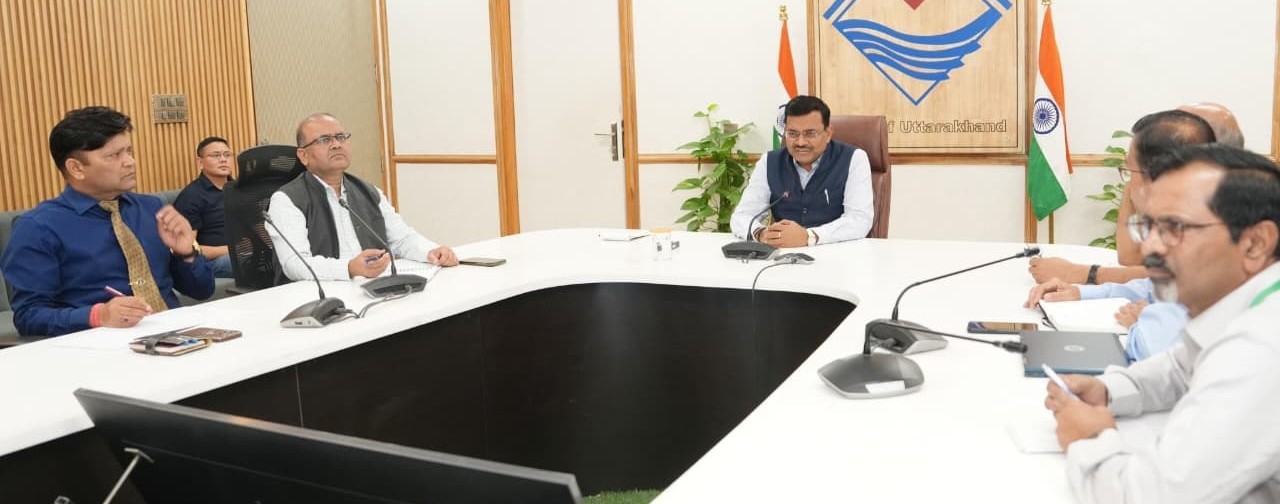
Dehradun, 4 May: Chief Secretary Anand Bardhan held a detailed review of the progress of the earthquake early warning system, the National Earthquake Risk Mitigation Programme, the National Glacial Lake Outburst Flood Risk Mitigation Programme and landslide reduction measures at the Secretariat here today. During the review meeting, he also examined the status of ongoing projects and issued necessary directions to departments and institutions concerned.
Under the glacial lake outburst risk mitigation programme, the Uttarakhand State Disaster Management Authority and Wadia Institute of Himalayan Geology presented the current progress and future plans.
Disaster Management and Rehabilitation Secretary Vinod Kumar Suman shared that Wadia Institute is developing Vasundhara Lake as a pilot site where state-of-the-art early warning systems and monitoring mechanisms will be installed. This model will later be replicated at other sensitive glacial lakes to strengthen scientific and technological risk management in the state.
Bardhan urged Wadia Institute to present a detailed timeline for proposed activities during 2026–27 and 2027–28, specifying the schedule of each task. He asked the institute to also provide a comprehensive plan of mitigation measures including installation of early warning systems, real-time monitoring, decision support systems and structural interventions such as controlled water discharge and reduction of lake levels.
In a separate meeting, the earthquake early warning system was also reviewed today. Secretary Vinod Kumar Suman informed that 169 sensors and 112 sirens have already been installed, with continuous efforts underway in collaboration with IIT Roorkee to strengthen the system. A significant MoU was signed with IIT Roorkee on 26 February 2026 under which alerts, operations and maintenance of the EEWS system are being carried out from 1 January to 31 December 2026. Under the National Earthquake Risk Mitigation Programme, 500 strong motion sensors are being deployed in seismic zones of the state to reinforce the warning system. Additionally, installation of 526 sirens, including 500 indigenous EEWS sirens and 26 multi-hazard early warning sirens, has been proposed to enhance dissemination of alerts.
Suman further informed that the National Centre for Seismology operates 167 seismological observatories across the country, of which eight are in Uttarakhand. To strengthen seismic monitoring, new permanent observatories are proposed at Roorkee, Devprayag, Karnaprayag, Ramnagar, Bageshwar, Almora, Kedarnath and Chakrata. The Chief Secretary instructed that the earthquake early warning system be made more effective, precise and swift, ensuring timely and widespread dissemination of alerts to the public. He emphasised expansion and regular maintenance of the sensor and siren network.
In another related meeting, progress on debris flow risk assessment was reviewed. It was reported that 48 sensitive sites have been identified in Chamoli, Uttarkashi and Pithoragarh districts, mainly along drainage channels, and categorised into high, medium and low risk levels for prioritised action. A joint committee has been formed involving the Uttarakhand Landslide Mitigation and Management Centre, Central Building Research Institute, Geological Survey of India, Indian Institute of Remote Sensing and Uttarakhand Space Application Centre. The Chief Secretary directed that surveys, monitoring and preventive measures be undertaken at identified sites on priority, with better coordination ensured between district administrations and technical institutions.
Among those present in these meetings were Wadia Institute of Himalayan Geology Director VK Gehlot, scientists K Luirei, Naresh Kumar and Manish Mehta, USAC scientist Asha Thapliyal, ULMMC Director Shantanu, CBRI scientist DP Kanungo and JCEO Obaidullah Ansari. At the same time. IIT Roorkee professor Kamal, GSI Director Ravi Negi and scientist Ajay Chaurasia joined the discussions on virtual basis.