Garhwal Post Bureau
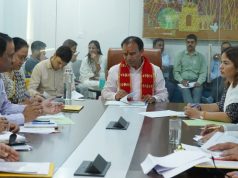
DEHRADUN, 13 Jun: The two-day national training programme focused on pre-monsoon preparedness, organised jointly by the National Institute of Disaster Management (NIDM), Ministry of Home Affairs, Government of India, and the Uttarakhand State Disaster Management Authority (USDMA), concluded successfully on Friday.
Addressing the valedictory session, Vice-Chairman of the Advisory Committee, Disaster Management Department Vinay Ruhela expressed hope that the workshop would provide significant support in reducing the risks associated with monsoon-induced disasters in Uttarakhand. He said the programme has enabled the state and the district-level officers to gain knowledge of modern techniques, improved coordination mechanisms and effective response systems for dealing with landslides, flash floods, cloudbursts, urban flooding and other monsoon-related disasters.
Professor Navneet Kumar of NIDM said that the nature of disasters was becoming increasingly complex due to the impacts of climate change and that the likelihood of events such as Glacial Lake Outburst Floods could increase in the coming years. He stressed that scientific approaches, the use of modern technologies and stronger institutional preparedness would be essential to effectively address such challenges. Appreciating the initiatives undertaken by Uttarakhand in the field of carbon trading, he said these efforts represented an important step towards environmental conservation and sustainable development and would yield positive outcomes in the future.
During the second day of the training programme, participants were briefed on various aspects of psycho-social support for disaster-affected individuals, relief management and community-based disaster management. A series of table-top exercises based on different disaster scenarios was also conducted, during which participants undertook practical exercises involving departmental response mechanisms, resource management, coordination and decision-making processes in simulated disaster situations.
Vinod Kumar Suman, Secretary, Disaster Management and Rehabilitation, observed that the experts had held detailed discussions on several important issues relating to the management of monsoon-induced risks during the programme. Technical sessions placed special emphasis on landslide risk assessment and mitigation, the disaster management cycle, climate change-related challenges and the application of emerging technologies in disaster management. He said modern tools such as the drones, GIS, remote sensing, mobile applications and digital platforms are now playing a crucial role in making disaster management more effective, prompt and accurate. Detailed discussions were also held on early warning systems, strategies for ensuring the timely dissemination of information to the last person in vulnerable areas, and the roles and responsibilities of various officers under the Incident Response System.
Prakash Chandra, Additional Chief Executive Officer (Administration), said that the two-day training programme has proved to be highly informative and beneficial for the participants. Through the programme, a comprehensive understanding was developed on key subjects including pre-monsoon preparedness, risk assessment, early warning systems, health sector preparedness, community participation, inter-departmental coordination, damage and needs assessment, and effective disaster response. He expressed confidence that the knowledge, experiences and recommendations gained during the training would make a significant contribution towards strengthening, streamlining and enhancing preparedness for monsoon-induced disasters in the State.
Among those present at the programme were Rajeev Baluni, DIG Home Guards; Durga Bahadur Sonar, DIG SSB; Anand Singh, Second-in-Command, CRPF; Dr Harishankar, Scientist, IIRS; Dr Bimlesh Joshi from the Health Department; SK Rana; Mohammad Obaidullah Ansari, Joint Chief Executive Officer; Rohit Kumar, Assistant Professor at NIDM; along with senior officers and experts from various departments.
A special session was also organised on the effective management of relief camps and the distribution of relief material. Participants were provided detailed information regarding the management of accommodation, food, drinking water, sanitation, healthcare facilities and the needs of vulnerable groups in relief camps. They were also briefed extensively on the composition of relief kits distributed to disaster-affected families, the essential items included in such kits and the procedures for their distribution.