CD Ratio of lead banks in Doon below norm
Garhwal Post Bureau
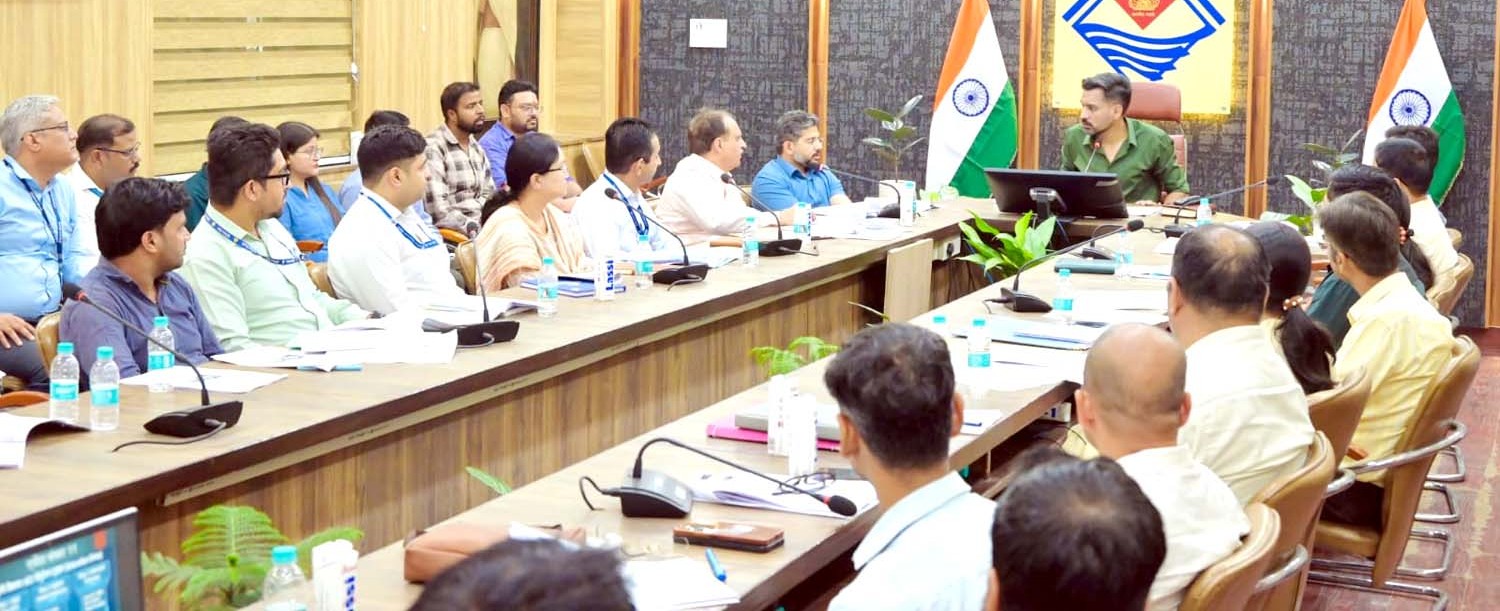
Dehradun, 25 Jun: District Magistrate (DM) Dr Ashish Chauhan today adopted a tough stance against the functioning of banks and non-banking financial companies (NBFCs), directing the financial institutions to play a more meaningful role in the district’s development rather than merely mobilising deposits. Chairing the quarterly review meeting of the District Level Review Committee (DLRC) and District Consultative Committee (DCC) at Rishiparna Auditorium here today, the DM emphasised that banks must maintain a people-friendly approach and ensure effective implementation of employment-oriented schemes.
Chauhan insisted that unnecessary harassment of the citizens reflects administrative negligence and he warned banks to immediately improve their functioning or face stringent legal action. Stressing that the savings of local residents should contribute to the district’s economic growth, he said banks must actively support development and self-employment initiatives on the ground.
Taking a particularly strong position against NBFCs, the DM cautioned them against creating hardship for people in the name of lending, investment and financing activities. He directed that Reserve Bank of India guidelines must be followed in letter and spirit. Expressing concern for economically weaker sections, he warned that if any poor family was trapped in a debt cycle and forced onto the streets through auction of its home or coercive recovery practices, those responsible would have to face the consequences. He further said that, if any irregularity in loan distribution or recovery affects the law and order anywhere in the district, the administration would take the strictest possible action.
Chauhan also expressed displeasure over the absence of representatives from Bandhan Bank, IndusInd Bank and IDFC Bank during the review meeting. He noted that several chief managers of other banks were also absent and directed that show-cause notices be issued immediately to all the institutions and officials who failed to attend the meeting, describing their absence as a serious lapse.
During the review of the district’s Credit-Deposit (CD) Ratio, the performance of the State Bank of India came under scrutiny. The District Magistrate expressed dissatisfaction after it emerged that SBI had recorded the lowest CD Ratio in the district at just 21.73 per cent. He also noted that against an agricultural lending target of Rs 277.50 crore, the bank had achieved only 28.53 per cent of the target. Observing that the hard-earned savings of local residents should be invested within the district, he remarked that banks collecting deposits from the people of Dehradun while investing those funds elsewhere could not expect support from the district administration. At the same time, he assured all possible assistance to banks demonstrating good performance and commitment to local development.
The administration also made it clear that applications received under various Central and State Government self-employment schemes, including the Prime Minister’s Employment Generation Programme (PMEGP), Mukhyamantri Swarozgar Yojana, Veer Chandra Singh Garhwali Yojana and the National Rural and Urban Livelihood Missions, should not be kept pending by banks. Eligible beneficiaries, he said, must be provided loans without unnecessary delay.
The DM further directed that whenever a loan application is rejected, the bank concerned must clearly communicate the reasons for rejection so that applicants can rectify deficiencies and reapply in time. The banks were also instructed to coordinate closely with the respective tehsils for the recovery of long-pending loan cases.
Presenting the banking performance data, Lead Bank Officer Sanjay Bhotia informed the meeting that the overall CD Ratio of Dehradun district stood at 42.69 per cent at the end of March, reflecting an improvement of 0.45 per cent over the December figure. However, six major banks including State Bank of India, Punjab National Bank, Union Bank of India, UCO Bank, IDBI Bank and Bank of Baroda, continue to remain below the Reserve Bank of India’s mandatory benchmark of 40 per cent.
He added that 916 out of the district’s 921 ATMs are currently operational and that 95.98 per cent of the district’s population has been connected to digital transactions. He further informed the meeting that under the Mukhyamantri Swarozgar Yojana, loans had already been sanctioned to a record 751 beneficiaries against the target of 650, exceeding the prescribed objective.
Chief Development Officer Abhinav Shah, Lead Bank Officer Sanjay Bhotia, RBI Lead District Officer Avneshwar Singh, NABARD District Development Manager Pradeep Ram, along with district and branch managers of various banks and officials from different departments were among those who were present at the meeting.