Garhwal Post Bureau
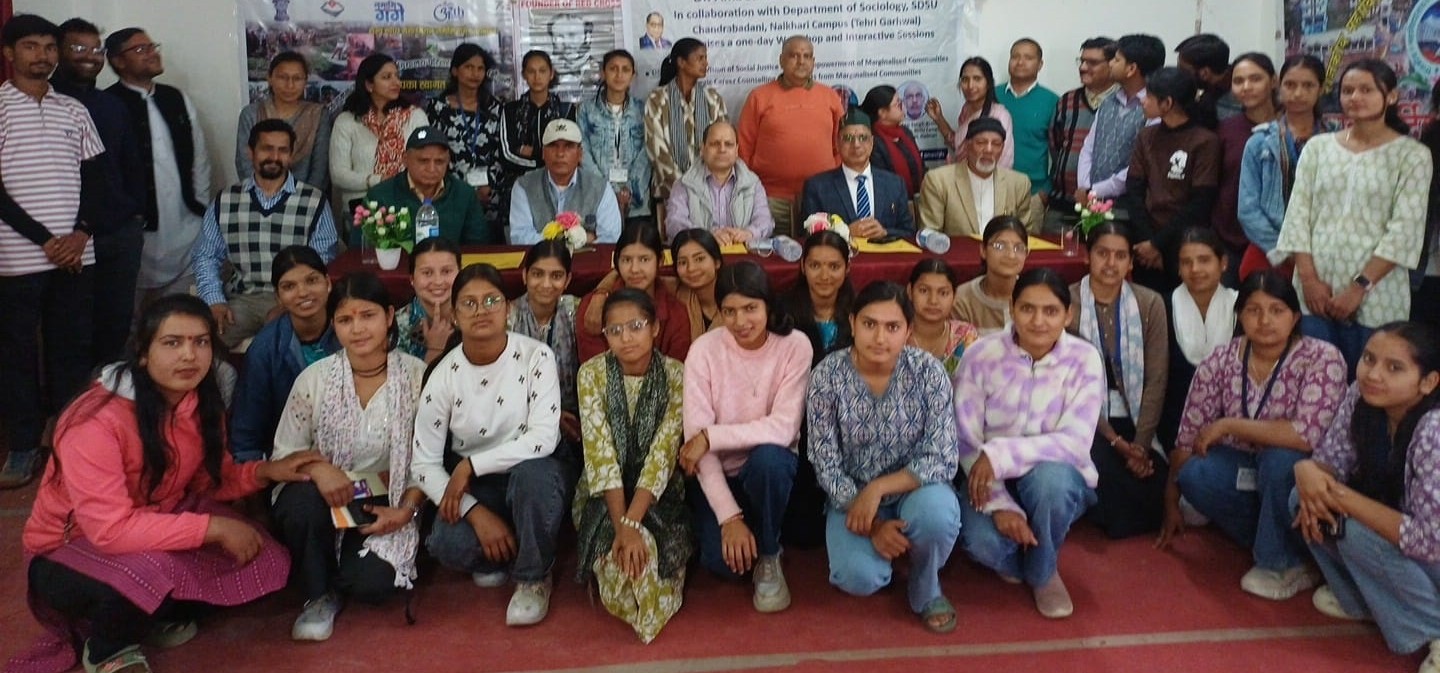
Chandrabadni (Naikhari), Tehri, 10 May: Dr Ambedkar Chair at Doon University and the Department of Sociology at the Chandrabadni (Naikhari) campus of Sridev Suman Uttarakhand University convened a landmark collaborative programme on empowerment of marginalised youth of hill regions of the state.
This joint initiative focused on two core pillars of contemporary social development: “Dr Ambedkar’s Vision of Social Justice and Empowerment of Marginalised Communities” and “Strategic Career Counselling for Students from Marginalised Communities.” The event served as a platform for experts to bridge the gap between Babasaheb’s constitutional philosophy and the practical aspirations of students in the remote Himalayan regions.
Prof Harsh Dobhal, holding the Dr Ambedkar Chair at Doon University, provided an in-depth analysis of the socio-political frameworks established by the architect of the Indian Constitution. He emphasised that Babasaheb Dr Ambedkar’s philosophy remains exemplary for social justice and the empowerment of marginalised sections of society, serving as a living blueprint for modern governance.
Prof Dobhal noted that the Constitution is not merely a legal document but a testament to Babasaheb’s exceptional craftsmanship, ensuring that Dalits, Backward Classes, Adivasis, and women are granted the constitutional rights necessary for holistic development. He further explained that the Dr Ambedkar Chair is committed to conducting rigorous research into the socio-economic challenges of Uttarakhand’s border regions, using dialogue with students in remote areas like Naikhari to formulate a roadmap for localised empowerment.
Adding to the discourse on leadership and character, Campus Director Prof Mahanth Maurya highlighted the timeless relevance of Babasaheb’s personal journey. He remarked that Babasaheb Dr Ambedkar is an ideal for society, transcending age and community to inspire every citizen. Prof Maurya asserted that the campus is dedicated to organising such initiatives so that students might draw profound inspiration from Babasaheb’s personality, enabling them to bring glory to India on both national and global stages. By integrating these values into the academic environment, the institution aims to foster a generation of students who view their education as a tool for social transformation and personal excellence.
The programme also addressed the critical need for professional direction through a session led by Prof HC Purohit, Dean of Student Welfare at Doon University. Prof Purohit engaged in a detailed interaction with the students, guiding them through the strategic aspects of selecting a career path that aligns with their strengths and social context. He emphasised that, for students from marginalised backgrounds, success is often achieved by resisting negative social narratives and cultivating a positive, rigorous outlook. He urged students to pursue their chosen subjects with depth and expertise, as academic mastery is the surest way to lead a successful and fulfilling life.
Reflecting on the broader impact of these constitutional ideals, former senior journalist Shishir Prashant observed that the visible increase in the presence of women in educational institutions is the ultimate proof of social progress. Prashant stated that the burgeoning participation of girls in every sector of society is a living testament to the fact that the nation is moving toward the egalitarian future Babasaheb envisioned. He noted that the impact of the Constitution, coupled with the visionary foresight of Dr Ambedkar, is clearly reflected in the modern educational advancement of our society, breaking down traditional barriers that once hindered collective growth.
The programme was conducted by Dr PS Bisht of the Department of Sociology, who spoke on the foundational strength of India’s legal framework. Dr Bisht remarked that the Indian Constitution is the greatest shield for the marginalised, and its strength lies in the fact that it prioritises human dignity over historical prejudice. He emphasised that Dr Ambedkar did not just write a book of laws, but created a living document that serves as a compass for true social democracy.
The event concluded with a shared commitment from both universities to continue their collaborative efforts in research and student mentorship across the state. A number of students and faculty members including Dr Ashutosh Pandey, Dr Dayadhar Diksht, Dr Suresh Kumar Bhatt, Dr Vednidhi Gauniyal, Dr Anupa Phonia, among others participated in the proceedings.