By Arun Pratap Singh
Dehradun. 17 Apr: Uttarakhand High Court’s directives and those issued by the National Green Tribunal (NGT) regarding action against encroachments on riverbeds in Doon Valley have pushed the administration into action, but the issue is largely influenced by unwanted political interference and vote bank politics.
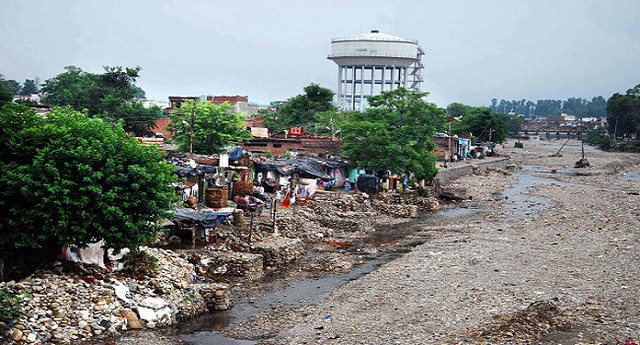
It may be recalled that rampant illegal encroachments along the banks of the Rispana and Bindal Rivers in Doon have become a flashpoint for environmental degradation, demographic transformation, and administrative paralysis in Uttarakhand’s capital. While the High Court and the National Green Tribunal (NGT) have repeatedly directed the state government to act decisively, enforcement remains inconsistent, hindered by political resistance as well as a systemic inertia.
Over the past two decades, Dehradun has witnessed a steady surge in illegal settlements along its seasonal rivers, with migrants from other states occupying government land, and it is claimed that this has been done with the tacit support of local politicians. These settlements have drastically altered not only the ecological but also the social and the demographic landscape of the city. Experts warn that majority of these encroachments fall within designated flood zones, making them highly vulnerable to natural disasters.
It may be recalled that the Uttarakhand High Court, responding to a Public Interest Litigation (PIL), had recently summoned the state government for an explanation on its failure to address encroachments. The Dehradun district administration has now sought time until 30 June 2025 to clear the identified illegal constructions.
This move follows the NGT’s stern observations, last year, when it fined the Dehradun District Magistrate and other officials Rs 1 lakh, each, for failing to act against encroachments on riverbanks. The NGT had labelled the inaction as “administrative negligence” and also warned of stricter penalties if encroachments were not promptly removed.
It may also be recalled that in May-June 2024, under judicial pressure, the administration initiated a limited anti-encroachment drive along the Rispana River. Although some structures were demolished, many areas were reoccupied shortly afterward, pointing to a lack of sustained enforcement and political will. One would also recall as pointed in a news story published today in Garhwal Post, that under pressure from the High Court, the then state government had initiated a major survey and anti-encroachment drive in Dehradun in 2018 but thereafter had left the campaign midway on pretext of the approaching winter season, claiming that thousands of families would be rendered homeless. Later on, the government also brought forward some ordinances granting protection to slum colonies on riverbeds. However, though the ordinance keeps getting extended, the government also has not dared to regularise these colonies.
It may be reminded here that the state and the district administration, along with the Dehradun Municipal Corporation and Mussoorie Dehradun Development Authority (MDDA), have identified 534 post-2016 encroachments, issuing notices to occupants. However, encroachments made before 2016 are not being targeted due to a controversial decision by the then Harish Rawat-led government to regularise these slums.
Meanwhile, the activists and the local residents argue that the issue has been compounded by vote bank politics. Encroachments have been allegedly encouraged or overlooked to consolidate political support, particularly among migrant populations. Local MLAs, municipal councillors, and party leaders, across the political spectrum, have reportedly used their influence to obstruct demolition drives, seeing slum dwellers as key constituents. In such a situation, the state administration is now finding itself caught in a bind, with NGT breathing down its neck while political stakeholders demand status quo.
In fact, the encroachment problem is not merely an issue of land use, it carries serious environmental and demographic consequences. Experts warn that rivers like Rispana and Bindal, though appearing tame now, can return to their natural courses over decades, wreaking havoc on illegally constructed settlements. Not only this, in this state, even many strategic government buildings like the Vidhan Sabha premises, UKSSSC, and even the Sahaspur located Mental Asylum are located on riverbanks. As per the local hydrologists, this situation can invite unwanted disaster in future. As per the survey conducted recently, there are 129 slum clusters in the 13-kilometre stretch of Bindal and Rispana rivers, housing over 40,000 people, most residing on land classified as floodplain or riverbed and catchment area. As a result, Rispana and Bindal rivers now resemble polluted nullahs with their banks transformed into densely packed settlements.
It may also be recalled that The Rishiparna (Rispana) Riverfront Project, once part of then Chief Minister Trivendra Singh Rawat’s vision to revive and beautify the river, has also faded into oblivion with the change in government. Meanwhile, land regularisation has continued informally, with properties changing hands via Rs 100 stamp papers, which is an illegal practice with long-term implications.
The NGT has now directed the Uttarakhand Pollution Control Board to take independent action if encroachments persist. The High Court, too, has instructed the state to expedite clearance operations and file a status report by the end of June.
Whether the state will finally act decisively or continue to tread the path of appeasement remains to be seen.