Garhwal Post Bureau
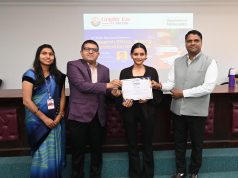
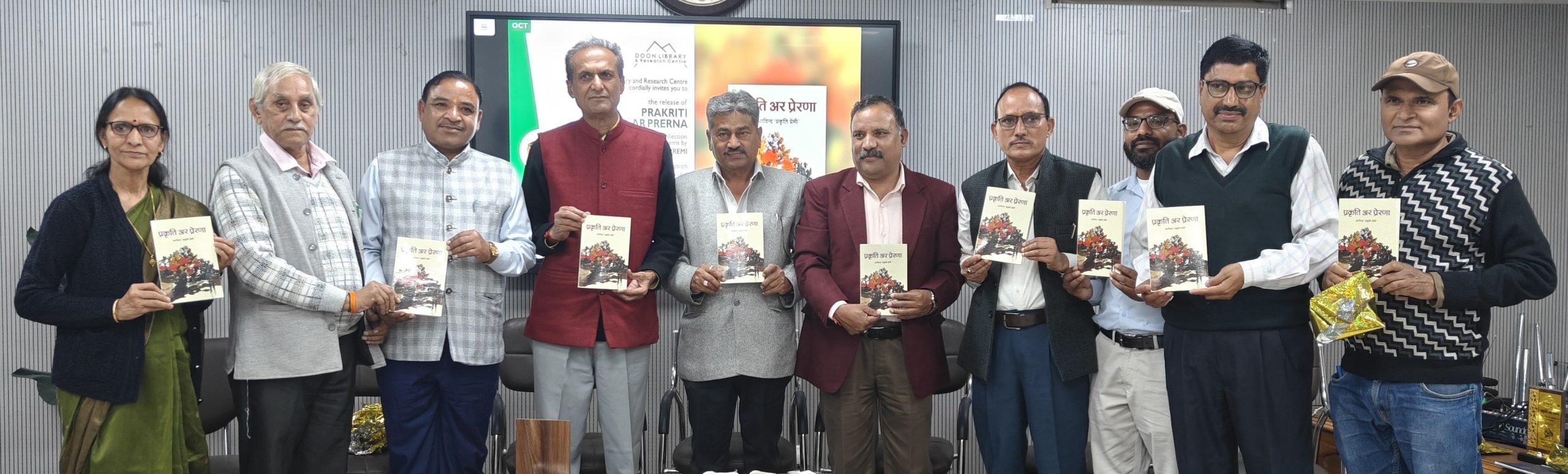
Dehradun, 29 Oct: Doon Library & Research Centre, Dehradun, organised the launch and a literary discussion on ‘Prakriti Ar Prerna’, the latest Garhwali poetry collection by poet Arvind ‘Prakriti Premi’, today, during the evening session. The programme was presided over by Madan Mohan Duklan, Editor-in-Chief of the literary magazine Chitthi-Patri. Dr Nand Kishore Hatwal, noted litterateur and theatre personality, was the Chief Guest, while Shanti Prakash ‘Jigyasu’, a writer and active advocate of the Garhwali language, attended as the Guest of Honour.
The programme was organised as part of the literary and cultural activities of Doon Library & Research Centre. Its objective was to promote literature in regional languages, provide a platform for local writers to share their ideas and engage in meaningful discussions, and encourage the preservation and promotion of Uttarakhand’s linguistic and cultural heritage.
At the beginning of the programme, Chandrashekhar Tewari, Programme Officer at Doon Library & Research Centre, welcomed and greeted the guests, writers, poets and other participants. He observed that a library is not merely a place for collecting and reading books, but also an important centre for literature, ideas, dialogue and creative expression. Such programmes help connect regional writers with readers and introduce Uttarakhand’s rich literary traditions to the younger generation. He emphasised the importance of continued literary creation in Garhwali and expressed his gratitude to all the guests and participants.
Presiding over the programme, Madan Mohan Duklan observed that Arvind ‘Prakriti Premi’s poems inspire hope and encourage society to move forward. His poetry seeks to dispel darkness and lead individuals and society towards greater awareness and enlightenment.
Chief Guest Dr Nand Kishore Hatwal remarked that the poems in the collection express a deep love for nature and the environment while also reflecting dissatisfaction with superstition, social injustice and harmful social practices. He appreciated the effective use of idioms and expressions in Garhwali, noting that the inclusion of authentic local vocabulary connects the poems closely with the region’s life and lived experiences.
Guest of Honour Shanti Prakash ‘Jigyasu’ stated that several poems in the collection, if translated into Hindi, could reach a wider readership and gain recognition beyond regional boundaries. He observed that the poet was advancing in terms of awareness and intellectual depth. Such works, he said, could help Garhwali poetry establish its identity at national and international levels. He also highlighted the growing refinement and maturity of the poet’s creative expression.
Reviewing the book, litterateur Shiv Dayal ‘Shailaj’ observed that Prakriti Ar Prerna contains free-verse, thought-provoking and reflective poetry. While engaging with contemporary poetic trends, the poems sharply critique deeply rooted social contradictions, distortions, hypocrisy and ostentation. He described the collection as an effort to explore new directions for contemporary Garhwali poetry.
Dr Umesh Chamola, who wrote the foreword to the collection, said that the poems explore the relationship between nature and human beings. Emerging from the harsh realities of contemporary society, they raise strong questions about social evils and superstitions.
Dr Satyanand Badoni highlighted the linguistic richness of the collection. He noted that the poet had attempted to revive words from the Tiryali dialect, particularly those once used in the Bhilangana and Bal Ganga valleys but now heard less frequently. Words such as ‘Bhainu’, ‘Abalikha’, ‘Samyar’, ‘Tar’, ‘Khagal’, ‘Sabalya’, ‘Barkha’, ‘Sal’ and ‘Syanra’ contribute to enriching the vocabulary of the Garhwali language. He also appreciated the poet’s attention to linguistic standardisation, describing it as a positive contribution to the development of written Garhwali.
A major strength of the collection lies in its integration of sensitivity towards nature and the environment with social awareness, experiences of local life and contemporary concerns. Through regional vocabulary, idiomatic expressions and linguistic diversity, the poet maintains a strong connection with his cultural roots. At the same time, the poems question social evils and superficial practices, presenting poetry as a medium for reflection and change. In this respect, the collection makes a meaningful contribution to the preservation and promotion of Garhwali and to contemporary literary expression.
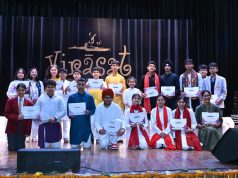
The programme was conducted by poet Bina Benjwal. Writers, poets, literary enthusiasts, intellectuals, young readers, cultural practitioners, library readers and other distinguished members of society from different parts of Uttarakhand attended the event.