Gantzers to receive Padma Shri this year for their travel writings
By Arun Pratap Singh
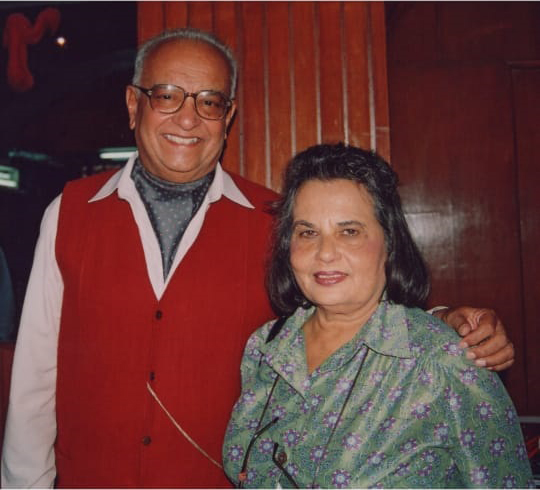
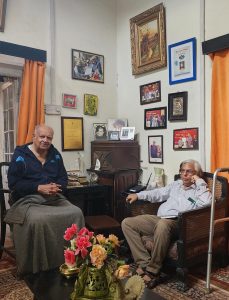
Mussoorie, 25 May: Hugh and Colleen Gantzer, among the most renowned couples of Mussoorie, resided in a 180-year-old cottage situated along a narrow hillside path near the ITBP Station, nestled amidst deodar trees. Following the demise of Colleen Gantzer last year, Hugh Gantzer continues to live in the same cottage.
Commander Hugh Gantzer (Retd), a veteran naval officer turned pioneering travel writer, has been jointly awarded the Padma Shri with his late wife, Colleen Gantzer, for their distinguished contribution to Indian travel journalism. Over a span of more than five decades, the Gantzers meticulously chronicled the cultural and natural diversity of India. They were among the first to write regular travel columns for Indian newspapers and travelled extensively across all states and union territories—well before such journeys became popular.
The Gantzers also contributed hundreds of articles to the Garhwal Post, a collaboration that continued until Colleen Gantzer’s passing late last year.
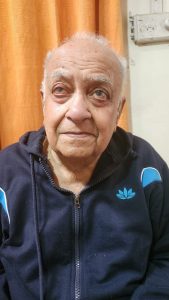
In this candid conversation, Hugh Gantzer speaks about his life, his wife, the late Colleen, and their travels across the globe. Some experts:
Congratulations on the Padma Shri. How does it feel to receive this national recognition for travel writing?
Thank you. It is deeply humbling. It was entirely unexpected. I was in the Nilgiris visiting our son Peter when I received a call from an official at the Union Home Ministry. He informed me that I had been chosen for the Padma Shri. I said if the award is only for Hugh Gantzer, I must respectfully decline. When the official clarified that it was being awarded to both Hugh and Colleen Gantzer, I humbly accepted. She may not be here in person, but her spirit remains ever-present.
Many readers know you as a travel writer, but few are aware of your naval past. Could you share memories of those early years in uniform?
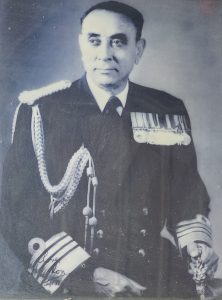
Of course. I joined the Indian Navy in the 1950s and served for over two decades, retiring as a Commander in 1974. I was posted across the country, including a particularly memorable stint in Cochin. While in the Navy, I took two and half rounds of the globe. The Navy instilled in me a love for discovery, adaptability, and discipline, qualities that served me well when I eventually turned to travel writing.
And was it during your naval service that you met Colleen?
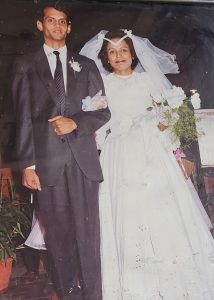
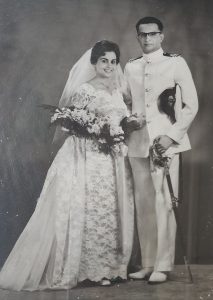
Yes, in Bombay. One Sunday, I saw her once from behind walking towards the church across the lawn of a naval officer’s home in Byculla, while looking down towards the lawn from the balcony and did not see her face or did not even know her name or who she was but thought that is the girl I’m going to marry. And, so I did, in 1960. From the very beginning, our shared curiosity and sense of wonder bound us together, personally and professionally.
You also served aboard the INS Khukri before it sank during the Indo-Pak war. Please share with us about that poignant chapter in your professional life as a naval officer.
Very much so. INS Khukri was an anti- submarine frigate. I was transferred off the INS Khukri barely a month before she was sunk by a Pakistani submarine on 9 December 1971. It was a devastating loss, 176 sailors and 18 officers perished, including her commanding officer, Captain Mahendra Nath Mulla. Captain Mulla chose to go down with his ship. He stood on the bridge, calmly lit a cigarette, and went down with his men. His quiet courage epitomised the highest traditions of naval service. I think of that day often. If I had been still posted with INS Khukri, I would not been here today talking to you on our travel writings. Of course we visited the rebuilt INS Khukri, later.
You retired shortly thereafter. Was there a particular reason?
Yes. I was superseded by an officer who had not only been my junior but had once been my petty officer. It was a moment of profound disillusionment. I shared my thoughts with Colleen, and we made the decision together to move on. We settled in Mussoorie, and thus began our second innings, as writers.
How did you settle in Mussoorie?
My father headed the survey of Bihar and Orissa. I was born in Patna and lived there till age 8. I remember the top storey of our home was destroyed in the Great Bihar Earthquake. My father retired and we moved up to Mussoorie in 1940. Then, after my premature retirement from the Navy, we returned to Mussoorie to make it our permanent home.
How did both of you take to travel writing which was not very popular in India at that time?
We both liked to travel around. Kerala gave a boost to our travels. I was fond of writing while she was very curious about the country and the world. We stayed on in Kerala after retirement. We saw this amazing state which was a wonderful mixture of religions and culture. Islam arrived in India from Kerala. Christianity first came to India through St Thomas, who was an apostle of Christ. St Thomas was a Jew and possibly came to Kerala because he could communicate with the other Jews who lived here. We’ve been to the place where the first Christian colony was established in Kerala.
Kerala was the centre for spices which was carried by Muslim traders from India to Europe. When the spice traders from the Arab nation came to Kerala they stayed till the end of the monsoon. During that time, they married local women and that is why the Muslims of north Kerala are called Moplahs — which is derived from the Malayalam word ‘mapilla’, meaning son-in-law.
Of your many international travels, your journey to China is often mentioned. What made it so significant?
We visited many countries in Europe and other continents but never the US. We travelled mostly on invitations. But we visited China in the early 1980s, not on invitation but with our own resources. Mostly, we have travelled around India and the world on invitations. The Chinese visit made us reflect deeply on India, our systems, our inefficiencies, and our potential. That journey changed not only our view of China, but also how we saw our own country. I must add here that after our travel to China and after we wrote about our travel, Indian travel agencies started promoting China as a destination for Indian tourists.
Were there challenges being Indian travel writers abroad in those early decades?
Oh, certainly. We were often met with curiosity, sometimes suspicion. People didn’t expect Indian writers in that genre. But it only deepened our determination. We learned to observe cultures respectfully and engage with humility. That is the essence of meaningful travel.
I hear you were collaborating with Colleen on a book at the time of Colleen’s passing. What was it about?
Well, we were writing on the love life in Mussoorie. You see, in Mussoorie, you could see a large number of young white widows till a few decades ago. It was because young British women used to be sent here and were given one year to find love and marry white men. Often, they married old men in order to stay on longer. Mussoorie has never been used as an administration hub or centre unlike Shimla and it had lot of bachelor white men who used this place as a resting station before their ventures, and they were looking for love or relationships. With Colleen’s passing, the work on this book has been discontinued.
What changes have you witnessed in Indian travel culture over the decades?
The transformation is astonishing. When we began, leisure travel was rare among Indians. Today, young Indians are climbing Himalayan trails, exploring Bhutan, backpacking across Europe. The tools have changed, blogs, vlogs, reels, but I hope the essence of travel endures: engagement, empathy, and discovery.
Please share something about your writing for Garhwal Post for so many years!
It was in the mid-nineties that a young man by the name of Satish Sharma visited us here and shared that he was about to launch a newspaper called Garhwal Post, and he wanted us to contribute to the publication. We were delighted. We felt that writing for Garhwal Post would be one way of giving something back to Mussoorie. We continued contributing our column regularly until Colleen passed away last year.
You see, Garhwal Post is a unique newspaper. It carries on its masthead the line, “For Tomorrow’s People”. I want it to focus more on tomorrow’s people, not just on what the politicians like to pontificate or preach, but on what tomorrow’s people want and how their needs are being met. I am very happy to have been able to write for Garhwal Post regularly over the years.