 By Dr AK Srivastava
“I am proud of my country, India, for having a constitution that enshrines principles of democracy, socialism, and secularism.” – Dr BR Ambedkar
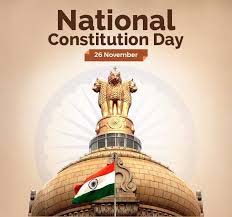
National Constitution Day or Samvidhan Diwas is celebrated on 26 November in India. It is on 26 November 1949 that the constituent assembly adopted this constitution which was prepared by very learned, seasoned and knowledgeable statesmen and politicians of our nation. The constitution came into effect on 26 January 1950. That is why we celebrate Republic Day on 26 January every year. The constitution of our country is the Supreme Law and the Pride of our nation. Nobody is above it and it is compulsory for every citizen of India to abide by it.
The Modi Government decided to celebrate 26th November as Samvidhan Diwas in order to commemorate this significant date in the history of Independent India. The ministry of Social Justice and Empowerment issued a notification on 19 November 2015 in this connection.
The constituent assembly started its work on 9 December 1946 and Dr Rajendra Prasad was elected its President. Initially, the constituent assembly had 299 members and it took three years to complete the work. Finally, 284 members signed the draft of the constitution when it was ready for the nation.
The Constituent Assembly had 13 committees which worked in different areas of administrative and public interest. Dr BR Ambedkar, a renowned scholar and statesman, was the chairman of the drafting committee. That is why he is known as “the father of the Indian Constitution”. The work of the drafting committee was particularly challenging and crucial as it required a clear and minute understanding of the intent and aspirations of the members of the constituent assembly.
The constitution of India is a unique, comprehensive and wonderful document. It was prepared by consulting numerous constitutions of different countries. It is the longest constitution in the world. It declares India to be a Parliamentary Democracy and a Republic with a Federal structure. The citizens of India are the real and ultimate custodians of the constitution. The sovereignty of the country lies in the hands of its citizens, and it is the duty of citizens to follow the constitution in letter and spirit. The constitution has three organs—Executive, Legislative and Judiciary. The powers and responsibilities of these organs are clearly defined. It can be amended as per the changing needs and circumstances of the developing and progressing world. It has been amended more than a hundred times so far just to be in tune with the times.
The Preamble of the constitution is its soul and it clearly mentions the core values and what it stands for. The constitution guarantees us some fundamental rights.
- Right to equality
- Right to Freedom
- Right against Exploitation
- Right to Freedom of Religion
- Cultural and Educational Rights
- Right to Constitutional Remedies.
We can express our ideas and feelings without any restrictions. We can also live and work in any part of the nation and assembly for any social, political and religious purpose.
In 1976, the 42nd amendment to the constitution was introduced and it dealt with a code of ten fundamental duties for every citizen of India. It is expected of every citizen to follow ten duties in the interest of the nation. The 86th Amendment to the constitution added the 11th fundamental duty.
It shall be the duty of every citizen of India
a – to abide by the Constitution and respect its ideals and institutions, the National Flag and the National Anthem;
b – to cherish and follow the noble ideals which inspired our national struggle for freedom;
c – to uphold and protect the sovereignty, unity and integrity of India;
d – to defend the country and render national service when called upon to do so;
e- to promote harmony and the spirit of common brotherhood amongst all the people of India transcending religious, linguistic and regional or sectional diversities; to renounce practices derogatory to the dignity of women;
f- to value and preserve the rich heritage of our composite culture;
g- to protect and improve the natural environment including forests, lakes, rivers
and wildlife, and to have compassion for living creatures;
h – to develop the scientific temper, humanism and the spirit of inquiry and reform;
I – to safeguard public property and to abjure violence;
j- to strive towards excellence in all spheres of individual and collective activity so that the nation constantly rises to higher levels of endeavour and achievement;
k – who is a parent or guardian to provide opportunities for education to his child or, as the case may be, ward between the age of six and fourteen years.
Another interesting feature of the Indian constitution is that it was neither hand-written nor printed. It was most beautifully handcrafted by artists of Shantiniketan under the supervision of Acharya Nanda Lal Bose with the calligraphy texts written by Prem Behari Narain Raizada. It took him about 6 months to finish this task, yet he did not take any money for this work. We can find original copies of our constitution in the library of the Indian parliament. Every part of the constitution is started with a depiction of an important phase or scene in Indian history.
In conclusion, we can say with confidence that the constitution of India is a wonderful document and we all should be proud of it. It has helped in shaping the destiny of 140 million people. We should celebrate National Constitution Day with full enthusiasm and vigour. We must explain the value and greatness of our constitution to posterity. We must always uphold democratic values and spread peace harmony and brotherhood.
“Constitution is not a mere lawyer’s document, it is a vehicle of Life, and its spirit is always the spirit of our Age.” B. R. Ambedkar
(Dr AK Srivastava is Principal, DAV Intermediate College, Dehradun)