Garhwal Post Bureau
Dehradun, 23 Jul: The Doon Library & Research Centre organised a special lecture today by renowned environmentalist, founder of the globally acclaimed Maiti Movement, and Padma Shri awardee Dr Kalyan Singh Rawat ‘Maiti’ on the theme “Innovative Experiments and Experiences in Environmental Conservation”.
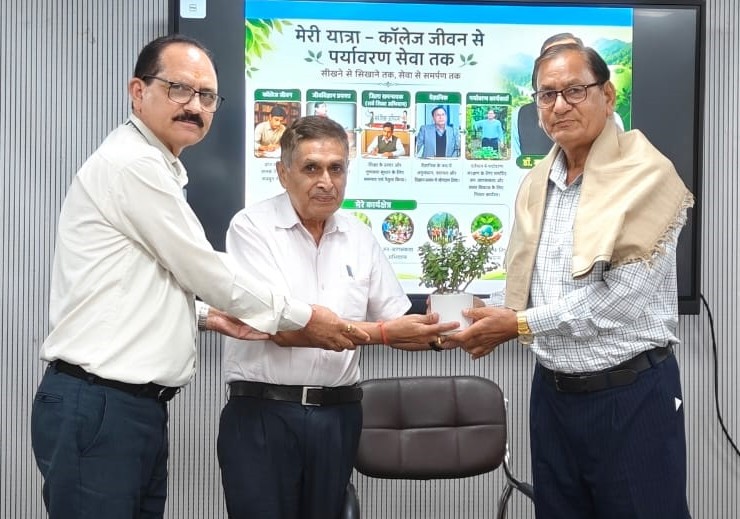
Through an inspiring illustrated presentation, Dr Rawat shared over four decades of his experiences in environmental conservation, highlighting innovative initiatives and successful community-based efforts to reconnect people with nature. His lecture carried a powerful message, inspiring the audience to become more conscious of and actively involved in protecting the environment.
Dr Rawat emphasised that environmental conservation is not merely the responsibility of government programmes, but a moral duty of every member of society. Reflecting on his childhood affinity for nature, his association with the Forest Department, and the inspiration he drew from life in the Himalayas, he explained how these experiences shaped his lifelong commitment to environmental protection.
Presenting the inspiring journey of the internationally recognised Maiti Movement, launched in 1995, Dr Rawat described how the tradition of newly married couples planting a tree during their wedding ceremony has evolved into a powerful people’s movement. Originating in Uttarakhand, the movement has spread across several Indian states and even to other countries, resulting in the plantation of millions of trees. He observed that when social customs are integrated with environmental stewardship, conservation becomes both sustainable and effective.
During his lecture, Dr Rawat shared inspiring experiences from the Chipko Movement, the Save Himalaya Campaign, biodiversity conservation, revival of natural water sources, wildlife conservation, and community participation. He stressed the importance of public awareness campaigns, school-based environmental programmes, and the active involvement of young people in safeguarding nature.
He informed the audience that the Maiti Research and Biodiversity Forest at Ranichauri (Tehri) was established through collective efforts, where thousands of trees have been planted to create a thriving green ecosystem. The centre also conducts environmental education programmes, biodiversity conservation activities, and skill-based livelihood training for young people. He further highlighted the development of a large nursery with the participation of university students at Ranichauri, extensive plantation drives in villages, and environmental awareness initiatives such as the Green Best Achiever programme.
Dr Rawat also spoke about several pioneering initiatives, including the Devbhoomi Vriksha Prasad Yojana, revival of traditional Chaal-Khaal water harvesting systems, conservation of Himalayan folk culture, the Bugyal Conservation Campaign, the Lokmauli Tree Culture initiative, water source conservation, and the organisation of a number of environmental fairs. He explained that events such as the Forest Fair, Tourism and Environment Fair, Himalayan Environment Fair, and the Ranichauri Environment Fair were launched to celebrate environmental conservation as a community festival, generating significant public awareness and participation.
He also highlighted the formation of Eco Clubs in schools, the involvement of thousands of students in environmental activities, the Harit Shri Award for outstanding schools, and the initiative to observe Bugyal Conservation Day every year on 2 September beginning in 2024. Referring to plantation drives at several heritage sites, including the historic Khalanga Memorial in Dehradun, he said these efforts aim to transform such places into green memorials. He concluded by emphasising that only an environmentally responsible lifestyle can ensure a safe and sustainable future for generations to come.
Welcoming the speaker, Chandrashekhar Tewari, Programme Officer, Doon Library & Research Centre, said that the Maiti Movement has given a new direction to environmental conservation by integrating it with social traditions and community participation. He described Dr Rawat’s life as an inspiring example of dedication to nature, public awareness, and transforming environmental conservation into a people’s movement.
The participants described Dr Rawat’s illustrated lecture as highly inspiring and unanimously expressed that public participation is the greatest need of the hour for environmental conservation. They emphasised that the protection of water, forests, land, and biodiversity is not only the responsibility of governments but a shared responsibility of every citizen.
The programme was moderated by noted social historian Dr Yogesh Dhasmana.
Among those present were Dr DK Pandey (Librarian), Sunder Singh Bisht, Jagdish Singh Mahar, Madan Bisht, Sheeshpal Gusain, Col DS Bartwal, Col DP Dimri, Gajendra Ramola, Shanti Prasad Jigyasu, Beena Benjwal, Surendra Sajwan, Shurveer Singh Rawat, Alok Himanshu Ahuja, Sandeep Gusain, Kavita Bisht, Param Jeet Singh, Kalyan Singh Butola, Devendra Kumar, along with a large gathering of environmentalists, nature lovers, intellectuals, writers, researchers, students, and young readers.