 By Savitri Narayanan
The night was still young. There we sat in the temple courtyard waiting for the Kathakali performance to start. It was the ‘ulsavam’, a weeklong annual event in the Krishna Temple in village Chethallur, in interior Kerala. A large durri was rolled out demarcating the stage. The villagers walked in, in small groups, and took their seats around. Children sat cross-legged on the rug which was spread in the front while the grownups pulled in the chairs behind them. There was an air of peace and relaxation combined with anticipation of the classical dance to be staged.
Once in a while one comes across a moment in life when one is transported to a different era. The temple courtyard provided one such moment for me. It was an annual ritual, happens every year, but the last time I’d been there was about six decades ago! Then I sat there cross-legged as a child, a student of the nearby village school and, here I was, a senior citizen, a retired educationist having explored the world, back with a limp and a walking stick! Things were the same and yet different! The people looked familiar, but I couldn’t place them!
The show was about to start. Artists came in with the musical instruments chenda, elatthhaalam and also the multicoloured curtain, therasseela.
Without further ado, the Kathakali got underway. Two men held the large multicoloured curtain across the stage. The drums and cymbals played the customary beats and the curtain was put away.
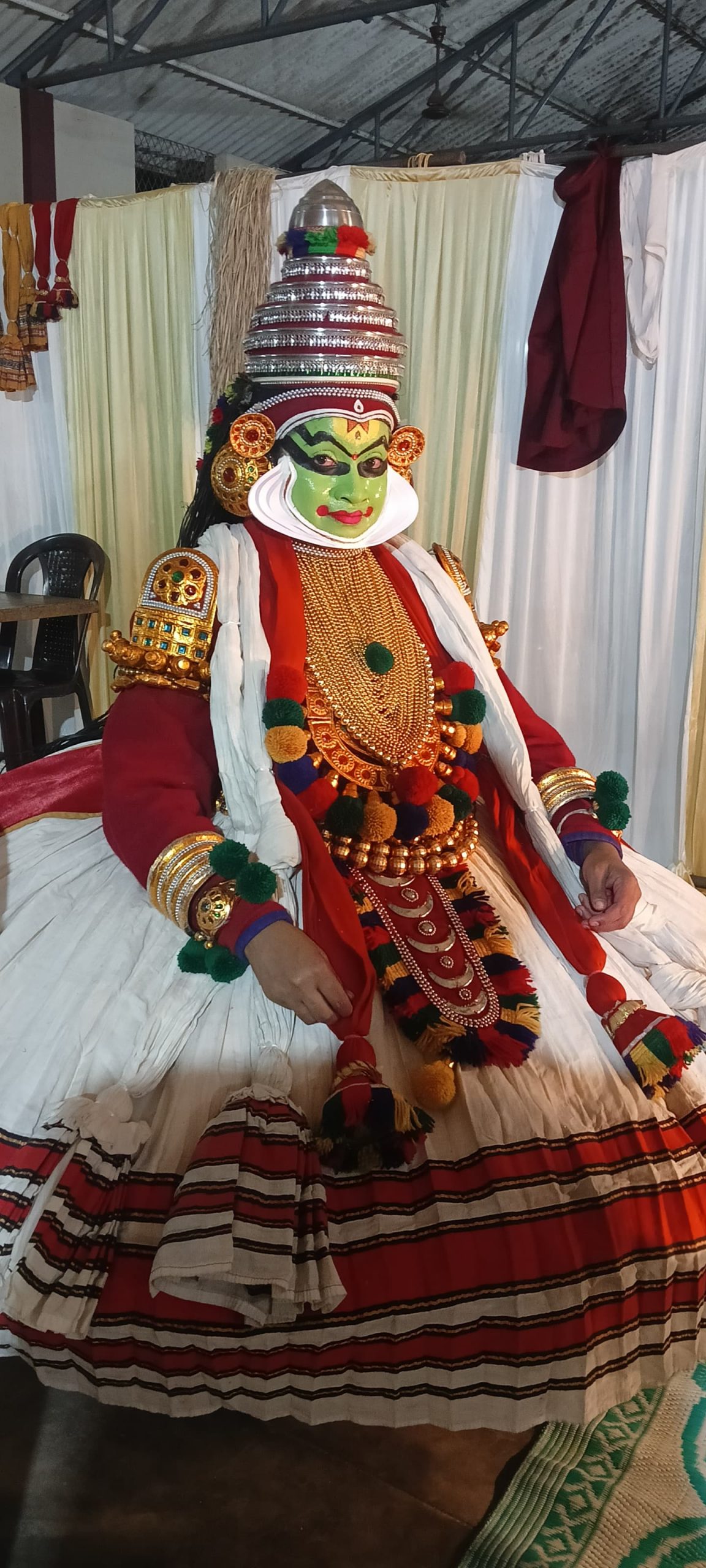
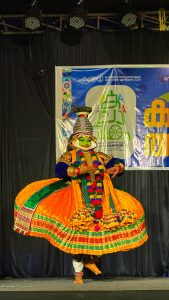
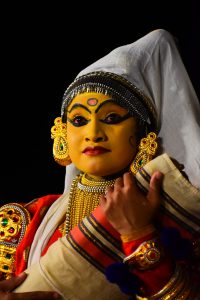
There on the stage stood Lord Krishna with his flute to his lips, delighting the audience with his benevolent smile. The glistening blue and yellow apparel with the golden sashes dotted with the decorative peacock feathers seemed to provide him a majestic glory, a divine aura.
“Our ex-student,” said a niece, a teacher in the school.

Krishna surveyed the audience gracefully with his expressive eyes, seemingly engaging the audience.
Soon the music picked up the tempo. The drums beat faster and louder, the artists’ steps turned firmer and swifter and the audience were lifted to an elevated plane of art appreciation. In the flickering flame of the large oil lamp, Krishna grew divine with his gentle movements and graceful gait.
When the curtain-bearers walked in signifying the end and the artists retreated to the greenroom, I said, “I would love to meet this artist!”
he next morning as I sat under the mango tree in the front yard of the bungalow, walked in an unassuming girl with plaited hair and a winning smile!
“I’m curious how you turned into a Kathakali artist,” without mincing words I came to the point, “Haven’t heard of many from here in Chethallur!”
“I’m not a Kathakali artist,” Agnishikha smiled, “I’m a student preparing for my final year BCom exam.”
“How come you learnt Kathakali? Any other senior artists in the family? Who showed you the way?”
“Unfortunately, I’ve no artistic background,” Agnishikha’s voice was gentle. “My mother is a homemaker and father is a painter. When there’s new construction in the nearby areas, he’s the one who paints the walls. My younger brother is a Class X student. Absolutely no art in the family.”
“Then how come you became interested and got trained in this classical art?”
Agnishikha’s eyes brightened as she relived that afternoon in middle school. She was a student of Class VII when the school had arranged a demonstration class of Kathakali by the local artist asaan Sadanam Sadanandan. After the demo, asaan offered to train the interested students in Kathakali. The classes started on Vijayadashami day; the venue was the village library. Agnishikha joined with a few others and soon got into the training. After months of systematic, rigorous training and regular practice, it was time to dance for an audience. The arangettam, the debut performance, was scheduled to be held in the Krishna temple, Guruvayoor. The whole village community got together in support, determined to make it a memorable day for the family. A bus was arranged and along with family and friends, many travelled about sixty kilometres to witness the event. It was a celebration for Chethallur village!
“We will always be grateful for the way the whole community stood by us all the way through,” gratitude shines through Agnishikha’s eyes and words. “And there was absolutely no financial burden on our family, neither as fees for the asaan nor as expenses for the arangettam. Whatever I’m today, is thanks to my aasaan and the supportive village community!”
“By the way, your name in not very common around here; what does it signify to you?”
“True, the name ‘Agnishikha’ is not common around here. My father says somewhere there’s a temple named ‘Jwalamukhi’, where the flame is eternal; he liked the concept, hence my name.”
“How successful do you see yourself as an artist?”
“For arangettam at Guruvayoor, I played Krishnan of Subhadraharanam; subsequently I’ve played roles in Rugmineeswayamvaram, Poothanamoksham, Kuchelavruttham, etc., in various stages. Without fail, the local people have been encouraging and supportive!”
“You dance so well, if you wish you could pursue training and be an accomplished Kathakali artist, right?”
“I’ve got other things in mind,” Agnishikha said thoughtfully. “Maybe I would attend some coaching classes and appear for PCS exam. It’ll be good if I could get a government job! My parents could take it easy; they’ve been working so hard all these years.”
“Assuming you pass the PCS exam and get a government job, will you continue Kathakali?”
“Yes, of course. Along with my job I would love to go on stage once in a while! With asaan’s guidance, I continue to learn and improve my performance!”
(Savitri Narayanan is a retired educationist at present in Goa. A mother and grandmother, loves readig, writing and travelling.)