 By GANESH SAILI
‘Grass does not grow on concrete!’ exclaimed the clean-shaven man in Bhurey’s Barber Shop. He tapped his fingers on his bald pate and said again: ‘Grass does not grow on concrete!’
Normally, I would have let it pass. But with a hairstyle like mine, I only say: ‘Bald is bold!’ Which would be perfect on the ghats of Haridwar, but not this hill station, for nowadays it is teeming with selfie-sticks.
‘Must be the City Board! They put something in the water!’ he lurches on. ‘I can’t stop writing. A month’s work done in a week!’ says Prajwal Parajuli, whose books include Land Where I Flee. He says: ‘In Landour, the juices flow.’ Some of his books are The Gurkhas’s Daughter and Land Where I Flee. They are about the Nepali speaking people in Sikkim and Bhutan. They are prescribed texts in American universities.
The cantonment’s thousand and forty acres is home to several prominent authors. Together, their work totals more than three hundred published titles. Step out beyond Landour and get to Bala Hisar where stands Oakless Cottage, once home to William McKay Aitken (our Bill Sahab). Near the ITBP Ockbrook lived the pioneers of travel-writing, the late Hugh and Colleen Gantzer. Lamentably, they passed away within eight months of each other. May they Rest in Peace!
How I wish history had a rewind and we could time travel to Landour of the 1980s and meet Ellwyn ‘Wynn’ and Sally Chamberlain at Seaforth Lodge. Wynn wrote Gates of Fire (1978), Hound Dog (1984), Thus Spoke the Thunder (1987) and Paradise (2016).
Of course, some believe writing is much too easy – all you need is pencil and paper. They forget the dustbin! That’s essential for failed dreams.
Ruskin Bond remains the Sachin Tendulkar of the writing world. At ninety-two, he has been at the crease for over seventy years of delightful batting.
And there’s Mussoorie-born Stephen Alter, with two-dozen titles. This is where Anita Desai was born at the Community Hospital; this is where Arvind Adiga came to wrap up The White Elephant and this is where I met Dhiren Bhagat – he had settled down in the Shanty, hoping to write his magnum opus. Tragically, fate intervened. While in Delhi, to sort out family business, a freak accident snuffed out a life full of promise.
Please, Gentle Reader, do notice: most prudently I have left myself out. With writers left, right and centre, I feel like the filling in a sandwich. My attempts at writing have made me a good typist. Good writing? The jury is still out on that!
Sometimes I wonder: ‘Where are the new writers?
As it turns out, I needn’t have worried.
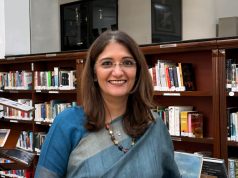
‘Despair not Ganesh!’ I say to myself as I meet pretty, twenty-something Nandini Kumar, whose short stories pack quite a punch. In her book Baaki ki Baat, my favourite remains Neeli which won the Kindle Pen to Publish Contest.
Quietly and without much fuss, Nandini voices the aspirations of the New Age.
‘Manto’s twists and turns inspire me. He is my North Star,’ she sighs. Good luck Nandini as you scale greater heights.
Walking around the Upper Chakkar, I bump into the Swiss novelist, Christian Kracht, and his family; they moved from Kenya to Landour and put their only child into school.
‘We’ve kept her away from the Internet!’ he tells me wistfully.
His Imperium which is set in 1902 is at once ‘funny, bizzare and shocking’. It’s a true story about a nervous vegetarian from Nuremberg, August Engelhardt. He sets sail to an island hoping to found a colony devoted to growing and eating coconuts. Seventeen years later, in 1919, his famished body is found washed up on a beach in the South Pacific. Translated into thirty languages the book has won many awards.
Christian dives deep, crafting a fable based on the irresistible allure of fringe extremism mingled with human cupidity. Although this amusing novel features palm-fringed islands with copious amounts of coconut oil – it is definitely not for the faint hearted.
But then, who said writing was easy. That too, is definitely not for the faint-hearted!
(Ganesh Saili, born and home-grown in the hills, belongs to those select few whose words are illustrated by their pictures. As the author of two dozen books, some translated into twenty languages, his work has found renown worldwide.)