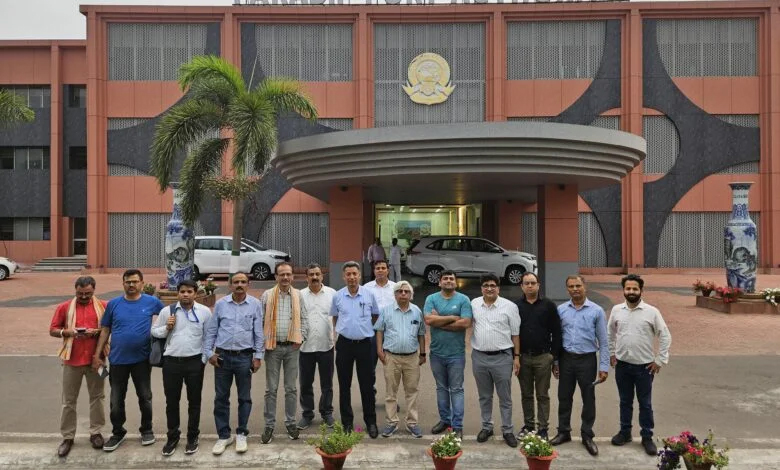
Paradip Port Authority showcases performance, vision to U’khand Media delegation
By Arun Pratap Singh
Garhwal Post Bureau
Paradip, 27 Mar: A media delegation comprising senior journalists from Uttarakhand visited Paradip Port on Wednesday and held an extensive interaction with the top administrative leadership of Paradip Port Authority, during which the port’s achievements, operational capabilities, future expansion plans, and environmental commitments were comprehensively outlined.
The media delegation was led by Assistant Director, PIB Dehradun, Sanjeev Sundriyal, and Assistant Director, PIB Bhubaneshwar, Mahendra Jena.
Deputy Chairman of the Paradip Port Authority, T Venugopal, Secretary Krishna Bapi Raju, and Advisor Asish Kumar Basu, briefed the visiting team, highlighting Paradip Port’s emergence as one of India’s premier major ports and a crucial pillar in the country’s maritime trade and energy logistics ecosystem.
During the interaction, the officers emphasised that Paradip Port has consistently emerged as the largest cargo handling major port in India by volume among the nine major ports, reflecting its operational strength and strategic importance. They informed that Paradip Port handled approximately 150 million metric tonnes (MMT) of cargo during the current financial year, maintaining its position as the top cargo handling major port in India. They noted that the port is strategically situated to serve a vast hinterland spanning Odisha, Jharkhand, Chhattisgarh, Madhya Pradesh, Uttar Pradesh, Bihar and West Bengal, thereby acting as a key gateway for bulk cargo movement across eastern and northern India.
Deputy Chairman T Venugopal stated that this achievement was the outcome of meticulous planning, continuous process optimisation, and improved turnaround times, adding that such benchmarks reinforce the port’s critical role in supporting India’s energy supply chain through the swift and reliable movement of thermal coal.
Providing an overview of cargo operations, the officers explained that Paradip Port handles a diverse range of commodities including crude oil, petroleum products, iron ore, thermal and coking coal, chrome and manganese ore, fertilisers, clinker, gypsum, finished steel, scrap, containers and various project cargoes. This diversity, they said, reflects the port’s versatility and its ability to cater to multiple sectors of the economy, from heavy industry to agriculture.
They also claimed that the port’s infrastructure is fully robust and future-ready, with 18 berths, three Single Point Moorings, a Ro-Ro jetty, and well-maintained approach and entrance channels with depths of 18.7 metres and 17.1 metres respectively, capable of handling vessels with a length overall of up to 300 metres. The port is equipped with a modern Vessel Traffic Management System to monitor and control vessel movements round the clock, ensuring safe and efficient navigation. The availability of six high-capacity tugs and a dedicated security-cum-pollution response vessel further strengthens maritime safety and operational readiness.
The officials also highlighted the port’s strong rail connectivity, noting that Paradip Port operates its own railway system with a route length of about 7.4 kilometres and an extensive track network of 84 kilometres, supported by multiple full and half rake sidings. This enables seamless evacuation of cargo and enhances logistical efficiency. The port’s mechanised coal handling plant, designed to handle 42 million tonnes per annum, was showcased as a key asset, featuring advanced stackers, reclaimers, conveyors and high-capacity ship loaders, along with a merry-go-round system for rapid wagon unloading.
Venugopal apprised that Paradip Port has consistently emerged as the largest cargo handling major port in India by volume among the nine major ports, reflecting its operational strength and strategic importance and has handled approximately 150 million metric tonnes of cargo in the current financial year. Port Secretary Krishna Bapi Raju stated that with a current rated capacity of 289 million metric tonnes per annum, Paradip Port is undertaking ambitious capacity augmentation programmes aimed at increasing throughput to over 300 million metric tonnes by 2027 and surpassing 350 million metric tonnes by 2029. He asserted that these expansions are aligned with the port’s mission to become the premier port on India’s eastern coast by offering efficient, cost-effective and integrated services to its users while adhering to global standards of safety, security and operational excellence. He further noted that the port has automated the cargo handling to a great extent and that this has increased the efficiency of the port.
The delegation was also briefed on the port’s customer-centric approach, with ISO 9001:2015 certification and ISPS compliance ensuring transparency, reliability and adherence to international best practices. The port operates round the clock throughout the year, providing uninterrupted services to importers and exporters.
In response to the query of the media persons, Advisor Ashish Basu informed mentioned the port authority’s commitment towards environmental sustainability, also detailing a wide array of initiatives undertaken under the Green Port programme. These include extensive road infrastructure within the port, continuous cleaning and maintenance of drains and road surfaces, and large-scale deployment of water tankers for dust suppression using treated water from sewage treatment plants. The installation of mist cannons, conveyorised road sweeping machines, and mechanised dust suppression systems has further helped in mitigating air pollution.
The officers added that the port has also established multiple sewage treatment plants with a combined capacity of 6.5 million litres per day, along with settling ponds and recycling systems for effective water management. Measures such as tarpaulin covering of stockyards, installation of tyre washing systems at entry gates, and regular air quality monitoring by recognised agencies have been implemented to minimise environmental impact. The creation of a green belt with over 12.5 lakh plantations in the past decade, along with ongoing plantation drives, reflects the port’s commitment to ecological balance.
The officers claimed that Paradip Port complies with all national and international safety regulations and is fully equipped to handle emergencies such as fires, collisions, oil spills and other maritime contingencies with prompt response mechanisms. They added that a good railway and road connectivity and upcoming highway projects will further augment the efficiency at the Paradip Port.
The officers also apprised the visiting delegation about the proposed satellite port at Bahuda in Ganjam district, which is being developed as a greenfield deep-sea port under Paradip Port Authority with an estimated investment of around Rs 21,500 crores. The Bahuda port is envisaged to handle large vessels, augment cargo handling capacity, decongest Paradip Port and strengthen Odisha’s position as a major maritime hub while generating employment and industrial growth in the region.
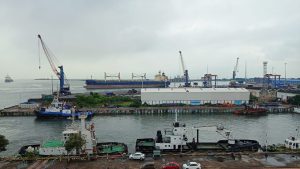
Earlier to the interaction, the media delegation was also taken on a motor boat around the port and shown the operations.