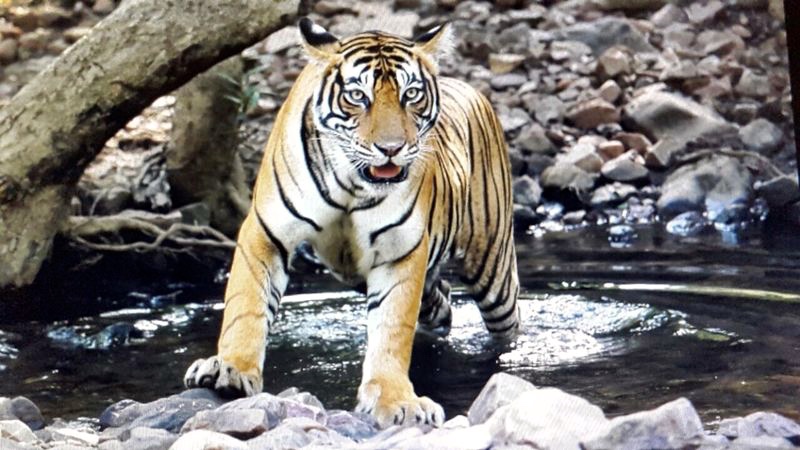
 By Ganesh Saili
After many years of futile search, I concluded that the famous Shikari naturalist Jim Corbett never visited Mussoorie. Much as some folks like to believe, he never trekked up the seven-mile-long bridle path from Rajpur; he never visited the Powell family living in Wayside Cottage, Barlowganj. Instead, while sifting through the hill station’s past, I found that the hunter pursued man-eating leopards and tigers with ease and tried his best to steer clear of the macabre.
He was thirty-two years old when he stalked the man-eating Tigress of Champawat – a fearsome beast that had strayed in from Nepal and had killed over four hundred and fifty people. Darkness follows dusk quickly in the mountains. That day’s end saw Corbett accompanied by a local government official and a tehsildar who insisted on going to the village several miles away rather than spending the night in the Dak bungalow. Corbett never talked or wrote about what happened that night, but we have a letter from a friend explaining why the tehsildar was so keen to put lots of distance between him and that forsaken bungalow.
‘Jim and a friend arrived at a very isolated Dak bungalow late one evening and prepared to stay the night. However, after getting a scratch meal, neither of the bearers would stay on and scurried off to the village before darkness fell.

‘Jim and his friend occupied separate rooms, and Jim had a hurricane lamp on a table beside his bed. He was extremely weary after a long day tracking a man-eater, but at about 1 a.m., he woke up suddenly to ‘feel’ an awful presence in the room. His light was then extinguished, and he went outside to find his friend there already, having suffered a similar experience. He assured me nothing would induce him to stay at the bungalow again!’
These encounters with the extraordinary became a part of his life. In the fall of 1938, a full thirty-one years after he had bagged the Champawat Tigress, he was tracking down the Thak man-eater when sitting atop his hideout, he heard a blood-curdling scream – an ‘Ar-Ar-Arr’ fading away. He wrote, ‘The scream had been the despairing cry of a human being in mortal agony, and reason questioned how such a sound could come from a deserted village. It was not a thing of my imagination, for the kakkar had heard it and had abruptly stopped barking, and the sambhar had dashed away, closely followed by her young one.
Such inexplicable events eventually saw him turn superstitious. For instance, Corbett’s readers know he always shot a snake the day before he bagged a man-eater. In 1929, at the holy hill of Purnagiri above a gorge on the Sarda River, he witnessed yet another incident. It had been a long trek of sixteen miles on a hot day through the Terai. As he sat back, smoking an after-dinner cigarette, three lights appeared on the hill on the far side of the river. Initially presuming them to be the burning of deadwood in Nepal, he was forced to change his view as more lights appeared. Could it be some rich zamindar who had sent out a search party to look for some valuables he’d lost?

At daybreak, there was no sign of human habitation or burning. He wrote, ‘Where the lights had appeared was a perpendicular rock face where no human being unless suspended from above, could have been.’
The temple is dedicated to the Goddess Bhagbatti, and thousands of pilgrims flock to Purnagiri. Legend has it that a stubborn sadhu once got to the top, where an angry goddess flung him to the other side of the river. Banished forever, he continues his worship, trying to placate the anger of the gods, dangling two thousand feet up in the sky.
These moving lights are visible only to the blessed, and Corbett muses, ‘This privilege was accorded to me as I was on a mission to save the hill-folk over whom the Goddess watches.’ When the end came for the Talla Des Man-eating Tigeress, it had killed 150 people in eight years.
At day’s end, the murky depths of the supernatural were certainly not Corbett’s cup of tea.
Ganesh Saili, born and raised in the hills, belongs to a select few whose words are complimented by their pictures. Author of two dozen books, some translated into twenty languages. His work has found recognition worldwide.