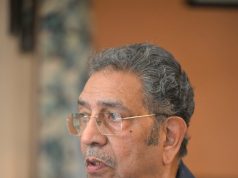
Exclusive chat with Bro Joseph M Joseph, Principal, SJA
By Arun Pratap Singh
St Joseph’s Academy (SJA), Dehradun, established in 1934 by the Patrician Brothers, stands tall as one of India’s premier educational institutions. With a rich legacy spanning over nine decades, the school has consistently nurtured individuals into accomplished professionals across various fields. Known for its academic rigour, disciplined environment, and emphasis on holistic development, SJA continues to uphold its motto, ‘Laborare Est Orare’ – ‘Work is Worship’ – ‘Udyamo hi Para Puja’. Affiliated with the Council for the Indian School Certificate Examinations (CISCE), SJA offers ICSE and ISC curricula.
Garhwal Post had an exclusive chat with Brother Joseph M Joseph, the School Principal, to discuss SJA’s enduring success, the impact of evolving educational policies, and the institution’s future plans. Some Excerpts:
With a history of 90 years, how has the school managed to retain and enhance its credibility over the decades?
The Patrician Brothers have managed the school for 90 years with unwavering dedication and we have carried on with the tradition and the same value system always. Our faculty, including the Brothers, the management and staff make immense effort to maintain a disciplined, supportive, and conducive learning environment. Moreover, the friendly atmosphere among management, teachers, and students fosters a unique bond that sets SJA apart. Our philosophy emphasises the holistic development of students, transforming them into gentlemen and ladies who contribute meaningfully to society.
With the introduction of the National Education Policy, how do you view its impact on secondary education?
The National Education Policy (NEP) stresses on application-oriented and situational learning, moving away from rote methods. The teacher’s role has evolved into that of a guide, encouraging students to take the initiative and be creative. Education today is student-centric, promoting critical thinking and adaptability, which is a positive shift.
See, knowledge today can be gained through different means. In the present times, the role of the teacher is more of a guide, more of a moderator, more a support for the interests of the child. We are looking at today’s child as the centre of activities. Focus has shifted to being child-centric or student-centric.

Technology is transforming every sector in the world including education. What technological tools does SJA employ for its students?
At SJA, we have fully digital classrooms equipped with interactive boards. Our teachers create personalised teaching modules, enhancing the learning experience. We also have three computer labs catering to juniors, middle school, and seniors. Looking ahead, we plan to introduce AI and robotics into the curriculum. While robotics is more feasible, AI teaching is still a challenge due to the lack of specific curriculums and qualified educators. Nonetheless, we are making strides in integrating technology into our pedagogy.
Have the school libraries transitioned to digital formats?
Not yet. We are exploring options for online libraries but face some challenges in finding the right agency or platform. For now, we continue to add 1,000 to 4,000 new books annually to our existing library.
Children have very different learning abilities, right? They may require diverse approaches, both in terms of teaching methods and curriculum design. How do you address this challenge?
In today’s education system, the focus is not on ensuring that every student scores 100, 90, or even 80 percent. Instead, the emphasis is on personal growth and improvement. Each student is encouraged to surpass their previous achievements. We have to acknowledge that not all children can perform the same way, and that’s okay. The aim is to foster individual development at a pace that suits each learner.
Extracurricular activities have always been integral to SJA. What new initiatives are being promoted?
Sports and games are a cornerstone of life at SJA. Our students excel in various sports including tennis, shooting, and roller skating, with some reaching national and international levels. Some of our students are ranked among the top 1,000 players in tennis. Beyond sports, we have thriving theatre, debates, and music programmes. Our Dance Studio and Music Department train students in instruments like drums, piano, guitar, and keyboards. These initiatives ensure a well-rounded education. An independent agency works on musical coaching in the school.
What community services is SJA currently involved in?
Community service is a priority at SJA. Our students collect items in kind, not in cash, to support underprivileged schools and NGOs. They donate textbooks, clothes, and even food items to marginalised sections of society. These interactions help students appreciate their blessings and cultivate empathy and social responsibility.
Could you share some of the school’s future plans?
We aim to build a multi-purpose auditorium and expand our classrooms. With a current strength of nearly 4,000 students across seven sections, we plan to increase capacity to accommodate the growing demand for admissions. In addition, the school’s goal is to maintain an optimal teacher-student ratio to ensure personalised attention. I must admit that we need some improvement here.
How are mobile devices affecting students and their studies?
Technology, including mobile devices, has both positive and negative impacts. While they offer vast learning resources, misuse can lead to distractions and addiction. It’s essential for parents and students to set boundaries. Unchecked use of mobiles often hampers students’ focus on studies.