 By Anoop Nautiyal
Dehradun’s dismal performance in the Swachh Survekshan 2024 – 2025 rankings has come as a reality check. From being the cleanest city in Uttarakhand last year, it has now slipped to the 13th position among 107 cities, towns, and cantonments across the state. For a state capital that presumably receives the highest budgetary allocations for urban services, especially waste management, this is not just deeply troubling and disappointing, it is alarming.
Swachh Survekshan 2023 and 2024 – 2025 Comparative Performance
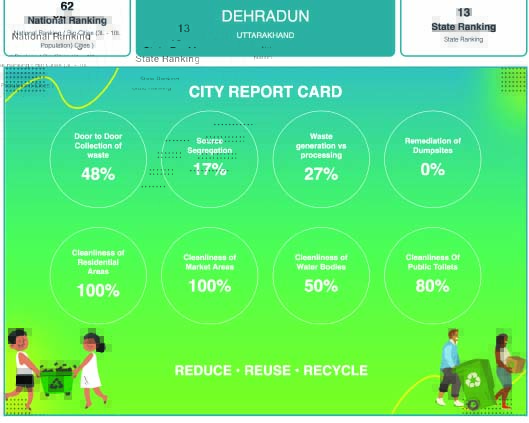
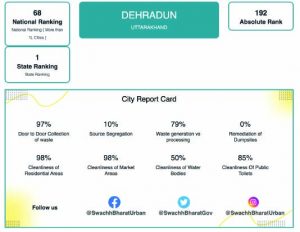
The drop in rankings is backed by sharp and undeniable data points. In 2023, Dehradun secured 6579 out of 9500 marks, i.e., about 69% and was ranked 68th out of 446 cities in the 1 to 10 lakh population category, nationally. Fast forward to 2024 – 2025, the city scored 7614 out of 12,500 marks, or 61%, and is now ranked 62nd out of only 95 cities in the 3 to 10 lakh population category.
On the surface, it appears that the city has improved its rankings and gained nearly a thousand more marks, but this is completely misleading. The scoring format has changed, and when viewed proportionally and in relative performance terms, the decline is evident and undeniable.
Critical Drops in Key Waste Management Metrics
Even more worrying are the regressions in core service delivery indicators. Door-to-door garbage collection, which is a basic pillar of urban cleanliness, has fallen dramatically from 97% in 2023 to a mere 48% in 2024 – 2025. Waste generation to processing levels have collapsed from 79% last year to just 27% this year. Yes, source segregation has improved from 10% to 17%, but that is far too abysmal for any city, forget that it’s a state capital.
Learn from Rudrapur
What makes the current situation even more embarrassing is the fact that towns across Uttarakhand that are much smaller in scale, capacity, and resources are outpacing Dehradun by a wide margin. Rudrapur in Udham Singh Nagar district has shown a phenomenal rise in source segregation from 8% last year to 59% this year.
There is no need for the Dehradun Nagar Nigam to visit Indore or Surat, frankly they are not at that level and don’t need to travel that far. Instead, they should visit cities like Rudrapur and the smaller ones in Uttarakhand to know what others are doing right and what the capital city can learn from them.
Small town success stories
Let’s now look at the success stories of the smaller towns in Uttarakhand. In our several years of analysing the Swachh Survekshan data for Uttarakhand, we have noticed often that the smaller towns are doing better on many parameters compared to the larger cities like Haridwar, Haldwani and many others. It is heartening to see that the Nagar Panchayat of Lalkuan has achieved source segregation of 58%, and even the small neighbouring towns like Doiwala and Vikasnagar are at 43% and 42%, respectively.
Hill towns like Bhimtal, Bhowali, Chinyalisaur, and Barkot that operate relatively on shoestring budgets have scored more overall marks than Dehradun in 2024. These are not isolated cases; they are telling examples of what is possible with consistent effort, decentralised leadership, and a functioning civic system compared to the apathy, cleanliness decay and lack of planning that is evident in Dehradun.
Time of reckoning
The moment demands an honest and objective stocktaking. The Dehradun Nagar Nigam must reflect seriously on where things have gone wrong and make course corrections in key areas. Immediate attention must go to restarting and expanding effective door-to-door collection, boosting source segregation through citizen outreach and operational planning, scaling up waste processing capabilities, and remedying long-pending legacy issues like the massive dumpsite on Sahastradhara Road.
Transfer stations like the one at Kargi Chowk and facilities such as the Shishambara landfill must be transformed from liabilities into functioning nodes of the city’s waste management network.
Why no one trusts Dehradun Nagar Nigam
None of this will work without active citizen participation. But let’s accept that people only participate when they trust the system. And that trust is currently broken. The blunt answer to why citizens don’t engage more is simple: they don’t believe the system works. Rebuilding credibility is a slow but vital process. It requires a city administration that not only has the technical knowledge and managerial skills but also the integrity and resolve to deliver results in a time bound and transparent manner.
Monitoring is key
On another note, it is crucial that the Government of Uttarakhand keeps a close and sustained watch on the performance of Dehradun. They cannot afford to let the capital city slide further under their watch. Cleaning up a few roads before a VIP visit or sprinkling water ahead of a dignitary’s arrival is akin to cosmetic surgery but progressive cities do not function in this fake charade of impersonation.
What they need to have instead are robust systems that work 365 days a year, regardless of who’s watching. That is the bare minimum Dehradun needs to aim for, and this is only possible with regular and consistent monitoring from the level of the state government or vigilant district authorities.
Dehradun can turn around
Despite the setbacks, Dehradun can still turn things around. But this can only happen if we first stop hiding behind misleading numbers and start accepting and confronting uncomfortable truths. Every city and community has the potential and with the right leadership and public engagement, Dehradun can become a model for others to follow, at least in Uttarakhand.
The time for excuses was long over. If even after this setback it’s still business as usual, it will only get worse in the coming months and years ahead. Clearly and without any further delays, the time for action is now.