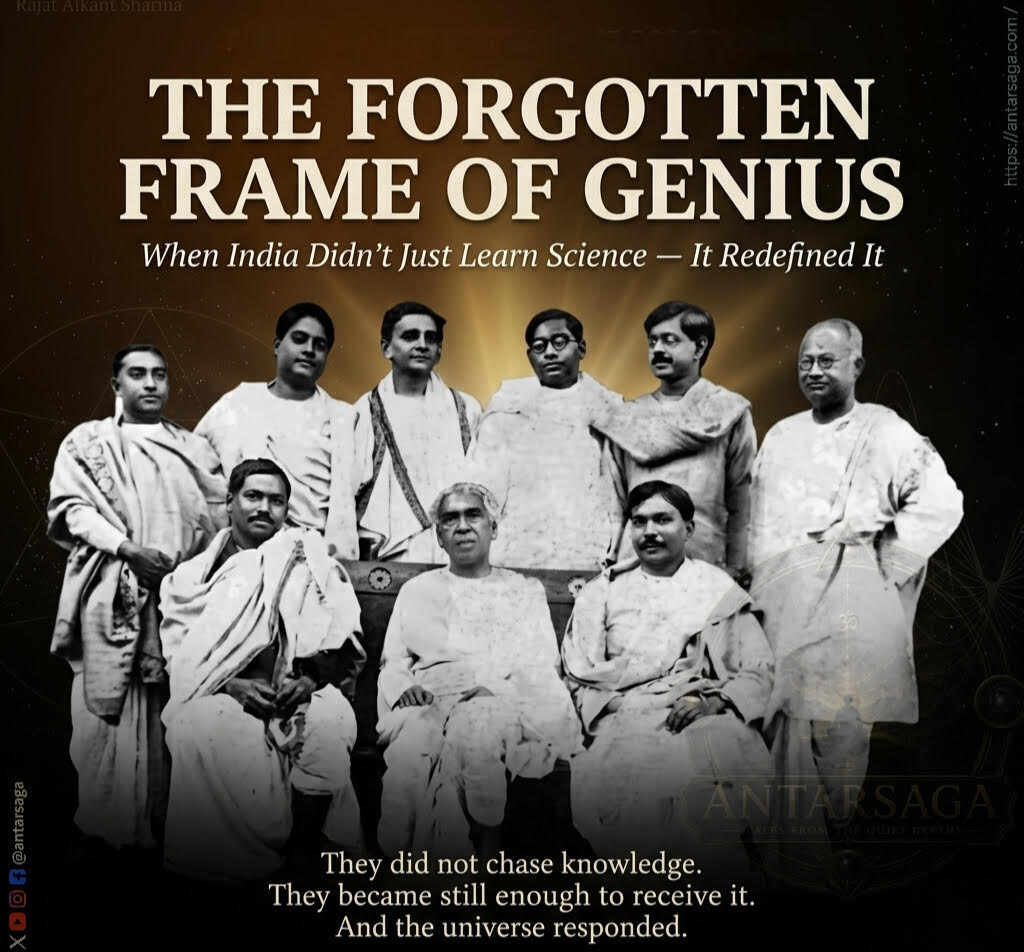
When India Didn’t Just Learn Science — It Redefined It
 By Rajat Aikant Sharma
I was scrolling—the way one does now, half-present, half-elsewhere—when the photograph stopped me. Not because it announced itself. No urgency engineered into it. Just nine men in white. Seated. Standing. Still.
Then I read the names.
And the ordinary shifted.
There are photographs—and then there are civilisational echoes, quietly preserved in a single frame. This is one of them.
Nine men. No spectacle. No grand laboratories. No visible instruments of genius. And yet within this modest composition stands a constellation of minds that helped reshape modern science—not by importing it, but by advancing it.
Six are identified. Three remain unnamed—a reminder that history rarely records everyone who stood in the room when something important was taking place.
We remember the theories. We have forgotten the frame.
“They did not wait for permission. They contributed.”
Jagadish Chandra Bose — Seated, Centre
Physicist · Biophysicist · Pioneer
A physicist who demonstrated wireless transmission before it became history elsewhere, then crossed into plant physiology to show that the boundary between living and non-living was far less fixed than science assumed. He presented his work publicly before filing patents—a mix of conviction and circumstance whose consequence was the same: credit drifted elsewhere. In his laboratory, the boundaries between disciplines dissolved. Science, for him, was not compartmentalised—it flowed.
Meghnad Saha — Seated, Left
Astrophysicist
His ionisation equation turned starlight into data, making the composition of distant suns legible for the first time. The sky ceased to be distant mystery—it became readable. That a young physicist working without the institutional resources of Europe produced a framework now fundamental to stellar science is not a footnote. It is a fact.
Jnan Chandra Ghosh — Seated, Right
Physical Chemist · Institution Builder
Less celebrated, but no less important. He understood that brilliance, unsupported, eventually extinguishes itself. His deeper contribution lay in building institutions—ensuring that scientific thinking in India would not remain isolated brilliance, but become a sustained tradition. That work does not appear in equations. It appears in the careers of those who came after him.
Satyendra Nath Bose — Standing, Second from Left
Physicist · Quantum Theorist
His 1924 paper on quantum statistics—sent directly to Einstein when Indian journals hesitated—gave rise to an entirely new class of particles: bosons, governing the behaviour of light and matter at the most fundamental level. Few scientists enter the language of the universe itself. He did.
Debendra Mohan Bose — Standing, Third from Left
Experimental Physicist
He worked in the unseen—studying cosmic rays and subatomic particles through inference rather than direct observation. His work belonged to realms that could not be seen, only inferred. The kind of science that builds the ground others stand on.
Snehamoy Dutt — Standing, First from Left
Scholar
Representing those who built the intellectual scaffolding of Indian science without the visibility that accrues to those whose names attach to equations. His presence in this frame is not incidental.
Three Unidentified Figures — Standing
Names Not Yet Recovered
Three men whose names have not survived in available records. Their anonymity does not diminish the moment. It reminds us that what we have recovered of this era is partial—and that there may be more worth recovering still.
This was not just a group. It was a turning point.
At a time when India was still under colonial constraint, these men were not absorbing knowledge—they were producing it. Original. Rigorous. Globally consequential.
“What shaped such minds? How did a generation, working without institutional validation, think with such clarity and originality?”
The answer may not lie in education alone. It may lie in orientation.
A way of engaging with reality not as disconnected fragments, but as patterns held together by underlying order. A quiet assumption that the universe is coherent—and that the human mind, sufficiently refined, can meet it.
This does not appear in equations. But it shapes how equations are found.
In earlier traditions of this land, knowledge was not pursued only outwardly. Equal emphasis was placed on refining the instrument that seeks knowledge—the mind itself. Through discipline, sustained attention, and inner stillness, the mind was trained not merely to accumulate, but to perceive.
And when such clarity is reached, insight does not always feel like invention. It feels like recognition.
Modern science draws a sharp line between intuition and proof. But history suggests something subtler. Many breakthroughs begin before formal structure—in a space of deep immersion, pattern recognition, and internal clarity that precedes validation.
Srinivasa Ramanujan remains the most striking example. Results of extraordinary complexity, emerging through processes that formal training alone cannot fully explain. Whether one calls it intuition, subconscious depth, or something we lack the vocabulary to name, it points to a mode of knowing we have yet to fully understand.
The scientists in this photograph stood at a rare intersection. They neither romanticised the past nor rejected it. They worked with rigour—while leaving space for wonder. That balance may be their most important lesson.
Because something has thinned since then.
We have more tools than any previous generation. More data. More speed. More access. And yet the quality of attention—the depth from which inquiry emerges—often feels diminished. We accumulate knowledge without refining the mind that engages with it.
“The next leap may not come from processing more information. It may come from a different quality of mind encountering that information.”
Consider what lies ahead. The boundaries between disciplines are dissolving again. Consciousness is becoming a subject of serious scientific inquiry. The separation between observer and observed, between matter and mind, is no longer as rigid as it once seemed.
What if the next breakthrough does not merely extend our understanding—but reorients it? What if reality, as we currently model it, is only a partial map?
This is not fantasy. This is where the questions are already pointing.
And if history is any guide, the minds that make that leap will not simply be the most informed. They will be the most clear. Precise, yet open. Trained in method, yet not confined by it. Grounded in evidence, yet aware that reality may exceed what we currently measure.
I was scrolling when this photograph appeared. It did not demand attention. It held it.
Perhaps that is how real things work. They do not announce themselves. They wait—to be noticed, to be carried forward.
Not just the theories these men gave us.
But the way they thought.
The way they saw.
The way they listened— to a universe that still has far more to reveal.
And somewhere, even now, another mind is learning to listen the same way.
(Rajat Aikant Sharma is a writer and photojournalist exploring culture, history, and human stories. Beyond print, he creates digital content, posters, and social campaigns that extend his editorial voice into the world of influencer engagement and brand storytelling.)