Around the World with the Most Travelled Indian
 By Nitin Gairola
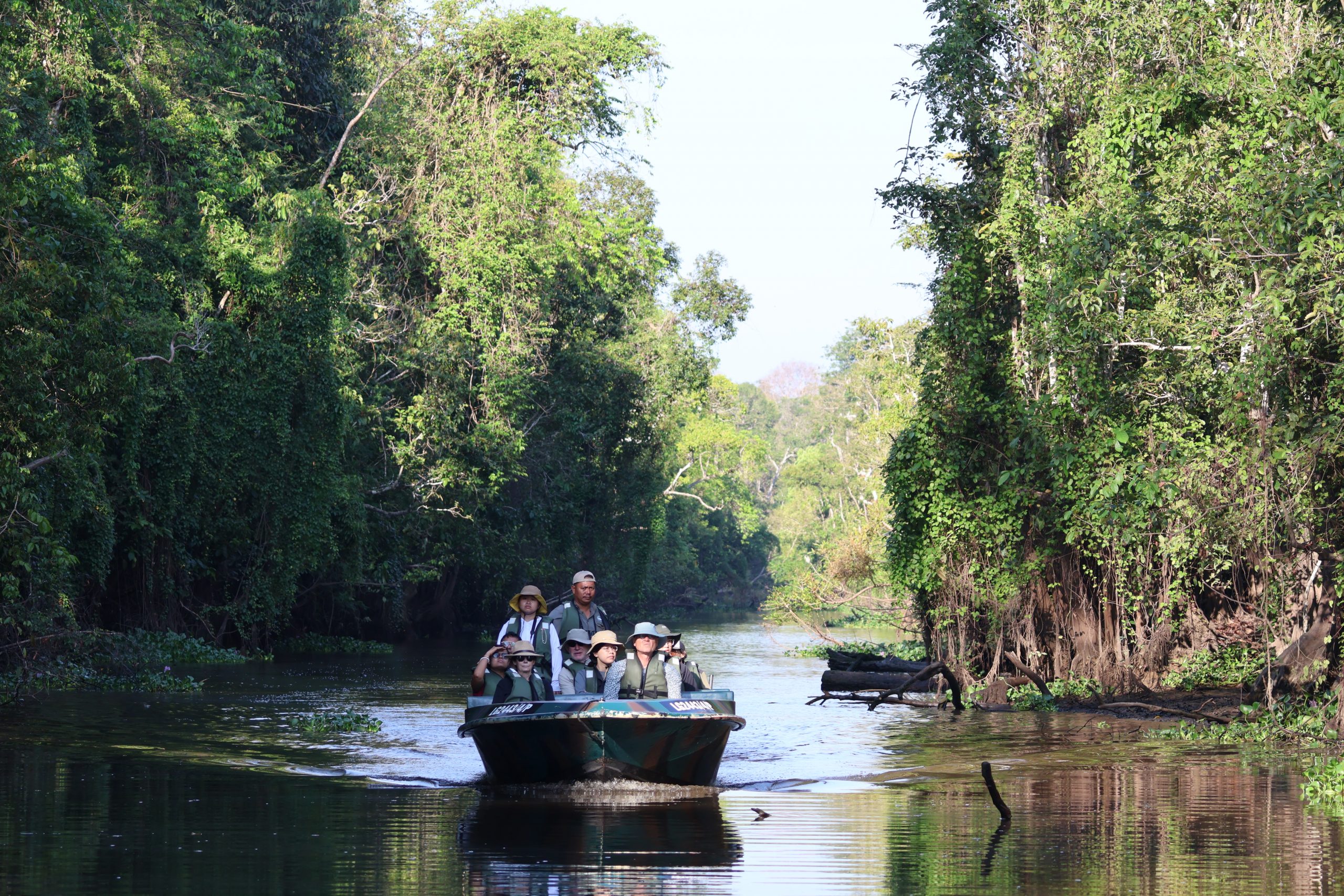
The jungle is deep, dense and damp to say the least. In Borneo we were inside a 140-million-year-old rainforest and, just like the Congo, it is home to a lot of mega fauna or large animals. And while the Amazon has the large feline predator in the muscular Jaguar, both Congo and Borneo are home to one large ape each. As some may know and some may not, apes are different from monkeys and the world has only 6 ape species left, of which 5 are the ‘great apes’ and 1 is categorised taxonomically as a ‘lesser ape’. The 5 great apes are Gorillas, Orangutans, Chimpanzees, Bonobos and Homo Sapiens (us) and the 1 lesser ape is the Gibbon. Basically, on the evolutionary path, the apes branched out of monkeys and lost their tails but only 1 ape evolved to bipedalism, which is the Homo Sapien. Since we had seen Gorillas and Chimpanzees in the wild in central Africa (on foot) besides we had also seen a lot of hominid fossil sites of early humans (my love for paleo-anthropology is evident), I thought it would be a good idea to see another great ape in the wild that lives far from Africa – and that’s the orange orangutan. This would be another piece in my personal paleo-anthropological puzzle that I can fit on my world map and with that I would only need to see Bonobos in the wild in the Congo to complete my great ape collection (this is since I have already seen Homo Sapiens – way too many).
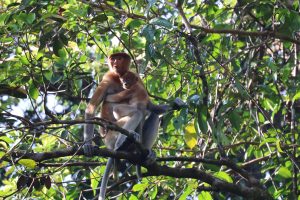
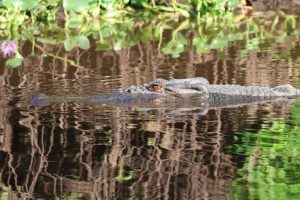
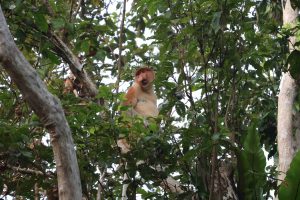
And so, on we went in our personal search for this creature. But just when I thought it would be all about the Orangutans in the same way as Uganda, Rwanda & Congo are all about the Gorillas and India is about the Tigers, I started realising that this ancient jungle holds many other exotic secrets. I was simply awestruck by the unique look of the Proboscis monkey, and its really, really long nose reminded me of the nose of Roberto Rastapopoulos, the fictional villain in the Tintin comics. The various day boat safaris also brought up other monkeys, monitor lizards, and more crocodiles, including the largest one in the area. While I don’t recollect its name, but let me simply call it the ‘monster croc’. That salt water croc was huge and it was scanning the muddy waters for some prey.
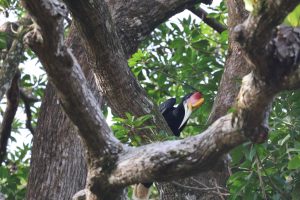
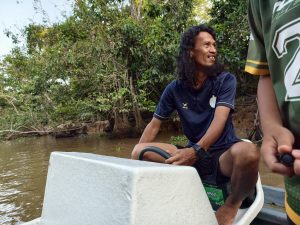
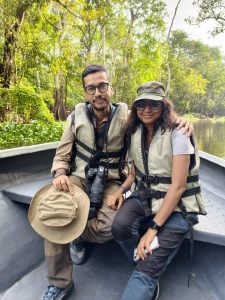
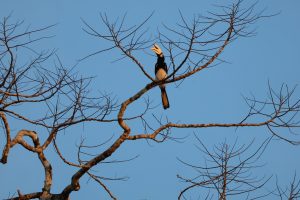
And let me not forget the birds. There were so many species of hornbills alone that I have lost count. One of the hornbills was called the Rhinoceros Hornbill because it has a large red-yellow horn like structure above its beak. And in Borneo they had copied the ‘big 5’ term used in Africa and as per them the ‘big 5’ of Borneo were the Orangutan, the Pigmy Elephant, the Sun Bear, the Proboscis Monkey and the Rhinoceros Hornbill. For 2 days I heard about this mythical ‘Rhinoceros Hornbill’ and it was only in the day-3 morning safari that we finally saw this magnificent creature on a treetop. In that particular ride, we had a group of Indian doctors and medical practitioners who were actually Malay nationals now. One of them was Prabha, a keen bird spotter, and she also carried a book on birds (just like our guide, Ayieml did) and Prabha could understand the bird calls and spot them from a mile away. We were so glad to have her on our boat that morning as she added a lot of ‘colour’ to what we were viewing.
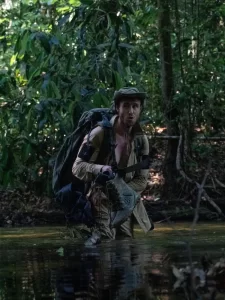
Dykes in Congo.
One of the memorable sightings was also the time when we saw a Proboscis mother and a baby gingerly crossing a rope bridge (put in place by conservations to allow monkeys to move from one side of the river to the other without having to go down and swim across it). I can just imagine how dangerous that river crossing would have been for the proboscis monkeys given how crocodile infested that river was. Seeing the mother and baby on the rope between two tall rainforest trees and the murky river below was a scene I won’t forget in a hurry. The same monster croc was waiting patiently below and we breathed a sigh of relief when they crossed over safely.
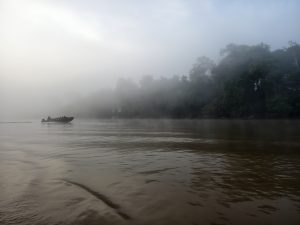
Besides the proboscis monkeys, we really wanted to see the Pygmy Elephants as well, and of course, the iconic Orangutans knowing well that Sun Bears were impossible to view in the true wild (only the semi-wild Sepilok area was an option for them). Our excitement grew when a group told us that they had seen a female orangutan just the other day in the evening (the boat ride we had narrowly missed). So, we went into the evening safari ride, two days post that sighting, with a lot of expectations given that we were to leave the next afternoon for Sepilok. The boatman and the guide were trying their best to ensure we got to see these two animals in the wild but for 2 hours on the river we had no such luck. We were fine with it since we got to see a lot of bird life, and more and more monkeys and crocodiles. We also had a lot of false alarms but our guide was really at his sharpest to track the big wonders of the jungle. And late in the evening he got a call on his satellite phone and the boat suddenly took a sharp U-turn and the motors were revved up. We knew something big was there but didn’t realise it was the biggest out there – we finally got to see the big ‘pigmy’ elephants of Borneo. These pigmy elephants are a sub-species of the Asian Elephants and are the smallest of all elephants in the world. But small in the elephant world is a relative term and these were still quite huge.
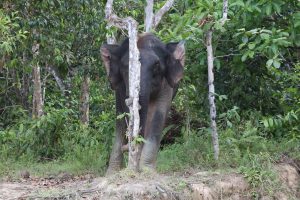
It was quite funny that one of the elephants was trying to hide behind a tree. I hope he realized that he needed more than a tree to hide. Then a while later the other one decided to play in the mud on the banks of the river and we just stood there viewing these wonderful ‘little’ giants. It was finally getting dark and we had to turn our boat out of the swamps and enter the wider river on our way back to the pier. But the jungle kept revealing its secrets for our viewing pleasure since en-route we saw many other species of the hornbill and then came a colony of bats for the closing ceremony, as they flew in the thousands over our head in the darkening sky.
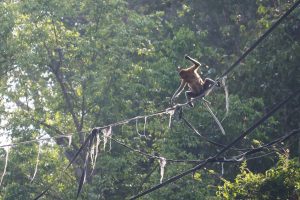
crocs below.
The Kinabatangan River holds so many surprises and no two journeys are the same. We never saw the orangutan in Sakau (we would see them later, and how) but that didn’t bother me much and I guess one needs to realize that the local wildlife isn’t there waiting for your royal highness to arrive. The jungle has so many other secrets and if we perpetually live in the future then we will miss out on the present in front of us. For me, going through the murky Kinabatangan River was like what Ash Dykes is doing right now in the Congo, on the Sangha River. But in his case, he is on an independent kayak along with 3 others in their own kayaks and that is not touristy at all. Ash is a real explorer and since I always wanted to be one myself (but wasn’t tough enough), so being guided on a boat was a safe way to feel the wild and not be swallowed up by it. The snake, that is the Kinabatangan, can actually swallow you whole – should you give it a chance.
Nitin Gairola is an extreme world traveller who has been to every major desert & forest ecoregion on Earth and to around 150 countries & autonomous territories. He is unofficially known as the ‘most travelled Indian’ and this multi-decade exploration program to witness the entire world is named ‘Borderless Planet’. Nitin is a published travel writer & poet too. Join him @ www.instagram.com/ MostTravelledIndian/