 By Rajat Aikant Sharma
“The mountain doesn’t speak; it remembers.
Those who listen become part of its memory.”
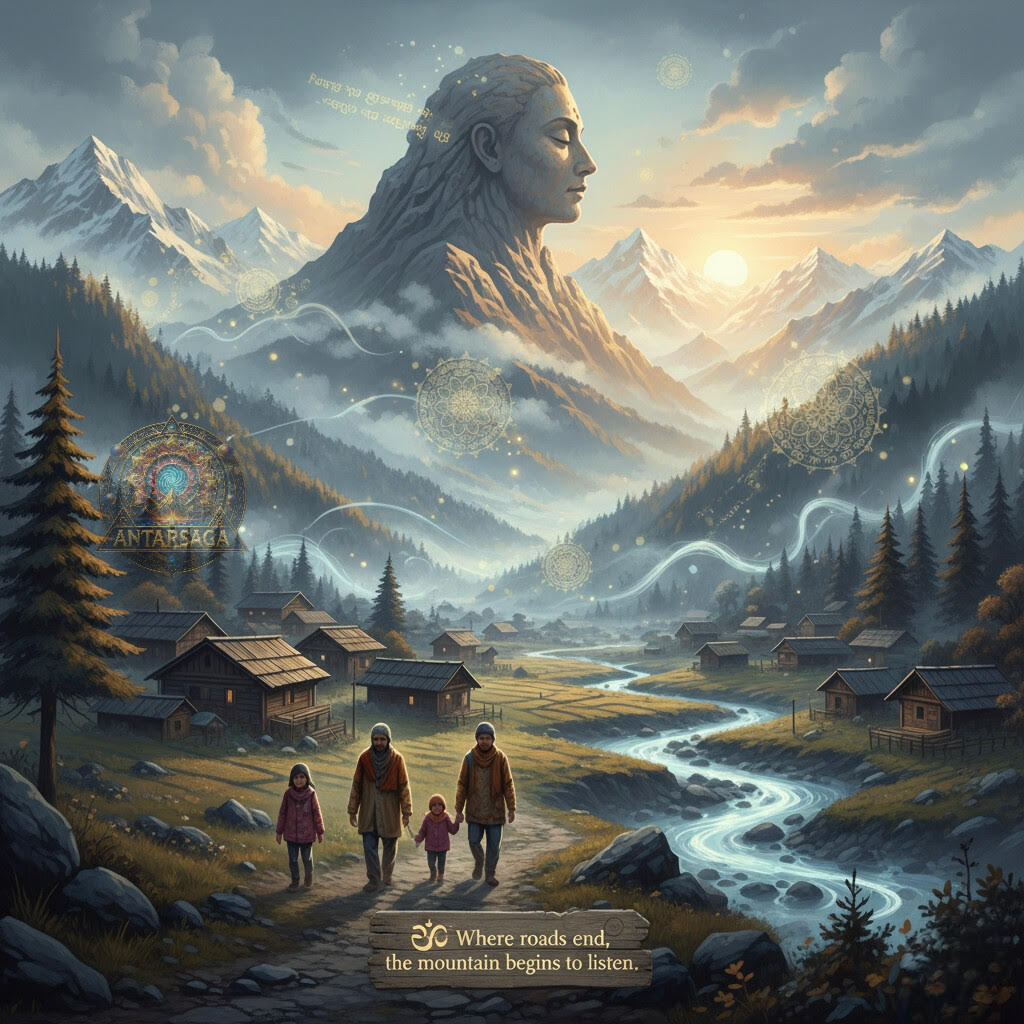
Are the mountains sentient? The villagers smile and say, “They listen.” It sounds poetic, almost naïve — yet perhaps they are right. The Himalaya does not merely stand; it responds. Science now calls it geomagnetism, but the ancients always knew it as consciousness in form — a vast, living field where thought meets terrain and silence turns into conversation.
This autumn, our journey from Mussoorie to Sankri began on roads half-broken by monsoon and machine. Between Naugaon and Mori, every bend felt like a dialogue between rock and rain. Bulldozers carved, rivers bit back, and landslides paused as if deciding the fate of travellers. More than once it seemed sensible to turn back — the road dissolving, the car rattling, nerves tested. Yet in the Himalaya, revelation arrives only after surrender. By dusk, we reached Sankri — that tender threshold where roads end and stillness begins.
Sankri is no metropolis; it is a pause. A cluster of wooden roofs, forested slopes, a small market, a few homestays and hotels, and the soft murmur of streams — a settlement breathing at the edge of sound. At its heart stands a modest restaurant run by a Nepali woman, Kalavati, whom everyone calls Kali Didi. Nearly twenty-five years ago, her kitchen was the beating heart of the village — a warm epicentre where trekkers, porters, and locals gathered over rajma, pahadi dal, kaddu, and tales from the trails. Today, many new eateries have sprung up, run by locals and Nepali families who have made these valleys their home. Yet I still find myself returning to her — not for comfort or convenience, but for continuity. Even when her seating feels humbler than others, the taste and her greeting carry a sincerity time hasn’t touched. I usually preferred eggs, and every year, the moment she sees me, she somehow manages to find a few — even if none are available anywhere in Sankri. That gesture alone feels like the Himalaya remembering.
I first met her decades ago, when she cooked for us after we had bought a chicken from the small market nearby. She prepared it with such patience and care that the act itself felt ceremonial — as though food here was never just cooked, but consecrated. Even now, each autumn when we return, dust-streaked and weary from the drive, she greets us with the same warmth — “Aa gaye phir se, bhaiya?” Her food is not merely nourishment but communion; each meal becomes a quiet ritual binding us to place, season, and memory.
Over the years, as cafés and homestay kitchens appeared across Sankri, I’ve still found myself walking back to her small wooden room — drawn not by comfort but by something subtler, almost magnetic. Even when eggs vanish from the market, she somehow manages to arrange a few, as if remembering my old preference before I speak. That simple gesture — the familiar smile, the clatter of utensils, the scent of smoke and spice — carries the tenderness of time itself. Perhaps this, too, is how the mountain remembers: not through monument or thunder, but through the continuity of kindness.
Kali Didi’s restaurant, modest and unassuming, mirrors the same intelligence that shapes the villages of these valleys. Nothing here feels accidental — not the placement of her hearth near the slope where sunlight lingers longest, nor the tin roof that hums softly in the wind. Like the ancient temples that receive the first and last light of day, her kitchen follows an unspoken geometry of balance. Every stir of her ladle, every spark beneath her pot, seems attuned to the mountain’s own rhythm — sustenance as sacred vibration, hospitality as a form of prayer.
The next morning, as we continued walking toward Taluka and Dhatmeer, that sense of harmony followed us. The villages we crossed were not built but placed — aligned with light, water, and flow. Spring sources appeared exactly where they must; homes curved with the contours of slope and stream; temples stood like tuning forks to the sky. The ancients called it vastu; modern science might call it ecological intelligence. Whatever the name, the outcome is the same — a design that breathes with the precision of physics and the grace of faith.
Sankri is more than a village; it is a threshold. From here, trails unfold like branches of memory — toward Taluka, Osla, Gangar, and the alpine pastures that cradle the Har-ki-Dun Valley, once believed to be the route the Pandavas took on their final ascent to heaven. To the north, the paths diverge toward Borasu Pass, crossing into Himachal near Chitkul, and toward the lesser-known Bali Pass that connects to the Yamunotri Valley. Higher still lies the mysterious Bharadsar Lake, perched between Uttarakhand and Himachal, its waters considered sacred to the sages. The twin rivers Rupin and Supin descend from these folds to form the Tons, their confluence carrying the mythic breath of Mahasu Devta — the guardian deity of this entire belt, still worshipped as a living presence said to have guided the Pandavas themselves. Every route from Sankri, whether towards a known summit or a forgotten shrine, feels less like a trek and more like retracing footsteps written in myth.
These repetitions of form — temple perches, streamside courtyards, circular fields — are not aesthetic coincidences but imprints of memory. They are the way consciousness arranges matter when given time and reverence. The Himalaya, in that sense, is a neuro-landscape — an open brain sculpted by tectonics and thought alike. Each ridge, each path, each shrine operates like a neuron in the mind of the Earth, conducting currents of gravity and remembrance.
Travelling with family deepened this realization. For the children, it was pure wonder — goats on terraces, echoes bouncing across valleys, clouds shifting like cathedrals. For us, it was introspection. Walking together — detached from signals and schedules — we began to sync with natural order. Silence revealed its own structure, like rhythm in music or pattern in light. The more often we make this journey, the more it feels less like travel and more like repetition of a mantra — each visit polishing perception, each silence widening awareness.
Beyond Dhatmeer the slopes rise into myth — Swargarohini, Har-ki-Dun, Ruinsara, Kedarkantha — mountains that exist equally in the Vedic cosmos and on the topographic map. They breathe a memory older than civilization. Locals say the forest beyond Taluka is conscious. I have felt that presence — not the watchfulness of eyes, but the subtle awareness of vibration. These woods respond to stillness. Even science now admits that trees communicate through frequency and that rocks hum at low electromagnetic tones. In that hidden register, mythology and geology meet halfway.
Yet this year, the mountains bore their own strain. Heavy rains wounded the slopes; landslides erased paths; the rajma and pahadi dal harvests faltered. Still, in Sankri there was no bitterness — only quiet acceptance. An old man at the tea shop smiled and said, “The Devta told us — 2025 will test, but 2026 will heal.” Faith here is not superstition; it is science translated through the heart — a predictive model measured not in algorithms but intuition.
Through all this, life continues in tranquil orbit. Each evening, temple bells mingle with laughter, the smell of woodsmoke with echoes of prayer. Children run freely, elders talk softly, and somewhere in the valley, Kali didi lights her chulha again — a beacon glowing through decades of seasons. Her welcome is as steady as the ridges around her, her cooking as grounding as the gravity she lives within. The true centre of Sankri may not be its roads or peaks, but her little kitchen — a human hearth warming the vast intelligence of stone.
After three days of walking — without networks, without noise — the mind slowed to the mountain’s rhythm. Silence became active, every breath a note in a larger composition. You begin to sense that the Himalaya is not outside but within you — its peaks thoughts, its rivers pulses, its villages neurons in the planetary mind. The sages were right: these valleys are not retreats but laboratories of perception.
Perhaps the Himalaya is the cognitive map of the Earth — vast, self-observing, electric with memory. The rivers are its thoughts in motion; rocks its data banks; forests its subconscious dreaming. Every rumble of thunder is a neuron firing across geological time. When villagers say, “The mountains listen,” they name a truth still waiting to be measured.
The mountain listens. The mountain remembers.
And if you walk long enough, quietly enough, it begins to speak — not in language, but in alignment.
Because some journeys are not made to reach a place.
They are made so the place can reach you.
Sankri and beyond — not a destination, but an initiation.
A mirror for the mind. A homecoming for the soul.
(Rajat Aikant Sharma is a writer, columnist, and photojournalist whose work spans culture, history, philosophy, and human narratives across the world.)