 By Wg Cdr Anupama Joshi (Retd)
(Wg Cdr Anupama Joshi (Retd) is an eminent resident of Doon. She is presently Director, Personel and Compliance at Wellington College India and an Executive Member of Routes to Roots.)
In March 2001, the world watched with horror the 6th century Bamiyan Buddha statues in Afghanistan being destroyed by the Taliban, leaving just the dust behind. Three decades before this horrific incident, a team from the Archaeological Survey of India had worked on restoration of the two gigantic statues.
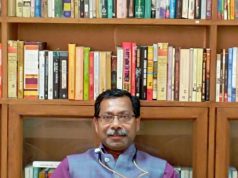
One of the restoration artists lives amongst us – Raghuvir Singh Panwar, who spent nine summers in Afghanistan to restore the paintings surrounding the 180 ft and 150 ft tall Bamiyan Buddhas. With a glimmer in his eyes, his memory is razor sharp with all the finest details of the restoration work. Having started his career as a fine arts teacher in Hindu National School and subsequently in MKP, he joined the ASI to work as a junior artist.

It was in 1969 that he went to Afghanistan as part of the delegation to undertake repair of the Buddha statues. During our interaction, he informed us that there were wall paintings in the numerous caves around the Buddha, which were very similar in terms of technique, style and colour, to that of the Ajanta paintings. The statues began to be carved during the times of the Kanishka dynasty. The Chinese traveller, Hiuen Tsang, in the 6th century AD, had mentioned the smaller Buddha. He mentions that 4500 manmade caves existed, which were square and octagonal in shape. These were evidence of Chaitya and Viharas. These were made by the Mahayana.
Panwar shared that the first sight on reaching the site was the strange look on the face of one of the statues, having been cut, and the head of the other, damaged. According to him, once they delved into central Asian history, they discovered that there was a culture of putting a mask on top of the face of Buddha. In this case, probably a bronze mask was used. He also shared a perspective that Hiuen Tsang has not mentioned Muslim advent in Afghanistan, as Islam came much later as a religion.
With impeccable clarity, he continued that the carving was done by chisel and hammer which first started in India over 2600 years ago. As Bamiyan had sedimentary rocks, it was not very difficult to cut the caves. He feels lucky to have got the opportunity to save the cave paintings of Bamiyan. It was difficult, as they were on mud and local colours were used, as also semi-precious stones like lapis lazuli were used with gum, hence the paintings were largely blue. The work around caves is mostly relief work with lotus and flowers dominating the figures.

An interesting fact he shared was that when they asked locals to measure the lips, they realised that they were so large that it could accommodate six people just inside the lips. The fine work of the drape was so large that one could walk on it from one shoulder to the other. The head was large enough to accommodate over forty-five people. It was a tiring task to reach on top of the statues daily as it involved climbing the mountain and then approach the paintings and the statues. The work carried on for nine years. Around four months, each year, work would stop as the city would be covered with snow during the winters.
Another titbit of history provided by Panwar was that, in 1840, a tourist by the name of Charles Masion came looking for treasure around the caves and, finding nothing, he wrote a message on the wall that ‘nothing will be found here, forgive him and if you don’t then you will be as blind as this big God’. And then he jumped down 180 feet to his death.
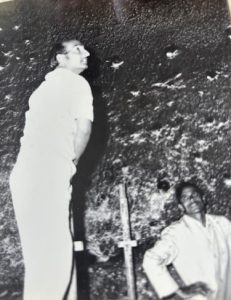
Panwar recalled all the details of the entire stay and narrated it like a commentary without a pause. It was almost like a film was playing in front of me. He recalled how they met Hema Malini and Feroze Khan who were there for a film shoot. Hema Malini refused to climb with shoes out of respect for the Buddha.
Panwar has a treasure that needs to be preserved. His love was evident from the replica that he has made and kept on his rooftop to remind him of his days in the beautiful valley of Bamiyan.
With the song “kya khoob lagti ho” humming in my head, I left his house wishing we could find more such jewels hidden in our Dehradun.