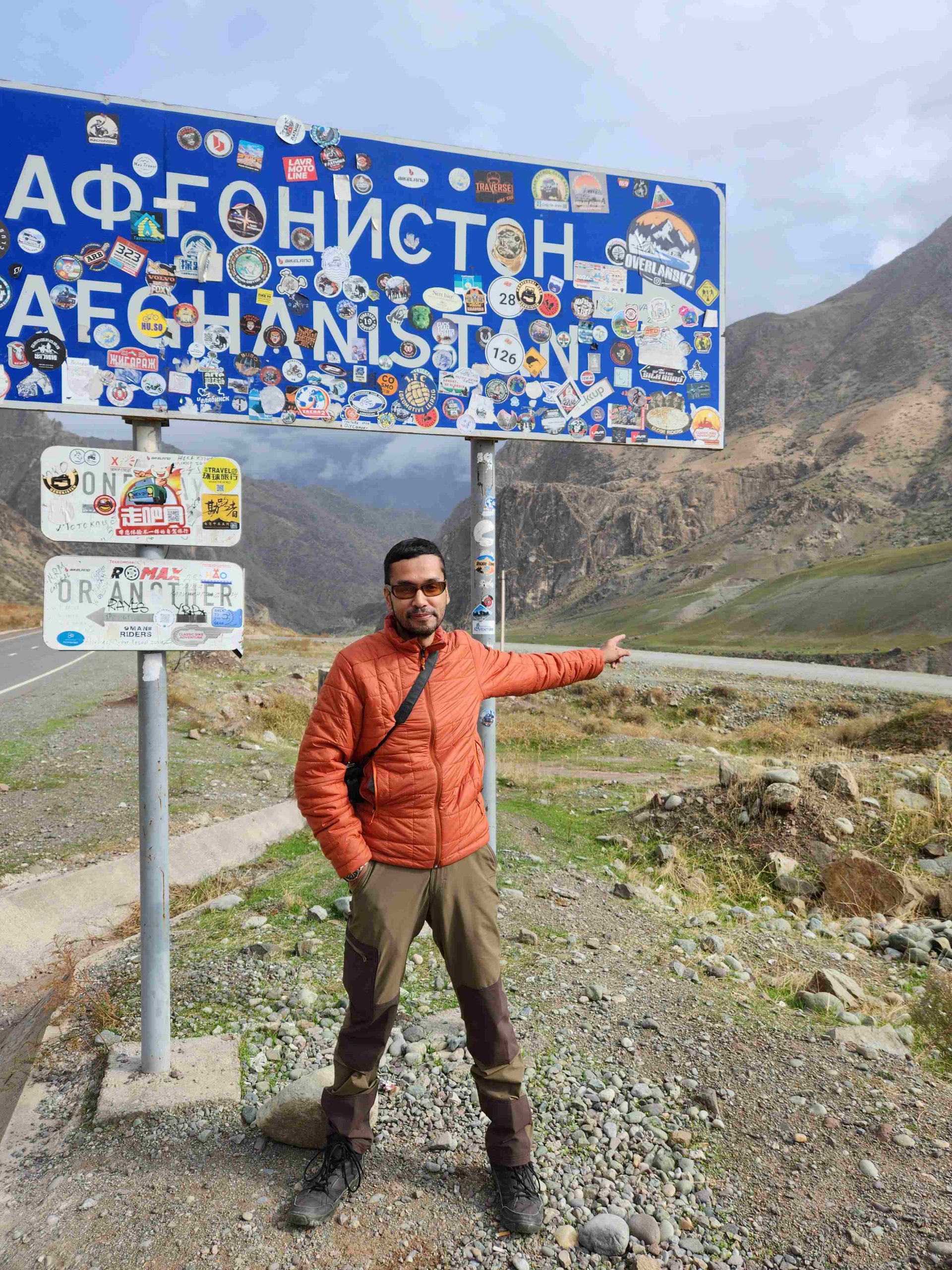
Around the World with the Most Travelled Indian
 By Nitin Gairola
Based on the amount of ice and fresh water they hold, the diversity of vegetation and wildlife they contain and the weather patterns they influence, our mountains are critical to planet Earth. They play the role of a crucial climate regulator, a habitat for life and provide a water lifeline for millions of humans.

So it is no surprise that one of my favourite physical world features are the mighty mountains and I believe I am not alone in my love for them. And being from the mountains makes the gravitation towards them even stronger. In travel, people at times ask a simple and funny question – are you a beach person or a mountain person? I have never quite understood what it really means but if I think I know what it means, then I would say mountains in a heartbeat. And this love for the mountains is not because I find any extra peace there or I intend to attain nirvana someday or I want to build a cabin high up in some remote (or not so remote) peak. It is simply because mountains are the most visible outcome of the forces of nature that are at work every day beneath our feet.

There is also some permanence about them in a very dynamic and ever-evolving planet. Of course, I say permanence with a grain of salt since I think of time in geological terms and not the way most of us think of it i.e. upto 2 generations either way. And finally, despite all their permanence at the core, their exterior is so vulnerable to factors like the changing climate and human interference and this too is a reason for my scientific interest in them. If the mountains are not in good health, know that the planet is not in good health either.

And while I don’t claim to be any climate scientist or even less a mountain adventurer (I was at one time scared of heights), I have visited all the prominent mountain ranges of the world because this is what I do. I visit all places of a particular type in the natural world (such as mountains, deserts, forests etc) and I am not done till I have seen all of them around the world. I do this so that I can see the bigger picture, to try to put all into context, to try to compare and connect the dots and see if some patterns emerge. I also know that none of this study of mine is original. I am reading it all from different sources but when I see the places first hand, it just gives me a better perspective and lends colour to the text. So, in this quest of ‘everything’, I have been to all prominent mountain ranges – be it in terms of their average height or their length or the area covered by a mountain range (So I am no sports adventurer who climbs the highest peaks, just visits the area). But regardless of not aiming to scale any peak, I was still in a bit of a hurry to visit all the mountain ranges in the world, since there is definitely an age limit to it. After all there are no medical facilities high up and the air is thin.

Some of the highest mountains are naturally in the Himalayas but be rest assured that Asia has many other mega ranges too – such as the Karakorum, Hindukush, Pamirs, Tien Shan and the Kunlun. All these are bunched up together and caused by the Indian continental plate ramming into Asia around 50 million years ago. The Altai mountains further up north in Kazakhstan, Russia, Mongolia and China are quite significant too. Further west towards Europe, we have the natural Asia-Europe border formed by the long-slender Urals, and by the Caucasian Mountains a bit further south near Azerbaijan, Georgia and Eastern Europe. The Scandinavian range in Norway is the longest in Europe whereas the Alps in Switzerland & Austria are the most popular and well know tourist friendly mountains. They are also very popular in Bollywood culture with a very popular movie from the 1990s being shot there (you know which one I am talking about)
Africa doesn’t have very high mountains ranges (Atlas in Morocco is moderate and so is the Drakensberg range down south) but they do have some big peaks towards the east such as Mt. Kilimanjaro (highest in Africa at 5,895 meters) and Mt Kenya, the 2nd highest. Kilimanjaro or Kili as it’s called, is a tourist magnet for those who are not ultra-fit however still want to do something mega. But unlike Africa, the Americas are home to ranges that rival the ones in Asia in terms of scale. While the Asian ones are giants in height, length and area, the ones in the Americas are the longest and the 2nd highest as well.

They are impressive and awe inspiring to say the least. But what is less known is that the Alaskan range, Rockies and the Sierra Madre of North America are no match for the sheer height and the unbroken length of the Andes in South America. Mt Aconcagua, the highest peak of the 2 Americas, stands very tall at 6961 meters. In comparison Mt McKinley or Denali of Alaska is 6,194 meters and is the highest in North America. And since we are comparing, Mt Everest is 8,848 (or 8,849) meters and there are 13 other Asian peaks are over 8,000 as well.

But it must not be forgotten that Antarctica has imposing mountains too going well upwards of 4,000 meters and with an attitude like that and in a latitude like that, we are talking serious frostbite territory (actually it is brain numbing). Finally, we have the other southern continent that we do not know as ‘Oceania’. But you must realize that we can’t call it Australia since then New Zealand, Papua New Guinea and a host of other island nations wouldn’t be very pleased. In terms of mountains this is relevant too. This is since while Australia has the longest range of the continent called the Great Dividing Range and New Zealand has it’s beautiful Southern Alps (these European invaders were not very creative with names), it is actually the large island of New Guinea that has the highest peak of the continent (Puncak Jaya at 4,884 meters).
In fact, the world has some very extreme adventurers who actually try to scale the highest peak of each continent. This global adventure project is called ‘The Seven Summits’ and it is then that the Oceania vs Australia debate becomes relevant. These Seven Summits are Mt Everest (Asia), Mt Aconcagua (South America), Mt. Denali (North America), Mt Kilimanjaro (Africa), Mt Elbrus (Europe), Mt Vinson (Antarctica) and Mt Puncak Jaya (Oceania).

And while I see mountains from the lens of science, my interactions with people from the mountains have been equally enlightening and enriching. Be it in the Andes, The Rockies, Atlas, Alps, The Dividing Range, Pamirs, Hind Kush, Karakoram, Tien Shan or our very own Himalayas. I am from the mountains myself and I find a kindness and genuineness in most mountain folk (but not all, it must be said). Somehow, mountains around the world feel like home to me, but I know I can’t stay at home for too long.
(Nitin Gairola is from Dehradun and has travelled the natural world more than almost any Indian ever. He is on the verge of becoming the first to travel to every Desert, Forest, Grassland, Tundra & Ice biomes on Earth. Nitin has set world travel records certified by India Book of Records, has written for Lonely Planet and holds National Geographic conservation certifications. He is also a senior corporate executive in an MNC and in his early days, used to be a published poet as well. Reach him at: www.facebook.com/MostTravelledIndian/)