By: Ganesh Saili
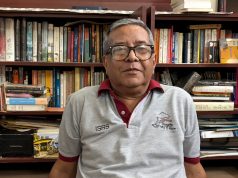
If you were to call Chunnu by his proper name, please forgive him for not answering. Manmohan Karanwal is what his parents lovingly named him. It was such a mouthful that none in our hill station, nay no one has ever called him that. On the day of the Mussoorie Massacre – the 2nd of September, 1994 to be precise – he had overslept. He woke up the day after in Hollow Oak – an old colonial bungalow – on the western edge that he had snapped up years ago.
The next day, not having the faintest idea what had happened in our hill station, he walked past the barrier temporarily set up at the Library Square. Quickening his pace, he found it strange that the whole town seemed to have overslept. At the Kutchery, he found himself surrounded by a bevy of men in uniform. They stared at him, and he looked them in the eye and blurted: ‘I have to see the SDM!’ They let him through. Badri Prasad Jasola, the SDM, had the day before reluctantly been forced to sign an order to open fire at the Children’s Park. He had had to, with a gun pointed at his head.
‘I need a pass and also one for my friend Ganesh.’ We were among the first to be co-opted onto the post-disturbance peace committee. Our job was to restore peace and assist in any way to help the town get over the dastardly events of that traumatic day.
Winkie, who runs a guest house below Sylverton, had a similar albeit funnier experience. He had no idea of what had gone down and thought nothing of it as he set out for his usual morning jog.
‘Where do you think you’re headed?’ asked the man in khaki at the picket post, striking the ground menacingly with his baton.
‘On my jog!’ answered Winkie coolly, blissfully unaware of the happenings of the day before.

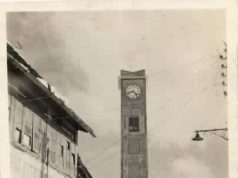
Pic courtesy: Author’s Collection
‘Idiot! Go home! Curfew!’ said the troopers, gagging with laughter.
Let me explain. A small forgotten hill station that had not witnessed a single lathi charge in its brief history of two hundred years was suddenly dealing with shots fired, people dead and a curfew imposed.
’I have never seen what it is like. A mela or a circus?’ Stubbornly he insisted on seeing what a curfew was. He did not have to wait long. He was duly enlightened at Mullingar where, encouraged along by several whacks from a lathi, he was shoved into the Landour Chowki.
On the third day, the administration decided to test the waters by allowing the citizenry to go and shop for two hours to pick up essentials.
Suddenly it dawned upon us that only women and children were thronging the shops.
‘Where had all the men gone?’ we wondered.
Aware of how a small spark could start a conflagration, we hoped they would not start anything afresh. With growing concern, we frantically fanned out in all directions looking for them.
We eventually stumbled upon a crowd of men gathered around a shop on Camel’s Back Road. There they were, the whole blooming lot of them; while we had been worried sick about them, they were merrily slaking their thirst at the local booze shop.
Harbinder Wadera, better known as Mr ‘Toothpick’ for his horrible habit of having a toothpick dangling from his mouth, set out, dapperly dressed, for his usual evening stroll through the shuttered bazaar.
‘Your father drove past me,’ he later told my daughter Tania, a friend of his eldest son Vinny: ‘He asked me to turn around and go home as the curfew was in force. Yes! I was most considerate. I waited for him to take the bend after Khaliq’s workshop so that he could no longer see me in his rear-view mirror! And then I carried on.’
Sure enough, as expected a police jeep intercepted him at Kohinoor Building; he was beaten black and blue and escorted to the thana. Curfew had truly begun.
The lesson was clear: ‘If you find yourself in a hole, stop digging!’
Many learnt this the hard way.
Ganesh Saili born and home-grown in the hills belongs to those select few whose words are illustrated by their pictures. Author of two dozen books; some translated into twenty languages, his work has found recognition worldwide.