 By Bharti P Jain
Dehradun sits in the Doon Valley, between the Himalayas and the Shivalik foothills. Historically, its soil profile and natural drainage systems allowed rainwater to percolate, replenishing aquifers that feed hand pumps and wells, while the extra flowed into seasonal streams.
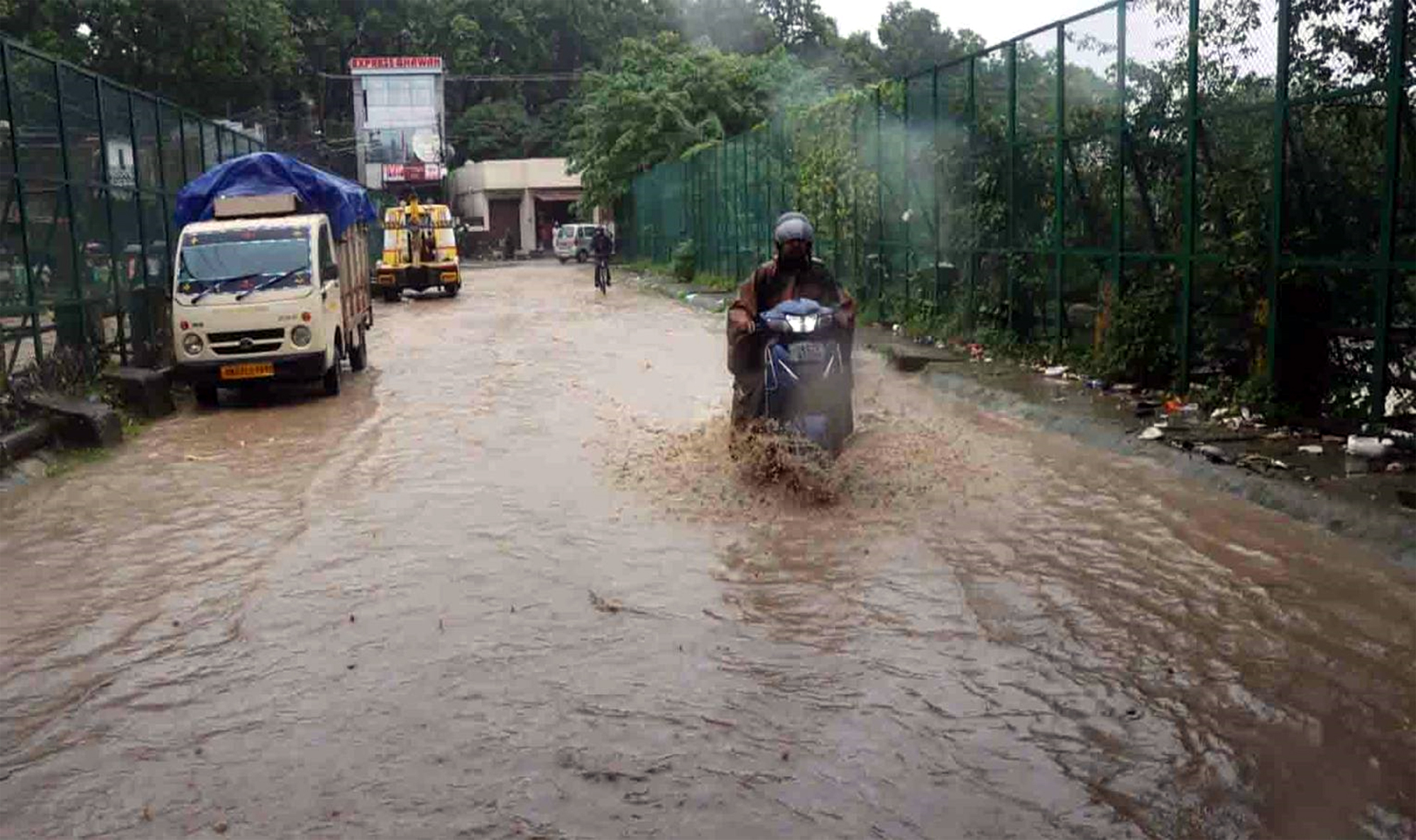
But rapid urbanisation has altered this balance. Each monsoon, especially with changing rain patterns, when it rains in Dehradun, in shorter span enormous volumes of rainwater flow down. This is because impermeable surfaces in the city have increased resulting in large volumes of water on the roads. The immediate concerns are familiar: waterlogged roads, traffic jams, and overflowing drains.
But the deeper issue is less visible.
Across Rajpur Road, Sahastradhara Road, GMS Road, Balliwala, and the fast-growing Shimla Bypass corridor, open land has steadily given way to paved roads, parking lots, tiled courtyards, and dense construction. Even residential colonies increasingly replace soil with concrete. The result is simple: rainwater has fewer places to go. Instead of soaking into the ground, it flows rapidly into roadside drains, often carrying silt, debris, and plastic waste. During intense rainfall, this leads to flash flooding in low-lying pockets such as areas near ISBT, parts of Turner Road, and stretches around the Rispana and Bindal river corridors.
As a result rainwater management in Dehradun is treated largely as a drainage problem. Hence we are designing our rainwater systems for evacuation, not absorption.
This, in turn, will have three major long-term consequences.
First, groundwater recharge declines. As more surfaces become impermeable, aquifers receive less replenishment. At the same time, dependence on borewells increases. The imbalance is not immediately visible, but it accumulates over years.
Second, soil erosion intensifies. Fast-moving runoff along road edges, construction sites, and slopes erodes topsoil and deposits silt into drains and rivers. This increases maintenance costs and reduces the carrying capacity of rainwater channels.
Third, the downstream flooding risks grow. When water is channeled quickly into narrowed natural river basins like the Rispana and Bindal, the peak flow increases, especially during high-intensity rainfall events. These events are becoming more frequent.
I strongly feel that rainwater should be managed responsibly and treated as an integral part of groundwater recharge and urban water management.
Key intervention is the systematic installation of groundwater recharge pits along paved surfaces. These can be introduced at intervals along major roads, near parking areas, in institutional campuses, and within large commercial developments. Instead of allowing runoff to directly enter drains, surface water can be diverted into these pits, where it percolates gradually into the soil.
Recharge pits do not require large surface area. Even small, distributed structures can collectively reduce runoff pressure and enhance groundwater levels. If integrated into road design standards for new projects they can become part of routine infrastructure rather than afterthoughts.
Green areas also need rethinking. Roadside plantations and green belts should function as active catchments, not decorative strips. By creating shallow depressions and contouring within these spaces, rainwater from adjacent roads can be directed into planted zones. This slows runoff, reduces erosion, and improves soil moisture.
Institutional campuses,including large schools, government complexes, and defence establishments in and around Garhi Cantt and Prem Nagar offer significant opportunities for decentralised rainwater harvesting and recharge integration.
Importantly, rainwater management must be linked with building approvals. Every large plot development should incorporate on-site recharge structures proportionate to paved area. Without such integration, municipal drains alone will remain overburdened.
Dehradun’s geography makes this urgent. As a valley city, it is vulnerable both to water scarcity and sudden flooding. Ignoring recharge while accelerating drainage will not serve us in the long run.
Rainwater should be treated as seasonal wealth. If we continue to drain rainwater out of the city, we will eventually pay for it through falling groundwater levels, higher pumping costs, degraded river systems, and greater flood vulnerability.
But if we integrate recharge pits along paved corridors, create functional catchments within green areas, and align urban design with the natural hydrology of the Doon Valley, we can build resilience quietly and effectively.
Rainwater drains are not just engineering utilities. They are instruments that shape the future water security of the city. Dehradun’s future depends on how intelligently we manage every drop that falls.
(Bharti P Jain is Principal Architect at P Jain & Co., Convenor, Intach, Dehradun Chapter, and Member of Dehradun Citizens’ Forum.)